




 here!
I’m your shopping assistant for PC builds, upgrades, and everything tech.
Got questions? Ask away!
Start a conversation
here!
I’m your shopping assistant for PC builds, upgrades, and everything tech.
Got questions? Ask away!
Start a conversationShipped by GUANGZHOU PINTECH CO LTD

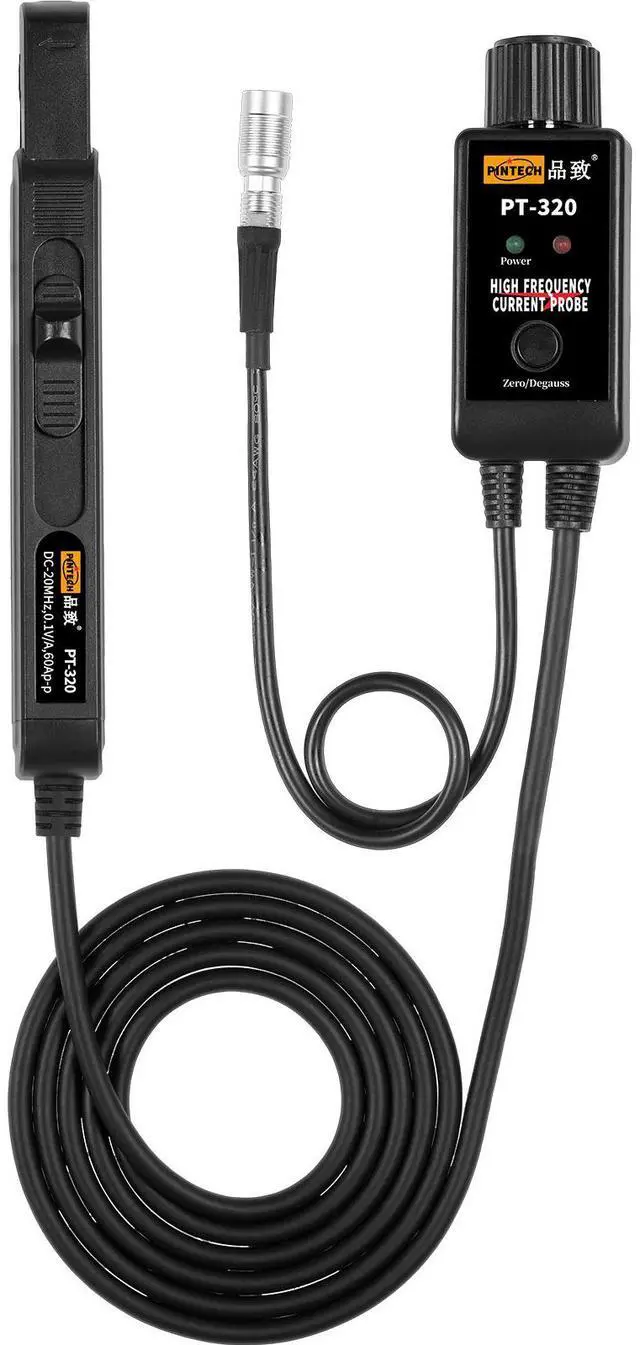
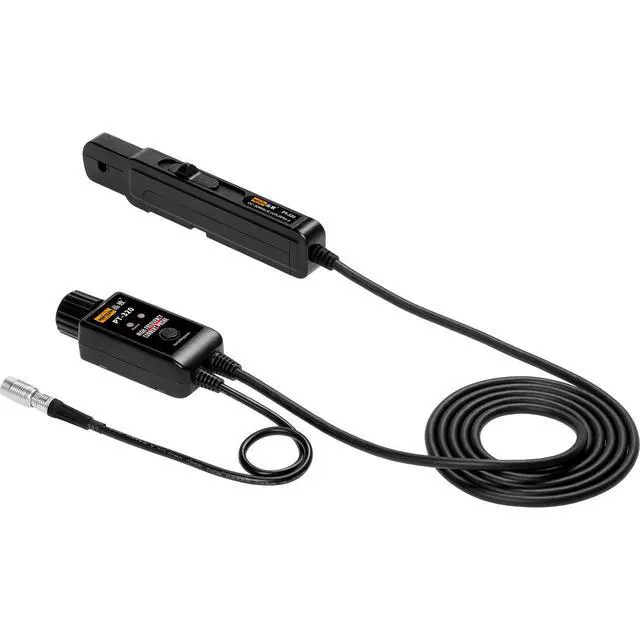
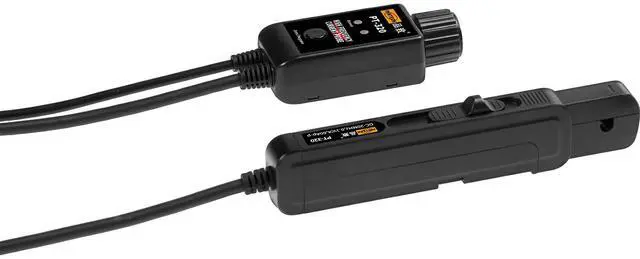



Any questions? Ask CelesteSM will help you find out quickly.
MODEL: PT-320
Bandwidth (-3dB): DC-20MHz
AC Current:60Ap-p
DC Current:30A
Maximum Current: 20A rms
Minimum Test Current: 20mA
Accuracy(Guarantee): 3%
Accuracy(Typical): 1%±5mV
Noise:6mA RMS
Rise Time:17.5 ns
Coupling Method:AC/DC
Conversion Ratio: 0.1V/A
Clamp Dia: 5mm
Length: 1.48M/58.27in
Weight: 450g/0.99lb(Adapter is included)
Size: 144 x 17 x 29 mm
The PINTECH PT-320 is a compact AC/DC oscilloscope current probe with up to 60A range and 20MHz bandwidth, suited for engineers, technicians, and lab users who need accurate current waveform capture on compatible BNC oscilloscopes.
| Attribute | Value |
|---|---|
| Best For | Measuring AC and DC currents during electrical testing and debugging with oscilloscopes and bench instruments |
| Model Identifiers | PINTECH PT-320 |
| Product Type | Electrical Testing & Measuring |
| Accuracy & Measurement | ±1%+5mV measurement accuracy |
| Physical Dimensions | 144 × 17 × 29 mm probe housing |
| Certifications | CE certified |
| Packaging And Unit | Sold individually (each) |
Q: Should I choose the PINTECH PT-320 or a lower-bandwidth 2.5 MHz current probe like the Micsig CP2100B?
A: Choose the PINTECH PT-320 when you need to see faster current edges and higher-frequency switching behavior on an oscilloscope. Its published bandwidth is DC to 20 MHz, while the Micsig CP2100B is positioned as a DC to 2.5 MHz probe. A 2.5 MHz model is usually enough for general power, inrush, and lower-frequency waveform work, but the PT-320 is the better fit when measurement priority is waveform detail in faster switching circuits.
Q: Is the PINTECH PT-320 a better choice than a Rogowski probe for AC-only switching measurements?
A: Choose the PT-320 when you need one probe for both DC and AC current measurements. A Rogowski probe is often preferred for wider-band AC-only work and flexible placement, but it does not directly measure DC. The PT-320 is more practical for mixed measurements such as startup current, DC bias with ripple, and general bench troubleshooting where both steady-state and transient current matter.
Q: Should I buy the PINTECH PT-320 or step up to a higher-end current probe from Keysight or Tektronix?
A: Choose the PT-320 when you want a general-purpose AC/DC current probe with BNC oscilloscope compatibility and midrange bandwidth for lab or service work. Step up to a premium Keysight or Tektronix model when your work needs higher bandwidth, tighter documentation, or stronger fit with advanced power electronics validation. For example, Keysight positions the N2783B at 100 MHz with 30 Arms capability, which aligns more with higher-end characterization than everyday bench use.
Q: Is the PINTECH PT-320 better for portability, or should I use a larger bench-focused current probe?
A: Choose the PT-320 when bench space, portability, and easy setup matter. Its listed body size is 144 × 17 × 29 mm, and it uses a standard BNC interface that works with common oscilloscopes. A larger bench-focused probe can make more sense when maximum current range, jaw size, or higher-end measurement capability matters more than compact handling.
Q: Will this work with my oscilloscope if it has a standard BNC input?
A: Usually yes for basic manual use. The PT-320 uses a BNC interface and is positioned as compatible with standard oscilloscopes, so it fits scopes that accept a BNC signal input. The trade-off is that this is a manual-accessory style probe, not an auto-recognized probe system, so users should expect to set scaling and verify scope input requirements themselves.
Q: Is the PT-320 suitable for both AC and DC current measurements?
A: Yes. The PT-320 is specified for AC/DC current measurement, which makes it more versatile than AC-only current probes for users who need to view steady current plus waveform behavior on the same tool. It is a better fit for troubleshooting power electronics, motors, and mixed DC-plus-ripple signals than a probe limited to AC current only.
Q: Who is this probe best suited for?
A: The PT-320 is best suited for bench troubleshooting and electronics measurement where you need non-intrusive current waveforms, moderate current range, and up to 20 MHz bandwidth. It is more appropriate for engineers, technicians, and advanced lab users than for casual household electrical checks, because it is an oscilloscope accessory rather than a standalone clamp meter.
Q: What are the main trade-offs versus a higher-end current probe?
A: The main trade-off is value versus convenience and performance ceiling. The PT-320 offers AC/DC measurement, 60 A class coverage, and 20 MHz bandwidth in a simpler BNC-based format. Higher-end probes from major oscilloscope brands often add broader compatibility guidance, dedicated probe interfaces, amplifier ecosystems, and in some cases much higher bandwidth or current capability, but they are typically more complex and much more expensive.
Q: Is 20 MHz bandwidth enough for most buyers considering this type of probe?
A: It is enough for many general power, motor, automotive, and low-to-mid-frequency switching measurements, but not for every high-speed design task. Buyers should choose it when their goal is current waveform visibility in typical lab and service work, and choose a higher-bandwidth probe only if they specifically need faster edge detail or higher-frequency switching analysis.
Q: Who is the PT-320 best suited for?
A: The PT-320 is best suited for oscilloscope users who specifically need to view current waveforms, not just voltage, and who need both DC and AC measurement. Its stated 20 MHz bandwidth and 60 A maximum make it more relevant for bench diagnostics, power electronics, motor drives, switching supplies, and similar troubleshooting where waveform shape matters. It is less suitable for beginners who only need basic voltage probing or simple go/no-go current checks.
Q: Is the PT-320 a good choice if I need to measure switching current waveforms?
A: Yes, if your work requires capturing current waveforms with meaningful high-frequency content. A key buying reason for this model is that it is an AC/DC current probe with a stated 20 MHz bandwidth, which is far beyond low-bandwidth clamp-style accessories often discussed for basic current viewing. The trade-off is that this is a more specialized tool than a general multimeter clamp, so it only makes sense if waveform fidelity on an oscilloscope is important to your work.
Q: What are the main trade-offs of the PT-320 compared with cheaper current clamps or basic probes?
A: The main trade-off is specialization. The PT-320 is designed for current waveform measurement on an oscilloscope, so it offers capabilities that cheaper current clamps or standard voltage probes do not, including DC plus higher-frequency AC current viewing. In return, it is a narrower-purpose accessory: it does not replace standard voltage probes, and it may be unnecessary if your work only needs low-frequency current indication or simple logic-level troubleshooting.
Q: Is the PT-320 overkill for basic hobby troubleshooting?
A: Often yes. For basic hobby use, many users only need standard oscilloscope voltage probes, a multimeter, or a logic analyzer, especially when checking low-frequency signals or digital state changes. The PT-320 becomes more justifiable when you need to inspect current behavior directly, especially DC plus fast-changing AC current, rather than infer it indirectly.
Q: Will the PT-320 work with most oscilloscopes?
A: It should work with most oscilloscopes that accept a BNC-connected probe input, because the PT-320 is described as using a BNC interface. That said, buyers should still confirm practical fit for their setup, including probe power requirements, scope input expectations, and whether the probe's bandwidth and scaling match the measurements they plan to make.



