




 here!
I’m your shopping assistant for PC builds, upgrades, and everything tech.
Got questions? Ask away!
Start a conversation
here!
I’m your shopping assistant for PC builds, upgrades, and everything tech.
Got questions? Ask away!
Start a conversationShipped by GUANGZHOU PINTECH CO LTD

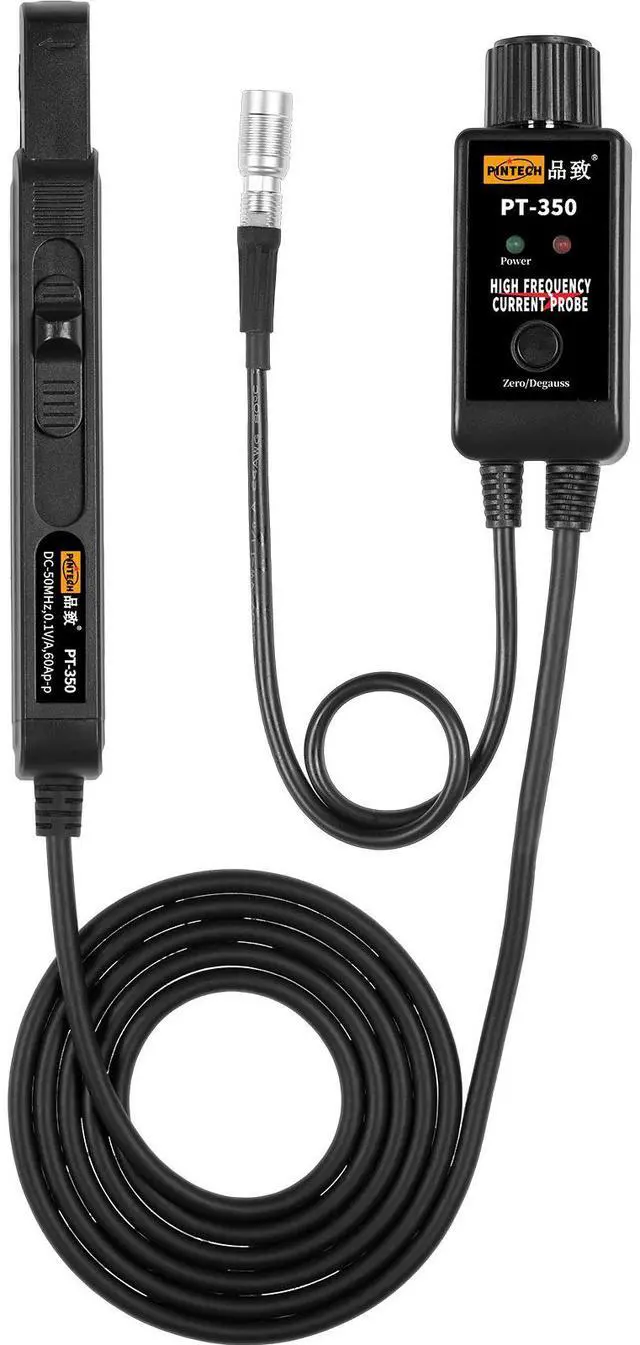
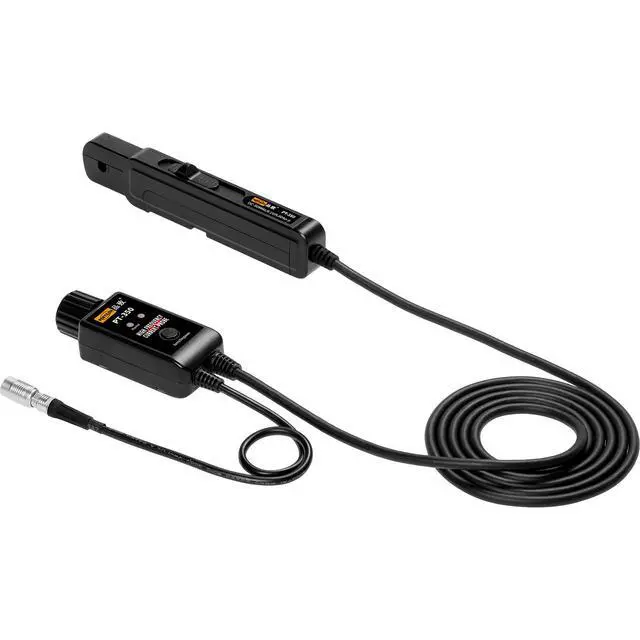
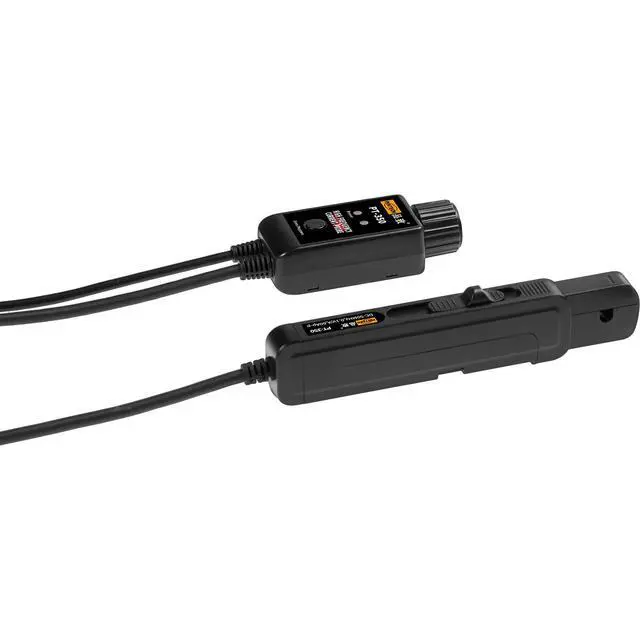
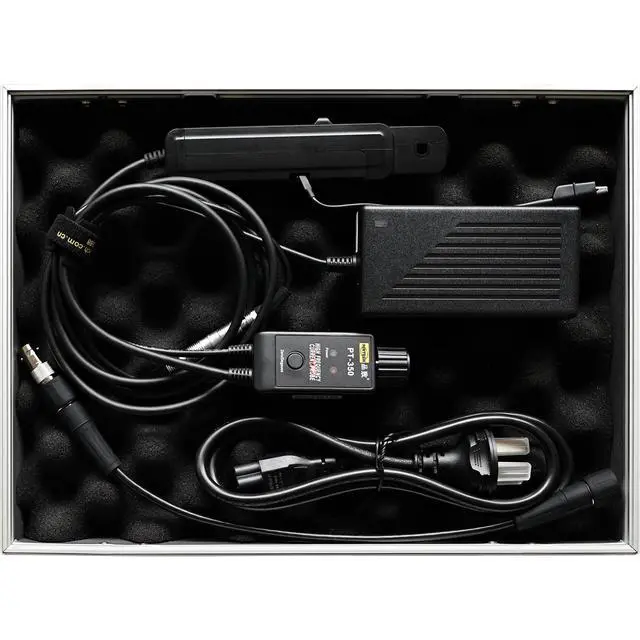



Any questions? Ask CelesteSM will help you find out quickly.
MODEL: PT-350>
Bandwidth (-3dB): DC-50MHz
AC Current:60Ap-p
DC Current:30A
Maximum Current: 20A rms
Minimum Test Current: 20mA
Accuracy(Guarantee): 3%
Accuracy(Typical): 1%±5mV
Noise:6mA RMS
Rise Time:7 ns
Coupling Method:AC/DC
Conversion Ratio: 0.1V/A
Clamp Dia: 5mm
Length: 1.48M/58.27in
Weight: 450g/0.99lb(Adapter is included)
Size: 144 x 17 x 29 mm
The PINTECH PT-350 is a high-precision AC/DC current probe for oscilloscopes, built for engineers, technicians, and electronics labs that need to capture current waveforms up to 60A with DC-50MHz bandwidth through a standard BNC connection.
| Attribute | Value |
|---|---|
| Best For | AC and DC current measurement with oscilloscopes and electrical test equipment |
| Model Identifiers | PINTECH PT-350 |
| Electrical Accuracy | ±1% + 5 mV accuracy |
| Physical Dimensions | 144 × 17 × 29 mm |
| Certifications | CE |
| Selling Unit | Each (sold individually) |
Q: Should I buy the PINTECH PT-350 or a lower-bandwidth AC/DC current probe for oscilloscope work?
A: Choose the PINTECH PT-350 when you need to view fast switching current waveforms, not just average or low-frequency current behavior. Official specs place the PT-350 at DC to 50 MHz with a 7 ns rise time, which is meaningfully different from the sub-1 MHz to low-MHz probes commonly discussed for general electronics and entry-level SMPS work. A lower-bandwidth probe is the better fit for slower power troubleshooting and lower cost. The PT-350 is the better fit when waveform shape, edge detail, and switching artifacts matter.
Q: Is the PINTECH PT-350 a better choice than a clamp meter for current measurement?
A: Buy the PT-350 if your goal is to see current as a waveform on an oscilloscope. It is an AC/DC current probe with a BNC output and 0.1 V/A conversion ratio, so it is built for time-domain waveform analysis. A clamp meter is the better choice for quick field readings and simpler electrical checks, but it does not replace a scope current probe for observing ripple, inrush shape, switching behavior, or transient current events.
Q: Should I choose the PINTECH PT-350 or a higher-end Tektronix current probe?
A: Choose the PT-350 when you want a conventional BNC-connected AC/DC current probe for bench use and its 60 A peak, 20 A RMS, 50 MHz class matches your measurement range. Choose a higher-end Tektronix probe when you need stronger ecosystem integration, broader model selection, higher certified safety claims, or direct auto-scaling/readout support on compatible Tektronix oscilloscopes. The PT-350 is the more straightforward choice for cross-brand oscilloscope compatibility; the Tektronix option is the stronger fit for users already invested in Tektronix probe interfaces and workflow features.
Q: Is the PINTECH PT-350 better for portable bench work or for higher-current testing?
A: Choose the PT-350 for portable bench measurements on smaller conductors, especially when compact jaw size helps. Its 5 mm clamp opening and small probe body suit electronics, power supply, converter, and lab troubleshooting work. For thicker conductors or higher sustained current measurement, a larger current probe is the better choice because the PT-350 prioritizes compact access and high-frequency response over large jaw capacity.
Q: Is the PINTECH PT-350 a good fit for general oscilloscope current measurements, or is it too specialized?
A: It is best suited for engineers and technicians who need to view both DC and AC current waveforms directly on an oscilloscope. Its stated DC-50 MHz bandwidth, 60 A maximum current, BNC output, and clamp-style form factor make it more appropriate for power electronics, switching circuits, inverter, motor-drive, and transient current analysis than for basic electrician-style current checks. For simple RMS current spot-checks, a clamp meter is usually simpler and cheaper. For waveform capture and current-vs-time analysis, a scope current probe is the better tool.
Q: Will this work with my oscilloscope?
A: Usually yes, if your oscilloscope accepts a standard BNC input and can be set up correctly for the probe's output scaling. The product description says the PT-350 uses a BNC interface and is compatible with oscilloscopes. In practice, buyers should still confirm input impedance and scaling requirements, because some current probes are specified for 1 MΩ oscilloscope inputs and can show reduced amplitude into 50 Ω loads.
Q: Is the 60 A rating enough, or should I buy a higher-current probe instead?
A: The PT-350 is a better choice for moderate-current work where waveform detail matters more than very high current capacity. A 60 A maximum is enough for many bench, lab, embedded power, and lower-power inverter tasks, but it may be limiting for automotive starter circuits, large motor drives, industrial power stages, or high-current battery systems. If your normal measurements approach the probe limit, a higher-current probe will usually give more headroom and be the safer choice.
Q: Is this a good option for measuring fast switching currents?
A: Yes, it appears suitable for relatively fast switching and transient work compared with low-bandwidth current clamps. The stated DC-50 MHz bandwidth is the key reason to buy this kind of probe: it is designed to capture current waveforms and edges that a basic clamp meter cannot show. The trade-off is that high-bandwidth current probes are more specialized, more setup-sensitive, and usually less practical for routine field checks than a standard clamp meter.
Q: What are the main trade-offs versus a cheaper low-bandwidth current clamp or clamp meter?
A: The PT-350's advantage is that it measures both DC and AC and is intended for oscilloscope waveform viewing, not just current magnitude. Compared with cheaper low-bandwidth probes or clamp meters, it should be better for seeing switching behavior, startup spikes, ripple, and timing. The trade-offs are lower convenience, the need for an oscilloscope, a smaller jaw opening than many electrician clamps, and less value if you only need quick current readings instead of waveform analysis.
Q: Is the PT-350 suitable for switching power supply and fast current waveform work?
A: Yes, if you need to view fast current waveforms rather than only low-frequency current trends. Community discussions around oscilloscope current probes repeatedly treat bandwidth as a key buying factor for SMPS work, and the PT-350’s stated 50 MHz bandwidth is materially higher than entry-level probes discussed in those threads. The trade-off is that it is a specialized probe for waveform analysis, not a general clamp meter.
Q: Who is the PT-350 best suited for?
A: The PT-350 is best suited for bench users who already have an oscilloscope and need non-contact current waveform measurement on individual conductors. Based on repeated Reddit discussion, that usually means electronics repair, power electronics, SMPS debugging, and lab troubleshooting. It is less suitable for casual users who only need RMS current readings or a general-purpose clamp meter.
Q: What are the main trade-offs of the PT-350 before buying?
A: The main trade-offs are capacity, opening size, and use case. The PT-350 is designed for waveform fidelity up to its stated bandwidth, but its 0.2 inch jaw diameter is small, so it is better for single wires and tight bench work than for large conductors. Its stated maximum current is 60 A, which is enough for many electronics tasks but not for every power application.
Q: Is the PT-350 a good choice if my oscilloscope only has standard BNC inputs?
A: Usually yes, because the PT-350 is specified with a BNC interface and is intended for oscilloscope use. However, Reddit discussions about current probes show that input termination can matter with some probe systems, so buyers should still confirm whether their scope setup matches the probe’s operating requirements and whether any termination or accessory setup is needed.



