



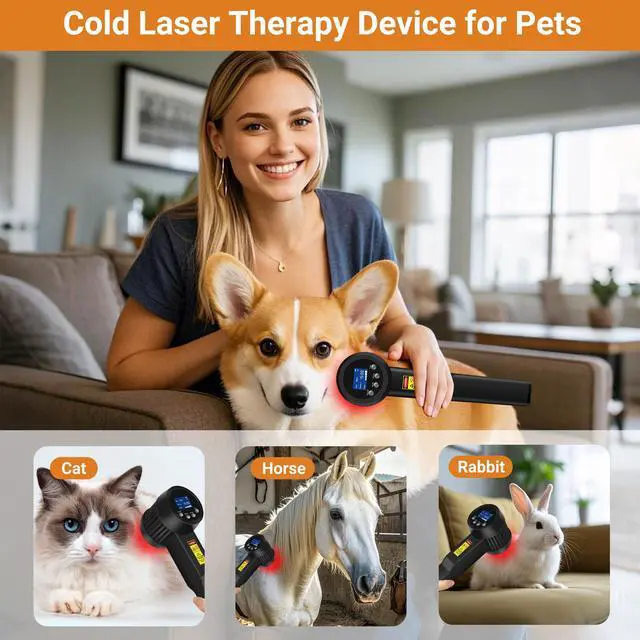
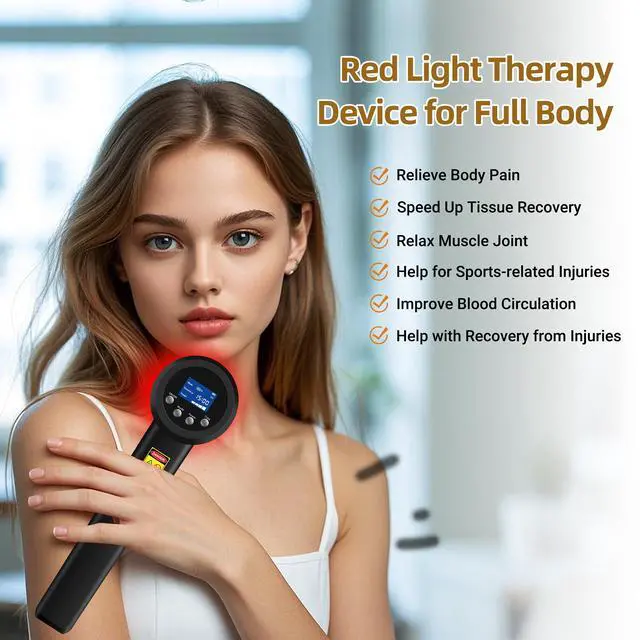

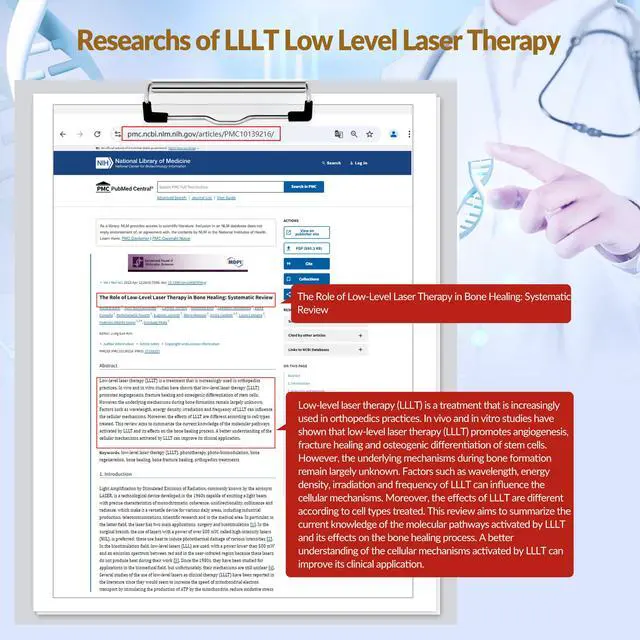


Laser phototherapy, also known as Low-Level Laser Therapy (LLLT) or Photobiomodulation Therapy (PBMT),is a non-invasive, painless treatment that uses low-power lasers or light-emitting diodes to stimulate cellular processes for healing and pain relief. It utilizes light of specific wavelengthsto interact with human/pet tissues, generating a photobiomodulatory effect. The light can penetrate deep into the body, stimulate cell activity, promote metabolism and tissue repair, and provide a scientific and safe solution for pain relief, inflammation reduction, wound healing, peripheral neuropathy treatment,and pain relief for dogs and pain treatment for dogs in pets.

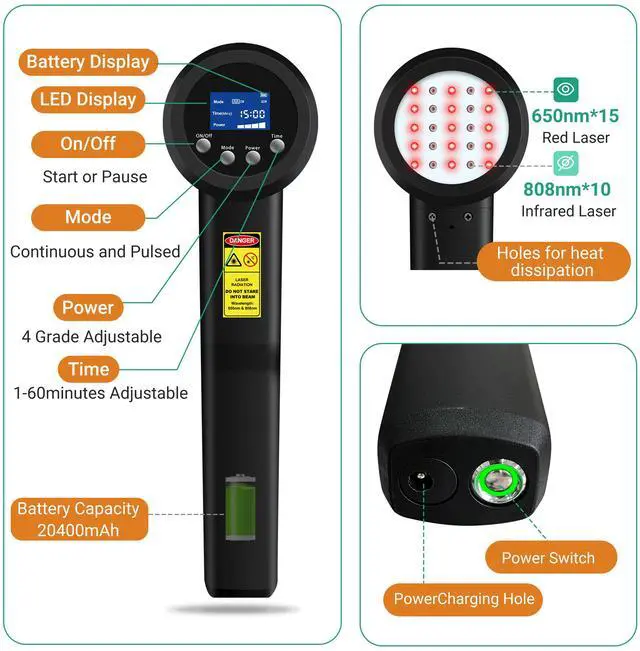
650nm
The 650nm wavelength laser falls within the visible red light spectrum, boasting strong penetrability that enables precise targeting of the skin surface. When its energy is absorbed by cellular mitochondria, it can promote the synthesis of ATP (adenosine triphosphate), enhance cellular activity, and accelerate the repair of damaged tissues. Meanwhile, the red light inhibits the release of inflammatory factors, reduces local swelling and pain, improves microcirculation, and aids in the elimination of metabolic waste.
808nm
With a longer wavelength and stronger penetrability, the 808nm laser belongs to the invisible light spectrum, acting on deep tissues such as muscles and joints. When its energy is absorbed by cellular mitochondria, it can promote ATP (adenosine triphosphate) synthesis, enhance cellular activity, and accelerate the repair of deep damaged tissues. Simultaneously, by improving local blood circulation, resolving deep inflammation, relieving muscle spasms, and inhibiting pain signal transmission, it achieves precise relief from deep-seated pains such as joint pain, muscle strain pain, and deep inflammatory pain.
Introduction to Application Scope
Suitable for people of all ages suffering from acute and chronic pain, inflammation, nerve damage, slow wound healing, and various musculoskeletal problems . This device is not only widely used in clinical treatment by doctors, orthopedists, sports therapists, chiropractors , and physical therapists but also serves for daily care, and providing safe and adaptive care for pets of different sizes.

Lasers act on nerve endings near the skin surface, mucous membranes, and nerve plexuses in deep tissues such as muscles and joints. When their energy is absorbed by cellular mitochondria, they can promote ATP synthesis and repair damaged nerve fibers. Meanwhile, by inhibiting the release of inflammatory mediators, improving local microcirculation, reducing nerve excitability, or regulating nerve conduction pathways, they alleviate superficial pains such as mucosal pain and superficial inflammatory pain, as well as deep pains such as joint pain and muscle strain pain, respectively.

When acting on swollen and bruised areas, laser energy is absorbed by cellular mitochondria to promote ATP synthesis and enhance cellular activity. It also improves local microcirculation (covering both superficial and deep tissues) to accelerate blood and lymphatic circulation, helping eliminate interstitial fluid and metabolic waste from bruising. Additionally, it inhibits the release of inflammatory mediators and reduces vascular permeability to decrease tissue fluid exudation, thereby alleviating swelling. It also promotes the repair of damaged blood vessels and the absorption of blood stasis, gradually relieving the deepening of bruise color and swelling discomfort.

Acting on damaged muscles and tendons, laser energy is absorbed by cellular mitochondria to promote ATP synthesis and significantly enhance the activity of myocytes and tendon fibroblasts. This accelerates the repair of damaged muscle fibers and the regeneration of tendon collagen fibers. Simultaneously, it improves local microcirculation to provide sufficient oxygen and nutrients to the repairing muscles and tendons, while removing metabolic waste.

When acting on joint areas, laser energy is absorbed by articular chondrocytes, synoviocytes, and mitochondria in surrounding tissues to promote ATP synthesis and enhance cellular activity. This accelerates the repair of damaged cartilage tissue and the resolution of synovial inflammation. It also improves local joint microcirculation to supply adequate oxygen and nutrients to cartilage and synovium, reducing the accumulation of joint effusion. Furthermore, it inhibits the release of inflammatory factors to relieve joint swelling and pain, while relaxing tense muscles and tendons around the joints.

Acting on wounds and damaged tissues, laser energy is absorbed by mitochondria in repair-related cells such as fibroblasts and epithelial cells to promote ATP synthesis and significantly enhance cell proliferation and activity. This accelerates the growth of granulation tissue and the migration of epithelial cells, facilitating rapid wound closure. Simultaneously, it improves local microcirculation to provide sufficient oxygen and nutrients to the healing tissue, efficiently removing metabolic waste and necrotic tissue from the wound. It also reduces excessive scar tissue hyperplasia and promotes tissue regeneration and repair.

- Moderate-to-severe cervical spondylosis
- Neck spasms
- Cluster headaches
- Occipital headaches
- Neck bruises
- Whiplash injuries
- Tmj pain

- Herniated lumbar disc
- Lumbar spondylolisthesis
- Disc bulges
- Chronic low back pain
- Back spasms
- Lumbar strains
- Sacroiliac joint pain
- Coccydynia
- Spinal stenosis

- Moderate-to-severe plantar fasciitis
- Golfer's elbow
- Tennis elbow
- Carpal tunnel syndrome
- Ankle sprains
- Synovitis
- Bursitis
- Finger joint pain
- Heel spurs
- Foot pain
- Achilles tendinitis
- Muscle tears
- Muscle contusions
- Intercostal muscle strains
- Trapezius pain
- Calf muscle pain
- Quadriceps strains
- Hamstring pain
- Groin injuries
- Muscle stiffness

- Canine disc disease
- Equine osteoarthritis
- Arthritis in large dogs
- Post-surgery recovery in pets
- Canine disc pain
- Soft tissue injuries in horses
- Dog acl tear
- Canine ccl tear
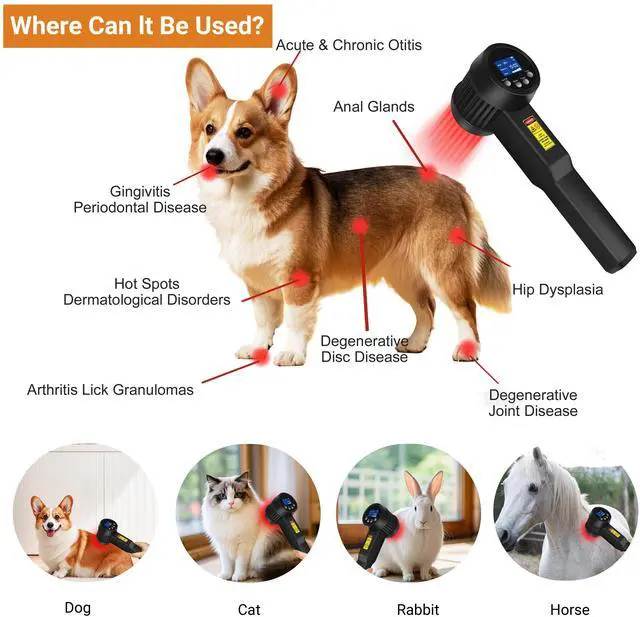
- Dog hip dysplasia

- Gout in the feet/ankles/knees
- Shingles pain
- Post-herpetic neuralgia
- Osteomyelitis
- Cellulitis
- Lymphadenitis
- Plantar warts
- Lymphedema
- Inflammation

- Pain Relief
- Open Wounds
- Injuries
- Acute & Chronic Otitis
- Degenerative Disc Disease
- Hip Dysplasia
- Degenerative Joint Disease
- Hot Spots
- Arthritis Lick Granulomas
- Anal Glands
- Musculoskeletal Abnormalities

- Moderate-to-severe dysmenorrhea
- Menstrual pain
- Ovulation pain
- Round ligament pain
- Inflammation
- Ear Infections
- Soft Tissue Injuries
- Trauma
- Nerve Regeneration
- Paw Pads Swelling Up
- Gingivitis Periodontal Disease


| Produce Name | 3-10W High Power Laser Therapy |
|---|---|
| Wavelength | 650nm+808nm |
| Power | 3-10W Available |
| Working Mode | Continuous Wave & Pulsed Wave, Adjustable |
| Spot Size | 55mm |
| Power Adjustment | 25% / 50% / 75% / 100%, 4 Grade Adjustable |
| Size | 29*9.5*7.5cm / 11.42*3.74*2.95in |
| Input Voltage | AC 100V-240V, 50Hz/60Hz or DC 12V |
| Mode Number | LRP Models |
|---|---|
| Number of Diodes | 25pcs Diodes |
| Light Type | GaAIAs Diode Laser |
| Frequency | 10Hz (1-10000Hz Customized) |
| Time | 1-60 Minutes Adjustable |
| Cooling System | Air Cooling |
| Net Weight | 0.98kg / 2.16lb |
| Power Supply | DC Charging & Rechargeable Lithium Battery (20400mAh) |

- Treat every other day for 4-6 weeks, 15-20 minutes each time (adjust treatment frequency and time according to the treatment area and your physical condition).
- Except for nerve treatment, pulsed wave (PW) is superior to cold wave (CW) in most cases. You can adjust the power according to the treatment effect.
- During cold laser treatment, keep the laser close to the skin, do not remove clothing, and move the laser back and forth in the treatment area, repeating this process until the desired treatment time is achieved.

- 1* Cold laser therapy device main unit with corresponding power
- 1* AC power adapter
- 1*Protective goggles
- 1*Detailed user manual
- 1*Storage box


