


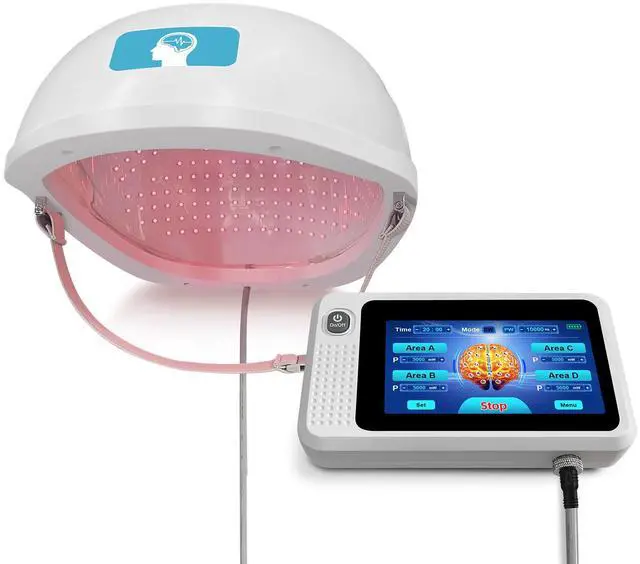
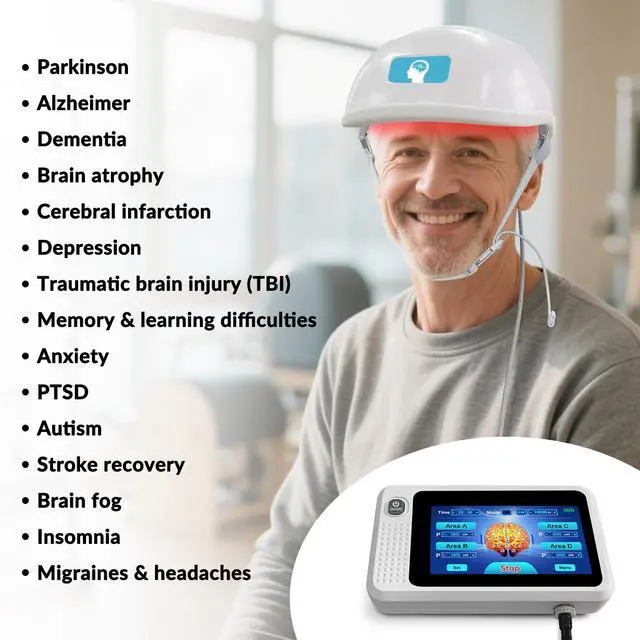
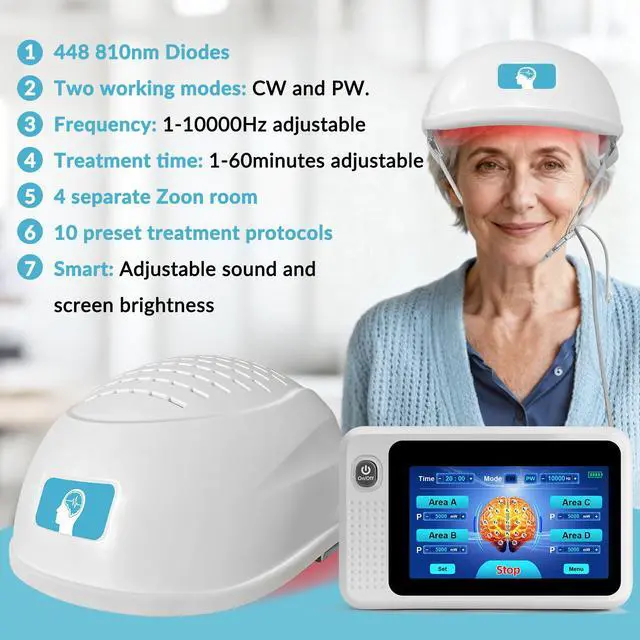
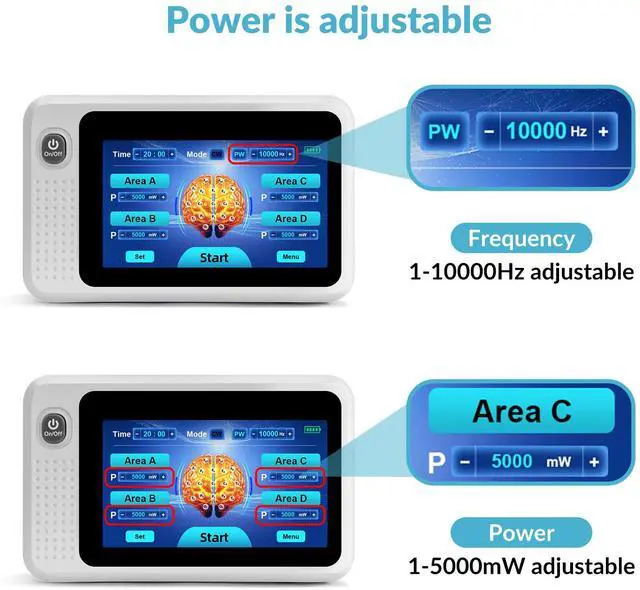
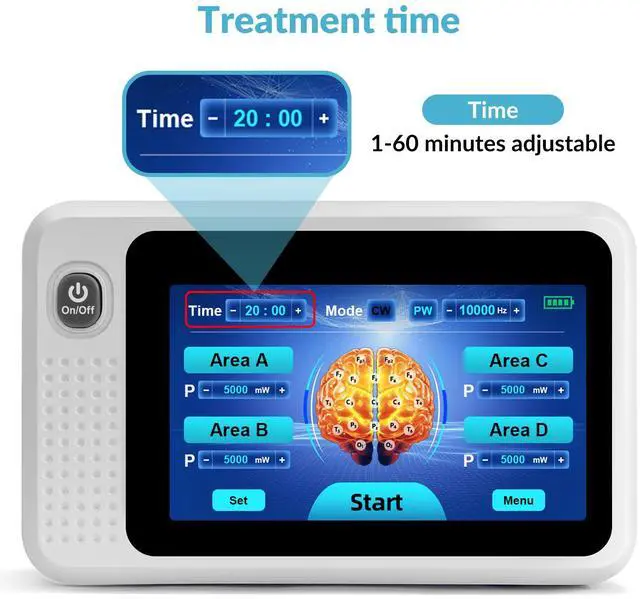


Cold laser (Low-Level Laser Therapy, LLLT/Photobiomodulation Therapy, PBMT) is a non-invasive, low-energy phototherapy that promotes tissue repair without thermal damage. This professional helmet features 448 810nm diodes (near-infrared light with optimal tissue penetration for brain/shallow tissues) - plus 4 separate treatment zones that act independently, each with adjustable power, ensuring targeted, safe light delivery.

810nm has become one of the core technical wavelengths in near-infrared light therapy brain therapy helmets due to its combination of excellent tissue penetration and biological safety.
The key advantage of 810nm lies in its deep tissue penetration capability: it can effectively penetrate tissue barriers such as the human scalp and skull, reaching deep into intracerebral cells - this is the core prerequisite for its application in brain therapy, ensuring that photons act precisely on intracerebral mitochondria rather than remaining only in superficial tissues. At the same time, this wavelength has mild energy; unlike short-wavelength light (such as visible light and ultraviolet light), it is not easily absorbed by the skin or subcutaneous tissues to generate excessive heat, and it also avoids the issue of long-wavelength near-infrared light having sufficient penetration depth but lower biological activity, thus striking a balance between "penetration depth" and "biological efficacy".
Principle
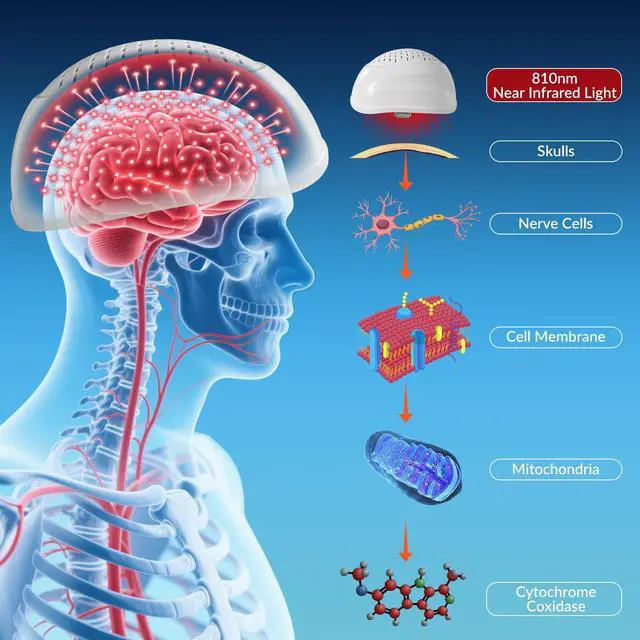
810nm near-infrared light (NIR) lies at the core of the 650-1100nm "optical therapeutic window," featuring low scattering and low absorption. It bypasses barriers from superficial tissues like the scalp, and penetrates the skull via two mechanisms: its photon energy matches the skull's hydroxyapatite-dominant) optical properties (only 15%-20% energy reflected/absorbed, reaching brain tissue through the diploe and dura mater), and scattered light forms a uniform field via "diffuse reflection superposition." On nerve cells, it acts on cell membranes- absorbed by photoreceptors to regulate channels (enhancing neurotransmitter release) and activate repair enzymes (restoring membrane integrity for injured cells).
Targeting mitochondria (nerve cells "energy factories"), 810nm NIR specifically activates Cytochrome C Oxidase (CCO), a key rate-limiting enzyme in the respiratory chain. Light energy relieves CCO inhibition by ROS/NO, boosting ATP production by 20%-30% and reducing ROS via optimized electron transport (while promoting antioxidants like glutathione). In summary, 810nm NIR penetrates the skull - acts on nerve cell membranes - targets mitochondrial CCO - enhances nerve cell activity - supports brain function improvement, forming a complete "phototherapy - cell repair - function optimization" loop.


The core pathology of such conditions involves neuronal degeneration and necrosis, or ischaemia and hypoxia resulting from impaired cerebral blood circulation. 810nm near-infrared light can penetrate the skull to reach intracranial lesions, exerting its effects through the following mechanisms: improving cerebral microcirculation by dilating vessels in ischaemic zones, increasing oxygen and nutrient supply, reducing ischaemic areas, and accelerating clearance of necrotic tissue; inhibiting oxidative stress to reduce ROS damage to neurons, delaying brain atrophy and lowering the risk of secondary injury following traumatic brain injury.

Such conditions are closely associated with neurotransmitter imbalances (abnormal secretion of serotonin, dopamine, etc.) and neural circuitry disruption. 810nm near-infrared light focuses on neural function regulation: modulating ion channel activity in neuronal cell membranes, promoting synthesis and release of 'pleasure neurotransmitters' while inhibiting excessive secretion of stress neurotransmitters to alleviate depression and anxiety; Enhances neural activity in regions including the prefrontal cortex and amygdala, repairs emotional memory circuits in PTSD patients, and reduces hypervigilance; Strengthens signal transmission in brain regions of autistic individuals, improves social cognitive deficits, and regulates abnormal neural developmental circuits.

The core issue lies in diminished metabolic activity and impaired signal transmission within the brain's cognitive regions (such as the hippocampus and temporal lobes). 810nm near-infrared light enhances cognition through the following mechanisms: - Targeting the hippocampus to activate mitochondrial metabolism, thereby boosting neural stem cell proliferation and differentiation, improving memory capacity, and alleviating learning difficulties; it reduces inflammatory factors and metabolic waste within the brain, thereby alleviating symptoms of brain fog such as inattentiveness and sluggish thinking while accelerating neural information processing; it modulates the release of cognition-related neurotransmitters like acetylcholine, reinforcing neural pathways between the cerebral cortex and hippocampus to enhance overall cognitive efficiency.

The core issue lies in neurotransmitter imbalance (e.g., abnormal serotonin, dopamine secretion) and disrupted neural circuit activity in the brain's emotional regulation regions (prefrontal cortex, amygdala). 810nm near-infrared light alleviates emotional disturbances via these mechanisms: - Targeting these regions to modulate membrane ion channel activity, promoting "pleasure neurotransmitter" (e.g., serotonin) synthesis/release and inhibiting excessive stress neurotransmitter (e.g., norepinephrine) secretion to relieve depression and anxiety; it improves abnormal emotional neural circuit activity, repairing PTSD patients' damaged emotional memory loops and reducing over-vigilance and fear; it regulates the hypothalamic-pituitary-adrenal (HPA) axis, cutting stress hormone (e.g., cortisol) release to stabilize mood and enhance the brain's stress-coping ability.
- Cerebral infarction
- Hemiplegia, aphasia
- Brain injury
- Neural repair
- Concussion
- Stroke sequelae
- Parkinson
- Alzheimer
- Dementia
- Brain atrophy
- Traumatic brain injury
- Stroke recovery

- Memory & learning difficulties
- Brain fog
- Insomnia
- Migraines & headaches
- Memory improvement
- Autism
- Attention deficit hyperactivity disorder (ADHD)
- Mild cognitive impairment (MCI)
- Language development delay (children)

- Chronic primary headaches
- Stable myocardial infarction
- Patients with stable coronary heart disease
- Hypertensive encephalopathy
- Post-herpetic neuralgia involving the head and face

- Depression
- Anxiety
- PTSD
- Autism
- Bipolar disorder
- Neurasthenia
- Insomnia


Area A (Frontal Lobe)
Corresponding to the frontal lobe region of the brain, phototherapy in this area of the helmet may assist in enhancing memory, attention, and cognitive decision-making abilities. It primarily targets conditions such as Alzheimer's disease and cognitive decline, aiding in the improvement of frontal lobe-related cognitive function deterioration.
Area B (Parietal Lobe)
Corresponding to the parietal lobe region of the brain, its function is to assist in enhancing spatial perception and bodily coordination. It is suitable for conditions such as traumatic brain injury and movement disorders, aiding in the improvement of parietal lobe-related bodily functions and spatial cognition.
Area C (Occipital Lobe)
Corresponding to the occipital lobe region of the brain, it can optimise visual information processing capabilities and improve sleep quality. It primarily alleviates issues such as insomnia and visual fatigue, assisting in the improvement of occipital lobe-dominant visual and sleep-related functions.
Area D (Temporal Lobe)
Corresponding to the temporal lobe region of the brain, it aids language function and protects emotional memory. Suitable for conditions such as autism and language disorders, it assists in improving temporal lobe-related language and emotional memory issues.

| Model Number | LH280-N810 |
|---|---|
| Number of Laser Diodes | 448pcs*55mW 448pcs*80mW |
| Power Adjustment | 0-24W Adjustable 0-36W Adjustable |
| Working Mode | Continuous Wave & Pulsed Wave, Adjustable |
| Functions | 4 Treatment Area, Independly Control |
| Screen | 5" True Color Touch Screen / 4.31*2.41in |
| Dimension | 28*13cm / 11.02*5.12in |
| Power Supply | AC85V-265V, 50/60Hz or DC 12V (10000mAh) |
| Wavelength | 810nm |
|---|---|
| Power | 24W |
| Laser Type | GaAlAs Diode Laser |
| Frequency | 1-20000Hz Adjusatable |
| Time Setting | 1-60 Minutes, Adjustable |
| Treatment Protocols | 10 Saving Treatment Protocols |
| Net Weight | 0.67kg / 1.48lb |


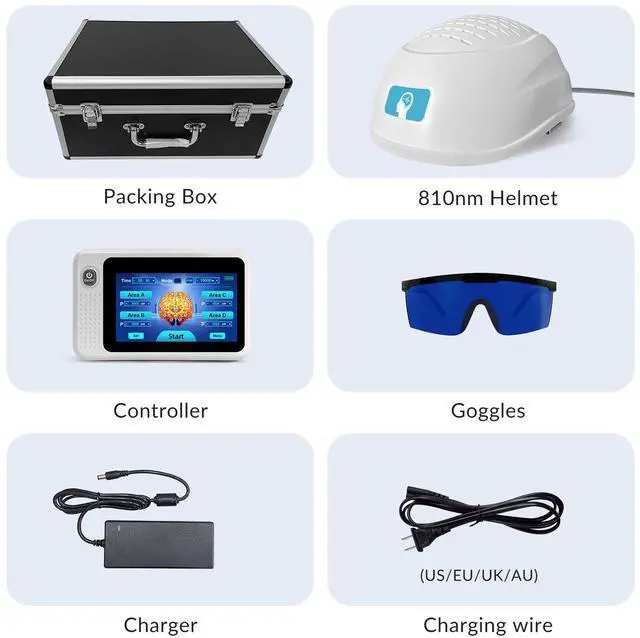
1*Packing Box
1*810nm Helmet
1*Controller
1*Goggles
1*Charger
1*Charging wire(US/EU/UK/AU)


