




 here!
I’m your shopping assistant for PC builds, upgrades, and everything tech.
Got questions? Ask away!
Start a conversation
here!
I’m your shopping assistant for PC builds, upgrades, and everything tech.
Got questions? Ask away!
Start a conversation Top Rated Top Rated Top Rated







Any questions? Ask CelesteSM will help you find out quickly.
We want to ensure your holiday shopping this year is hassle-free. That’s why we’re automatically extending our return policies on almost every product! For purchases placed between November 1st, 2026 and December 31, 2026 you will have until January 31, 2027 to return your product.
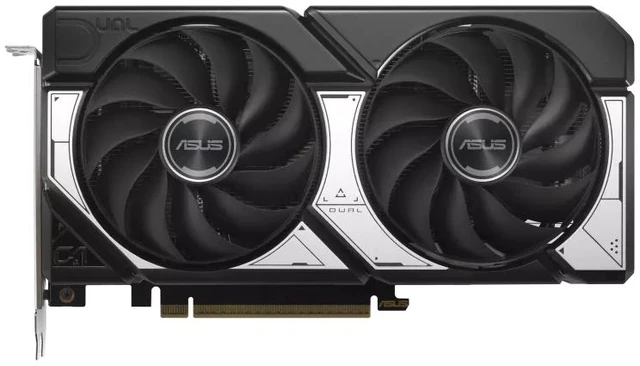
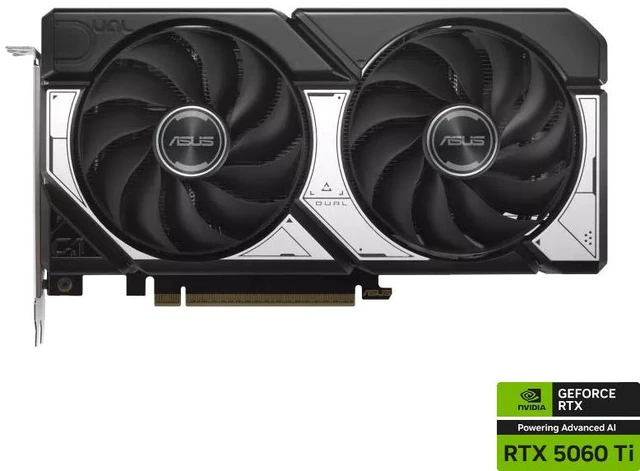
The ASUS Dual GeForce RTX 5060 Ti O8G is a compact dual-fan 8GB GDDR7 graphics card built for mainstream 1440p gaming, everyday creator workloads, and multi-monitor desktop setups that need current NVIDIA features in a shorter 229 mm, 2.5-slot design.
| Attribute | Value |
|---|---|
| Best For | Desktop systems that need an NVIDIA GeForce RTX 5060 Ti with 8GB GDDR7 memory and modern display outputs (DisplayPort 2.1b / HDMI 2.1b); fits ATX cases (229 mm card length, 2.5-slot) and is intended for PCIe-equipped desktops with a recommended ~550W PSU |
| Model Identifiers | ASUS Dual series — model DUAL-RTX5060TI-O8G (part number 90YV0MP2-MVAA00) |
| GPU And Architecture | NVIDIA GeForce RTX 5060 Ti (GeForce RTX 50 Series) using NVIDIA/Blackwell architecture |
| Clock Speeds And CUDA | Boost clocks — OC mode 2632 MHz, Default mode 2602 MHz; 4608 CUDA cores |
| Memory Configuration | 8GB GDDR7 on a 128-bit bus with an effective memory data rate of 28 Gbps |
| Display Outputs And Resolution | 1 × HDMI 2.1b and 3 × DisplayPort 2.1b, supports up to 7680 × 4320 resolution and up to 4 simultaneous displays |
| Interface And Compatibility | PCI Express 5.0 x8 interface for desktop PCIe slots (external sources also list PCIe x16 as hardware/interface variants); compatible with desktop systems |
| Cooling And Physical Fit | Dual-fan cooler (2 fans), occupies 2.5 expansion slots and is supplied in an ATX card form factor; color: black |
| Dimensions And Weight | Card dimensions 229 × 120 × 50 mm (max GPU length 229 mm); item weight ~0.656 kg, package weight ~1.1 kg; package size ~7.11 × 35.41 × 37.11 cm |
| Power And Connectors | Requires one 8‑pin power connector and ASUS recommends a 550W PSU |
| APIs, Features And Software | Supports DirectX 12 Ultimate, OpenGL 4.6, HDCP; virtual reality ready and includes NVIDIA features such as DLSS 4 (per external description) |
| Compatibility Notes | No CrossFireX or SLI support; designed for standard desktop PCIe slots—check case clearance for 2.5-slot, ~229 mm card |
| Package Contents | Includes the graphics card plus setup materials; software (ASUS GPU Tweak III, drivers) should be downloaded from the support site |
| Safety And Regulatory | Safety attestation present; California Proposition 65 warning noted |
Q: Should I buy the ASUS Dual RTX 5060 Ti 8GB or move up to an RTX 5070?
A: Choose the ASUS Dual RTX 5060 Ti 8GB if you want a smaller, lower-power card for 1080p gaming and mainstream 1440p settings. Move to an RTX 5070 if you want more headroom for higher refresh 1440p, heavier ray tracing, or longer-term margin from a higher tier GPU. The 5060 Ti 8GB fits compact builds well at 229 mm and uses a single 8-pin power connector, while the 5070 is the more performance-first choice.
Q: Is the ASUS Dual RTX 5060 Ti 8GB worth it over an RTX 4060 Ti?
A: Yes, it is the better buy if the price gap is reasonable. Reviews consistently place the RTX 5060 Ti ahead of the RTX 4060 Ti in modern games, and the Blackwell card also adds newer generation platform features. The main reason to keep a 4060 Ti is if you already own one and the upgrade cost is high. For a new purchase, the 5060 Ti is usually the more sensible choice.
Q: Should I get the RTX 5060 Ti 8GB or the RTX 5060?
A: Get the RTX 5060 if your goal is a lower-cost 1080p build. Get the ASUS Dual RTX 5060 Ti 8GB if you want a clearer step up in shader performance, memory bandwidth, and 1440p flexibility. The 5060 Ti is the better fit when you want stronger average FPS now, while the non-Ti makes more sense when budget matters more than extra performance.
Q: Should I choose this RTX 5060 Ti 8GB or an RTX 5060 Ti 16GB model?
A: Choose this 8GB ASUS Dual card when price, size, and efficient 1080p-first gaming matter most. Choose a 16GB RTX 5060 Ti if you expect to play newer games at 1440p with higher texture settings, keep the card for several years, or want fewer VRAM-related compromises. Community and review coverage repeatedly treats the 16GB version as the safer long-term option, while the 8GB version remains the value-focused entry into the same GPU tier.
Q: Is the 8GB ASUS Dual RTX 5060 Ti a good fit for 1080p gaming, or should I look for a 16GB model?
A: The 8GB ASUS Dual RTX 5060 Ti is a sensible fit for mainstream 1080p gaming and for buyers who want current RTX 50-series features in a shorter dual-fan card. The main trade-off is memory headroom: RTX 5060 Ti is sold in both 8GB and 16GB versions, so the 8GB model is the lower-VRAM option. If you mainly play at 1080p and value lower cost and a compact card, this model makes sense. If you keep GPUs for many years, use heavier texture packs, or want more margin for newer games and creator workloads, a 16GB RTX 5060 Ti is the safer choice.
Q: Will this card fit in a smaller mid-tower or compact ATX build?
A: Usually yes. This ASUS Dual model is relatively compact for a modern gaming GPU at 229 mm long and 2.5 slots thick, which makes it easier to fit than larger triple-fan cards. You still need to check case GPU clearance, nearby front radiators or drive cages, and whether your motherboard layout leaves enough room for a 2.5-slot card.
Q: Does this graphics card need a high-wattage power supply or special power cable?
A: No. This model is relatively straightforward to power: it uses a single 8-pin power connector and ASUS lists a 550W recommended PSU. That makes it easier to install than higher-end cards that may need larger power budgets or different cabling. It is a practical option for upgraders who want to avoid a PSU replacement, as long as their existing supply is a quality unit and has the required 8-pin connector.
Q: Who is this ASUS Dual RTX 5060 Ti 8GB best suited for?
A: It is best suited for buyers who want a current-generation NVIDIA card for 1080p gaming, general-purpose PC upgrading, and a build that benefits from a shorter dual-fan design. It is also a reasonable pick for users who want RTX features such as DLSS 4 support, ray tracing support, and modern display outputs without moving into a larger or much more expensive card. It is less ideal for shoppers specifically prioritizing maximum VRAM capacity in this tier.
Q: What are the main trade-offs versus a larger triple-fan RTX 5060 Ti?
A: The main advantage of this ASUS Dual card is practicality: a shorter 229 mm body, dual-fan cooling, one 8-pin connector, and easier fit in more cases. The trade-off versus many larger triple-fan alternatives is usually less cooling mass and less physical headroom for higher-end factory tuning. If your priority is broad case compatibility and a simpler upgrade, this Dual model is the better fit. If your priority is the biggest cooler or a more oversized design, a larger triple-fan card may be preferable.
Q: Is the ASUS Dual RTX 5060 Ti 8GB worth buying, or should I pay more for a 16GB card?
A: This 8GB ASUS Dual model makes the most sense if it is clearly cheaper than 16GB alternatives and you mainly play at 1080p with moderate texture settings. The main trade-off is memory headroom: 8GB is the limit users repeatedly question, so it is less suitable for buyers who want higher settings, longer-term use, or newer games that can exceed 8GB VRAM.
Q: Who is the ASUS Dual RTX 5060 Ti 8GB a good fit for?
A: It is a practical fit for buyers who want an NVIDIA midrange card in a relatively compact design, have a standard ATX case with room for a 229 mm, 2.5-slot GPU, and only need one 8-pin power connector with a 550W-class PSU. It is better suited to mainstream gaming builds than to buyers prioritizing maximum VRAM, heavy 1440p textures, or longer-term upgrade headroom.
Q: Is the ASUS Dual RTX 5060 Ti 8GB a good choice for older PCIe 3.0 systems?
A: It is compatible with older PCIe 3.0 motherboards, but it is not the safest choice for them. This card uses a PCIe 5.0 x8 interface, and repeated Reddit and YouTube discussion around RTX 5060 Ti 8GB focuses on bigger slowdowns on older PCIe 3.0 platforms, especially when VRAM is exceeded. It is a better fit in PCIe 4.0 or 5.0 systems.
Q: Should I choose the ASUS Dual version over another basic RTX 5060-class card if it costs more?
A: Only if the size, brand preference, or cooler design matters to you. Community discussion around ASUS Dual versus other basic models often treats performance differences as small, so a noticeable price premium is harder to justify unless you specifically want the ASUS card's compact dual-fan format and display output layout.


