





What are the different types of liquids used in liquid-in-glass thermometers?

There are many different liquids used in thermometers that range in environmental safety.
1. Enviro-Safe liquid - (exclusive to H-B Instrument) is a non-toxic mixture of biodegradable citrus liquid and a green, non-toxic dye. This liquid is used in Enviro-Safe, Easy-Read, Double-Safe and FRIO-Temp thermometers.
2. Mineral Spirits - Petroleum hydrocarbon, clear odorless liquid with a petroleum odor, usually mixed with blue, red or green colored dye.
3. Mercury - Metal, molecular formula: Hg, an odorless, silvery liquid with a metallic luster. Mercury based thermometers are banned from certain states because they are toxic.
4. Mercury/Gallium - Mercury and Gallium amalgam which increases the temperature range by increasing the mercury boiling point (used in thermometers up to 620 degree Celsius). Mercury based thermometers are banned from certain states because they are toxic.
5. Mercury/Thallium - Mercury and Thallium amalgam which lowers the temperature range of mercury to below -40 degree Celsius by lowering the solidification point of mercury. Mercury based thermometers are banned from certain states because they are toxic.
If the liquid in the column of a thermometer is separated, is the thermometer faulty?
Absolutely not! The liquid in any glass thermometer, regardless of type (e.g. mercury-filled, spirit-filled, etc.) can be separated within the in the liquid column. This may be a result of shipping and handling, or improper storage after the thermometer has left H-B Instrument’s possession.
Two simple methods have been developed to reunite separated fluid in a thermometer column. If employed correctly, the reunited liquid column will be as good as new.
Note: For each method we suggest you wear safety glasses and gloves when working with glass instruments.
Cooling Method:
Prepare a solution of shaved ice and salt or a solution of CO2 (Dry Ice) and alcohol. Place the thermometer bulb only in the solution. Keep the thermometer upright. Allow the liquid column to retreat into the bulb, swing the thermometer (bulb down) in an arc forcing the entrapped gas above the column. Allow the thermometer to return to room temperature slowly in an upright position.
Heating Method:
Heat the thermometer bulb in an upright position away from your face in warm liquid, air, or over a soft flame enough to allow the liquid column to rise slowly until the separated portion of the column enters the expansion chamber at the top of the thermometer. Note that applying heat for too long will over-fill the expansion chamber which will break the thermometer. Tap the thermometer bulb gently on the tabletop in an upright position allowing the gas separating the column to rise above the column. Allow the thermometer to cool slowly in an upright position.
Partial Immersion or Total Immersion Thermometers?

How do I know if thermometer is total or partial immersion?
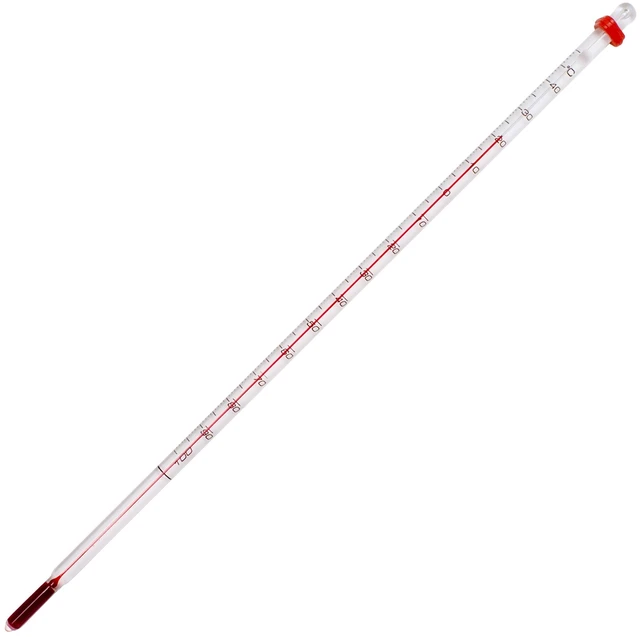
Whether a thermometer is total immersion or partial immersion is generally printed on the back side of the glass. Partial immersion thermometers will also have a line showing the depth to which the thermometer should be submerged.
How do partial and total immersion liquid-in-glass thermometers differ?
Liquid-in-glass thermometers can be used to measure atmospheric temperature, semi-solids, or liquids. The main difference between partial and total immersion thermometers is the application in which they should be used. If the depth of the test sample is shallow, a partial immersion thermometer is usually necessary.
Thermometers manufactured for total immersion indicate an accurate temperature reading when the thermometer is immersed to the level of the liquid in the capillary column. To begin, immerse the thermometer to the top of the liquid column as the temperature rises or falls adjust the thermometer until an accurate reading is achieved.
Thermometers manufactured for partial immersion indicate accurate temperatures when the thermometer is immersed to the specific depth indicated by the immersion line on the individual thermometer, and regardless of the of the liquid in the column. Partial immersion thermometers are appropriate for any application where total immersion is impractical or impossible, such as in a shallow water bath.
Can I use a total immersion thermometer in a partial immersion application or vice versa?
Yes, but it is not practical. If total immersion thermometers are used at partial immersion depths (or vice versa), inaccuracies will occur. These inaccuracies increase as the temperature increases above room temperature; temperature readings can vary 5 to 10 degrees. If, in a rare case, you must use a total immersion thermometer in a partial immersion application, corrections for emergent stem must be obtained to achieve an accurate reading. To reduce errors, use the correct thermometer to meet your application requirements.
More Frequently Asked Questions

What are the most common glass thermometer lengths?
- 203 mm = 8” in length
- 305 mm = 12” in length
- 405 mm = 16” in length
How do you convert °C to °F and vice versa?
Degree Fahrenheit = 9/5 degree Celsius + 32
Degree Celsius = 5/9 (degree Fahrenheit - 32)
Most liquid in glass thermometer are only in degree Celsius or degree Fahrenheit, so try to pick the unit that best matches your purposes.
What liquid-in-glass thermometers have high resolution and high accuracy?
H-B Instrument offers ‘ASTM Like’ liquid-in-glass thermometers with high resolution and accuracy. Each thermometer is also individually serialized and packaged. ASTM stands for the American Society for Testing and Materials which is an independent, private organization that establishes and publishes standards for use in industry. Although these thermometers can be used in any suitable application each model is designed and specified for specific applications and they generally feature a shorter scale than a regular thermometer. H-B Instrument refers to our thermometers as ASTM like because the ASTM guidelines call for mercury filled thermometers and as part of our environmental stewardship H-B Instrument has made a commitment to phasing mercury filled instruments from our product line.
What is the best way to store a liquid thermometer?
It is best to store thermometers vertically (in an upright position) or at an angle of at least 15 degree or more. Use a special tray or rack to store thermometers properly. Such options are very inexpensive and will help to eliminate liquid separation in thermometers. Unfortunately in real life, many thermometers are stored horizontally, usually in a drawer. Over time, this can lead to a separation in the liquid column, not to mention possible breakage from impact with other objects.
What are the different types of liquids used in liquid-in-glass thermometers?
There are many different liquids used in thermometers that range in environmental safety.
1. Enviro-Safe liquid - (exclusive to H-B Instrument) is a non-toxic mixture of biodegradable citrus liquid and a green, non-toxic dye. This liquid is used in Enviro-Safe, Easy-Read, Double-Safe and FRIO-Temp thermometers.
2. Mineral Spirits - Petroleum hydrocarbon, clear odorless liquid with a petroleum odor, usually mixed with blue, red or green colored dye.
3. Mercury - Metal, molecular formula: Hg, an odorless, silvery liquid with a metallic luster. Mercury based thermometers are banned from certain states because they are toxic.
4. Mercury/Gallium - Mercury and Gallium amalgam which increases the temperature range by increasing the mercury boiling point (used in thermometers up to 620 degree Celsius). Mercury based thermometers are banned from certain states because they are toxic.
5. Mercury/Thallium - Mercury and Thallium amalgam which lowers the temperature range of mercury to below -40 degree Celsius by lowering the solidification point of mercury. Mercury based thermometers are banned from certain states because they are toxic.
If the liquid in the column of a thermometer is separated, is the thermometer faulty?
Absolutely not! The liquid in any glass thermometer, regardless of type (e.g. mercury-filled, spirit-filled, etc.) can be separated within the in the liquid column. This may be a result of shipping and handling, or improper storage after the thermometer has left H-B Instrument’s possession.
Two simple methods have been developed to reunite separated fluid in a thermometer column. If employed correctly, the reunited liquid column will be as good as new.
Note: For each method we suggest you wear safety glasses and gloves when working with glass instruments.
Cooling Method:
Prepare a solution of shaved ice and salt or a solution of CO2 (Dry Ice) and alcohol. Place the thermometer bulb only in the solution. Keep the thermometer upright. Allow the liquid column to retreat into the bulb, swing the thermometer (bulb down) in an arc forcing the entrapped gas above the column. Allow the thermometer to return to room temperature slowly in an upright position.
Heating Method:
Heat the thermometer bulb in an upright position away from your face in warm liquid, air, or over a soft flame enough to allow the liquid column to rise slowly until the separated portion of the column enters the expansion chamber at the top of the thermometer. Note that applying heat for too long will over-fill the expansion chamber which will break the thermometer. Tap the thermometer bulb gently on the tabletop in an upright position allowing the gas separating the column to rise above the column. Allow the thermometer to cool slowly in an upright position.
Partial Immersion or Total Immersion Thermometers?
How do I know if thermometer is total or partial immersion?
Whether a thermometer is total immersion or partial immersion is generally printed on the back side of the glass. Partial immersion thermometers will also have a line showing the depth to which the thermometer should be submerged.
How do partial and total immersion liquid-in-glass thermometers differ?
Liquid-in-glass thermometers can be used to measure atmospheric temperature, semi-solids, or liquids. The main difference between partial and total immersion thermometers is the application in which they should be used. If the depth of the test sample is shallow, a partial immersion thermometer is usually necessary.
Thermometers manufactured for total immersion indicate an accurate temperature reading when the thermometer is immersed to the level of the liquid in the capillary column. To begin, immerse the thermometer to the top of the liquid column as the temperature rises or falls adjust the thermometer until an accurate reading is achieved.
Thermometers manufactured for partial immersion indicate accurate temperatures when the thermometer is immersed to the specific depth indicated by the immersion line on the individual thermometer, and regardless of the of the liquid in the column. Partial immersion thermometers are appropriate for any application where total immersion is impractical or impossible, such as in a shallow water bath.
Can I use a total immersion thermometer in a partial immersion application or vice versa?
Yes, but it is not practical. If total immersion thermometers are used at partial immersion depths (or vice versa), inaccuracies will occur. These inaccuracies increase as the temperature increases above room temperature; temperature readings can vary 5 to 10 degrees. If, in a rare case, you must use a total immersion thermometer in a partial immersion application, corrections for emergent stem must be obtained to achieve an accurate reading. To reduce errors, use the correct thermometer to meet your application requirements.
More Frequently Asked Questions
What are the most common glass thermometer lengths?
- 203 mm = 8” in length
- 305 mm = 12” in length
- 405 mm = 16” in length
How do you convert °C to °F and vice versa?
Degree Fahrenheit = 9/5 degree Celsius + 32
Degree Celsius = 5/9 (degree Fahrenheit - 32)
Most liquid in glass thermometer are only in degree Celsius or degree Fahrenheit, so try to pick the unit that best matches your purposes.
What liquid-in-glass thermometers have high resolution and high accuracy?
H-B Instrument offers ‘ASTM Like’ liquid-in-glass thermometers with high resolution and accuracy. Each thermometer is also individually serialized and packaged. ASTM stands for the American Society for Testing and Materials which is an independent, private organization that establishes and publishes standards for use in industry. Although these thermometers can be used in any suitable application each model is designed and specified for specific applications and they generally feature a shorter scale than a regular thermometer. H-B Instrument refers to our thermometers as ASTM like because the ASTM guidelines call for mercury filled thermometers and as part of our environmental stewardship H-B Instrument has made a commitment to phasing mercury filled instruments from our product line.
What is the best way to store a liquid thermometer?
It is best to store thermometers vertically (in an upright position) or at an angle of at least 15 degree or more. Use a special tray or rack to store thermometers properly. Such options are very inexpensive and will help to eliminate liquid separation in thermometers. Unfortunately in real life, many thermometers are stored horizontally, usually in a drawer. Over time, this can lead to a separation in the liquid column, not to mention possible breakage from impact with other objects.