




 here!
I’m your shopping assistant for PC builds, upgrades, and everything tech.
Got questions? Ask away!
Start a conversation
here!
I’m your shopping assistant for PC builds, upgrades, and everything tech.
Got questions? Ask away!
Start a conversation





Any questions? Ask CelesteSM will help you find out quickly.


In this busy world, all you need to do is follow your heart, be yourself.LOVE WHAT YOU LOVE----------------KDYNIX Creative Electronics


Product Introduction:
Exclusive & Patented: A KDYNIX exclusive, featuring a patented creative design in the US, ensuring a unique product offering.
Advanced GaN III Technology: Utilizes next-generation Gallium Nitride (GaN III) technology for a more powerful, efficient, and compact charger with superior power density compared to traditional chargers.
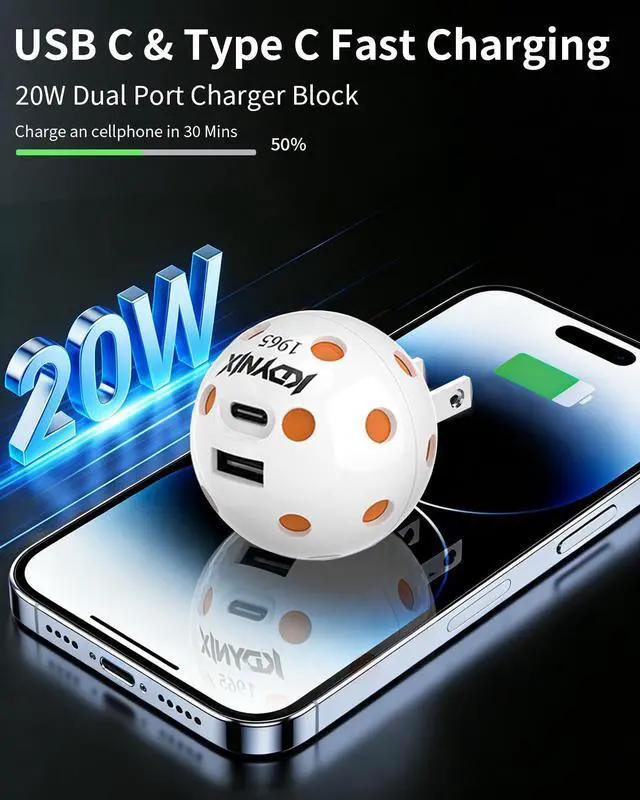
3X Faster Charging: Equipped with a USB-C port that supports fast charging, capable of charging an Phone to 50% in just 30 minutesup to three times faster than original standard chargers.
Ultra-Safe & UL Certified: Built with upgraded temperature control and intelligent current distribution. It is UL Certified for the US market, ensuring safety by preventing overheating, overcharging, and short circuits.
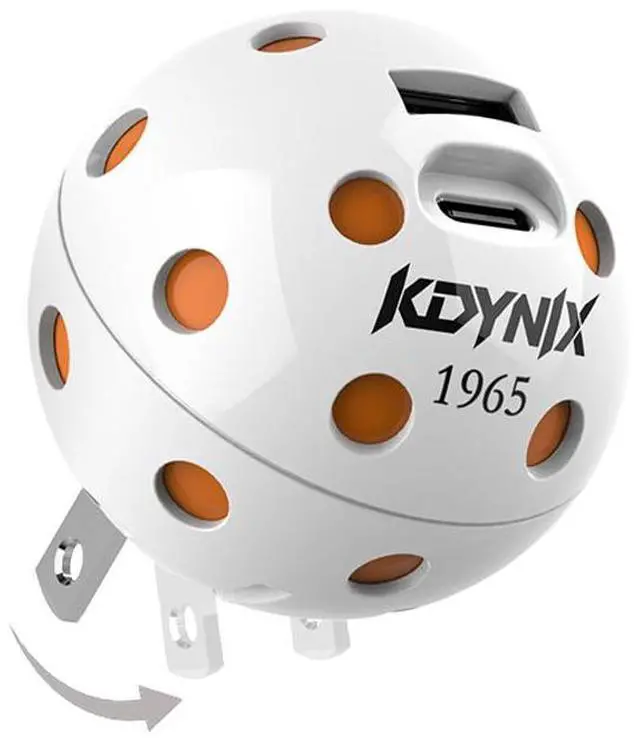
Durable & Portable Construction: Made from high-quality, scratch-resistant ABS material. Features a foldable plug, making it durable, lightweight, and perfectly portable for travel.
Intelligent Temperature Management: Incorporates a built-in smart temperature control system that monitors temperature over 100 times per second and adjusts output power in real-time to ensure safe operation.
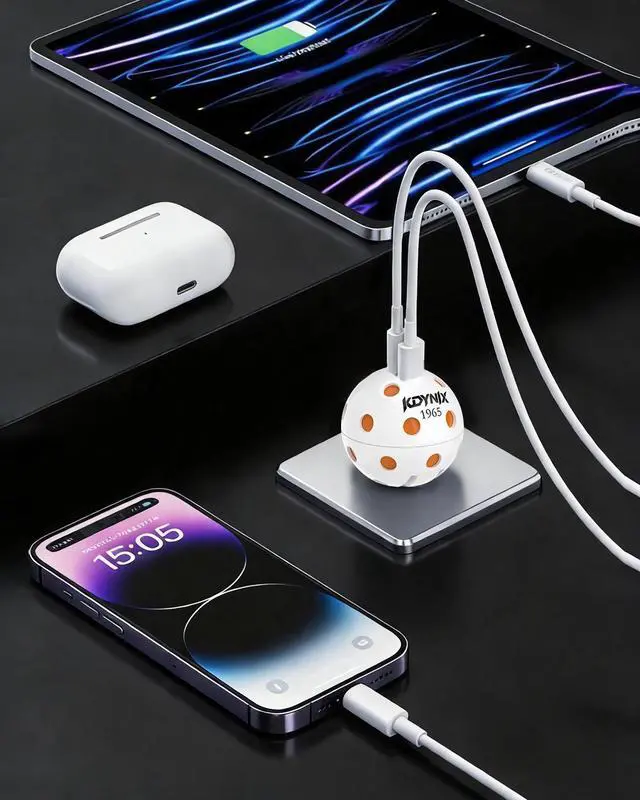
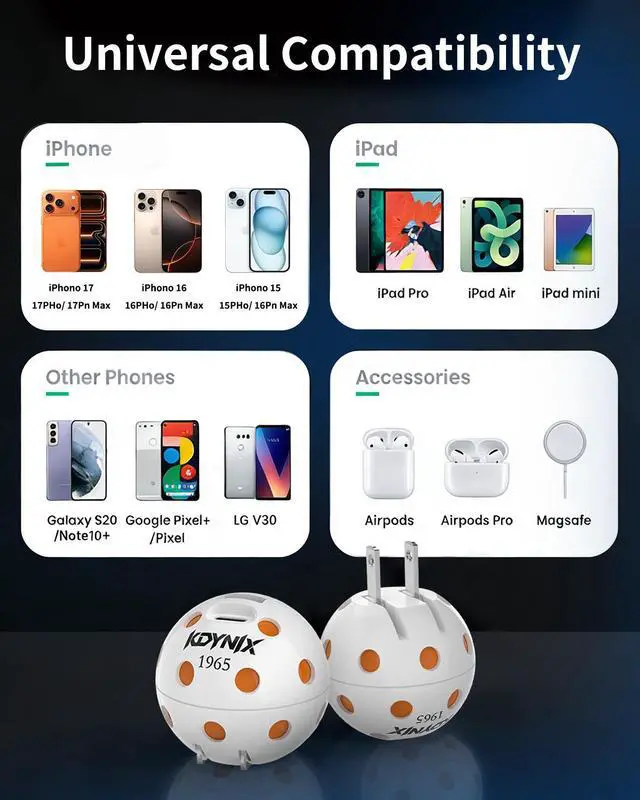
Wide Universal Compatibility: The USB-C charging block is universally compatible with iPhone 17/17 Air/17 Pro/17 Pro Max/16/16 Pro/16 Pro Max/16 Plus/15/14/13/12, Galaxy, iPad series, iPad, Galaxy, Google Pixel and more (supports PD3.0/QC3.0 protocols).
Perfect Creative Gift Idea: An ideal and impressive gift for various occasions, such as Father's Day, birthdays, Christmas, or as a prize for golf lovers and tournament winners.
Product information
| Brand | KDYNIX |
| Connector Type | USB Type A, USB Type C |
| Compatible Devices | Cellular Phones |
| Compatible Phone Models | Samsung Galaxy |
| Special Feature | Fast Charging, Retractable Plug |
| Color | White-orange Pickleball Charger |
| Input Voltage | 240 Volts (AC) |
| Number of Items | 1 |
| Output Current | 3 Amps |
| Specification Met | FCC |
| Package Dimensions | 3.43 x 3.35 x 2.13 inches |
| Item Weight | 3.53 ounces |
| Item model number | KD25G2 |
| Date First Available | September 19, 2025 |
| Manufacturer | Shenzhen Kechuanghui Electronic Technology Co., Ltd. |
The KDYNIX Golf Ball USB-C Charger is a 20W dual-port GaN wall charger with a foldable plug and golf-ball design, best for golfers or gift shoppers who want a compact charger for an iPhone, Galaxy, iPad, or AirPods at home, work, or while traveling.
| Attribute | Value |
|---|---|
| Best For | Charging phones and tablets that support Power Delivery 3.0 or Quick Charge 3.0 with universal USB device compatibility up to the charger's 20W capability |
| Power And Charging | 20W maximum output with up to 2.4A output; supports Power Delivery 3.0 and Quick Charge 3.0 for fast charging of compatible devices |
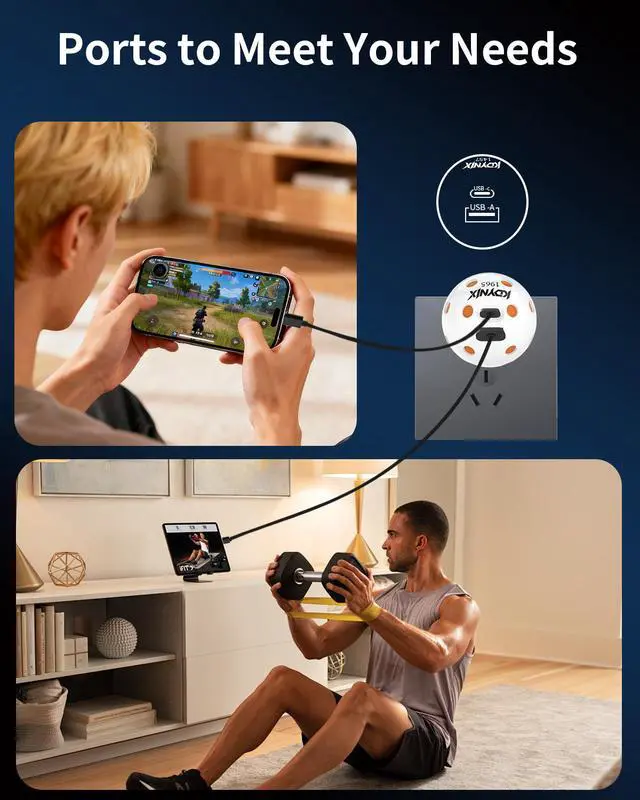
| Ports And Compatibility | Two USB ports including a USB-C connection, enabling charging of a mix of USB-C and USB-A devices with universal phone compatibility |
| Technology | GaN charger (Gallium Nitride) design |
| Physical Design And Color | White-orange finish |
| Model Identifiers | KDYNIX brand USB charger |
Q: Should I buy this KDYNIX 20W dual-port charger or a single-port Apple 20W charger for iPhone charging?
A: Choose the KDYNIX charger if you want one compact wall charger with both USB-C and USB-A, especially if you sometimes charge an iPhone plus AirPods, a watch cable, or another low-power device at the same time. Choose a single-port Apple 20W charger if your priority is a simpler one-device setup with no power-sharing between ports. In practical use, 20W is already close to the useful fast-charging range for many iPhones, so the main difference here is port flexibility rather than meaningfully faster phone charging.
Q: Is a 20W dual-port charger enough, or should I step up to a 35W to 47W dual-port charger?
A: Buy this 20W KDYNIX model if you mainly charge phones, earbuds, or other small devices and want a smaller travel charger. Step up to a 35W to 47W dual-port charger if you expect to charge two larger devices together, such as a phone and tablet, or if you want more headroom when both ports are in use. Higher-wattage dual-port models are positioned to maintain stronger output per device during simultaneous charging, while a 20W-class charger is better matched to lighter everyday loads.
Q: Is this charger a better fit than a 30W single-port charger?
A: This KDYNIX charger is the better fit if portability and multi-device convenience matter more than peak output. A 30W single-port charger makes more sense if you usually charge one device at a time and want extra power for tablets or other devices that can draw above 20W. For iPhones specifically, third-party testing commonly shows that moving from 20W to 30W produces only a modest charging-time gain, so the buying decision is usually about port count versus extra output capacity.
Q: Should I choose this USB-C plus USB-A charger or a newer dual-USB-C charger?
A: Choose this KDYNIX charger if you still use older USB-A cables or accessories and want one charger that works with both cable types. Choose a dual-USB-C charger if nearly all of your devices have moved to USB-C and you want a more current port layout for newer cables and accessories. The trade-off is compatibility versus forward-looking convenience: USB-A keeps older gear in rotation, while dual USB-C better matches newer phone, tablet, and accessory ecosystems.
Q: Is this a good travel charger for charging two devices at once?
A: Yes, if you mainly charge phones, earbuds, or a tablet while traveling. The KDYNIX charger has two ports, a foldable plug, and a compact 20W design, so it fits common travel use better than a single-port charger. The main trade-off is power: 20W is fine for phones and some tablets, but it is not the right choice for laptops or other higher-wattage devices.
Q: Will this charger fast-charge an iPhone or Samsung phone?
A: Usually yes, for supported phones. The product lists PD 3.0 and QC 3.0 support with up to 20W output, which matches the common fast-charging range for iPhones and many Samsung phones. It is best suited to smartphones and smaller USB-C devices, not larger devices that expect more than 20W.
Q: Who is this charger most suitable for?
A: It is most suitable for people who want a compact phone charger with a novelty design, especially golfers, gift buyers, and users who charge one or two small devices at a time. It makes more sense as a personal desk, bedside, or travel charger than as a universal charger for every device in a bag.
Q: What are the trade-offs versus a plain 20W charger from Anker, Apple, or Best Buy?
A: The main advantage here is the dual-port setup and gift-friendly golf-ball design in a compact charger. The trade-off is that buyers choosing mainstream alternatives often prioritize brand familiarity, while this product is more about design plus everyday phone charging. Functionally, it fits the same general use case as other 20W chargers: phones, earbuds, and some tablets, but not high-power laptop charging.
Q: Can this replace a tablet or laptop charger for work and meetings?
A: It can replace a phone charger and may be enough for light tablet charging, but it is not a full replacement for a laptop charger. A 20W adapter is best for smartphones and smaller USB-C accessories. If your work setup includes a power-hungry tablet, laptop, or fast top-ups during heavy use, a higher-wattage charger is the better fit.
Q: Is this charger mainly a novelty gift, or is it practical enough for everyday use?
A: It is best suited to buyers who want both a usable phone charger and a golf-themed design. Based on the product data, it offers real everyday features: 20W USB-C PD, a second USB-A port, foldable prongs, and broad phone/tablet compatibility. The main trade-off is power class: it is practical for phones, earbuds, and some tablets, but not a high-output all-in-one charger for larger devices.
Q: Is 20W enough if I just need a charger for my phone while traveling or at work?
A: Yes, for a phone-first setup, 20W is usually enough. This charger fits users who want a compact wall charger for an iPhone, Galaxy, AirPods, or similar small devices at a desk or in a travel bag. The trade-off is that 20W is limited compared with 30W-65W chargers that people often choose when they also want faster tablet charging or laptop support.
Q: Can it replace a higher-watt travel charger for tablets or laptops?
A: No, not fully. Its 20W maximum output makes it a phone and accessory charger first. It can work for light charging on some tablets, but it is not the right choice if you want one charger for a laptop or for faster multi-device charging. A higher-watt charger is the better fit for that use case.
Q: Is the dual-port design actually useful, or should I buy a single-port charger instead?
A: The dual-port design is useful if you often charge two small devices from one outlet, such as a phone plus earbuds or a phone plus watch cable. It is less compelling if you usually charge only one device at a time, or if you want the fastest possible charging for larger devices. In that case, a higher-watt single-port or higher-watt multi-port charger may be a better fit.
Q: Who is this charger a good fit for?
A: It is a good fit for golfers, gift buyers, and anyone who wants a compact charger for phones and small accessories without carrying a larger power brick. It is less suitable for users who prioritize maximum charging speed, laptop support, or a more conventional charger design over appearance.


