




 here!
I’m your shopping assistant for PC builds, upgrades, and everything tech.
Got questions? Ask away!
Start a conversation
here!
I’m your shopping assistant for PC builds, upgrades, and everything tech.
Got questions? Ask away!
Start a conversation



Any questions? Ask CelesteSM will help you find out quickly.
Most teams that need four coherent RF channels start by buying two single-transceiver cards and then discover the real project: keeping two clocks, two LOs and two data paths phase-aligned while the FPGA moves samples. That synchronization work eats weeks and never quite finishes.
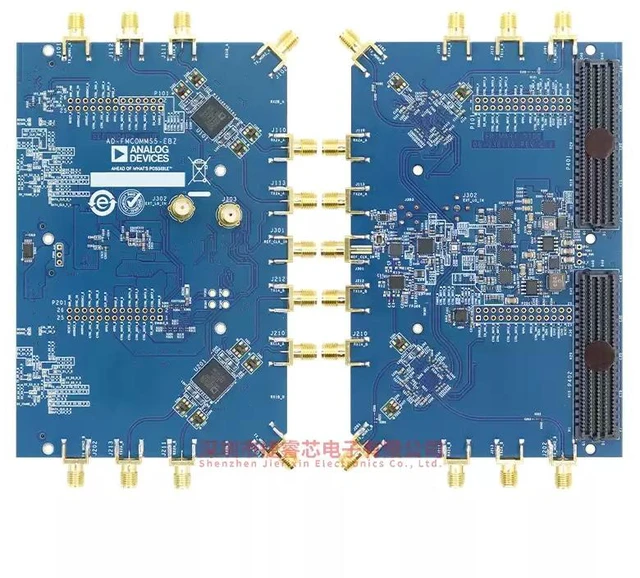
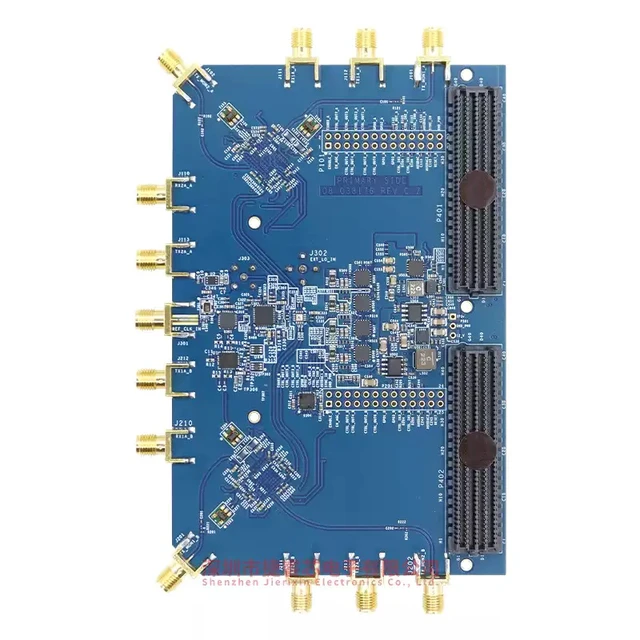
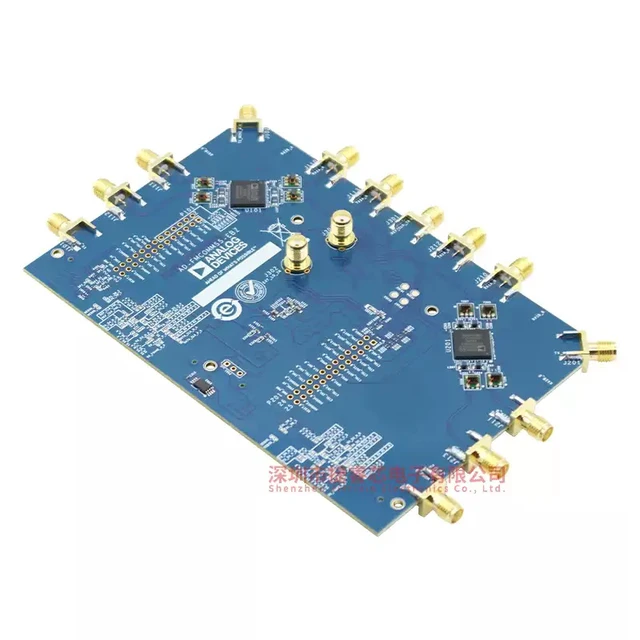
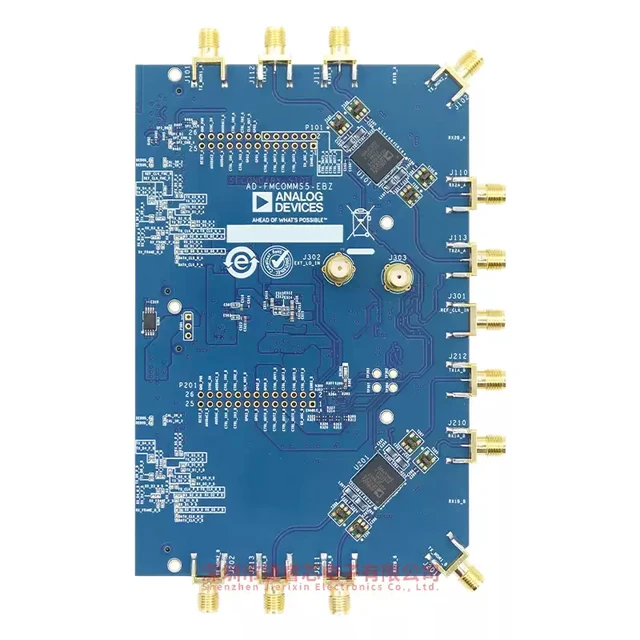
The AD-FMCOMMS5-EBZ is Analog Devices' answer to that problem. It puts two AD9361 agile RF transceivers on one FMC mezzanine card, giving you four receive and four transmit channels from 70 MHz to 6 GHz, with channel bandwidths from under 200 kHz to 56 MHz. The TX and RX paths are phase and frequency synchronized, and data lands in the FPGA aligned to within less than one sample on both ADC and DAC.
The card is designed around multi-chip control rather than two half-cards glued together. Both transceivers sit on one SPI bus using separate slave selects, take an external reference clock, and can be driven by the on-board ADF5355 synthesizer as an external LO. Wideband channels cover the full 6 GHz range, and narrowband channels arrive matched for 2.4 GHz work. ADI publishes the schematic, layout, BOM, HDL reference designs, Linux and No-OS drivers, so the card doubles as a reference design for your own product.
Teams use it for MIMO and SU-MIMO/MU-MIMO radio development, phased-array and beamforming experiments, remote radio heads, satellite modems, radar and imaging, and RF test and measurement.
Before you order, read the two requirements below. They are the difference between a card that works on arrival and one that sits in a drawer.
The AD-FMCOMMS5-EBZ is a mezzanine card, not a standalone board. It uses a dual FMC connector, which means your carrier must provide two adjacent FMC slots. Analog Devices names the ZC702 and ZC706 as suitable base boards. Boards with a single FMC connector ZedBoard, MicroZed, PYNQ and similar will not take this card.
The card draws its power from a single FMC connector on the carrier; no separate power supply is required.
If you plan to work in MATLAB/Simulink, note this explicitly: the FMCOMMS5 Receiver and Transmitter blocks are set up with Hardware Board = Xilinx Zynq ZC706 and Add-On Card = FMCOMMS5, live RF capture is supported on the ZC706, and the blocks use the IP core workflow rather than SoC Builder. ZC702 does not appear in MathWorks' supported-hardware list for live RF capture, even though ADI lists it as a valid carrier. Pick your carrier around your toolchain, not just around the slot count


