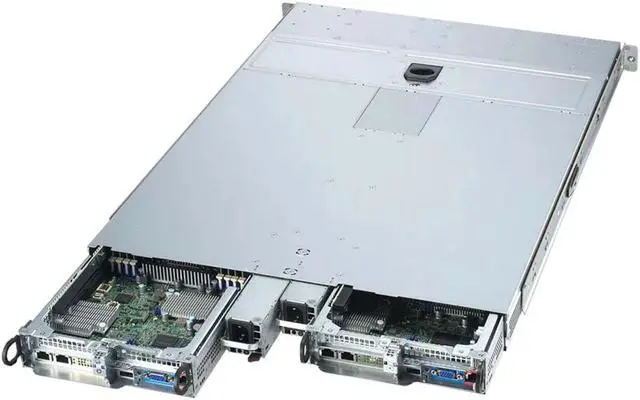
The Supermicro SYS-120TP-DTTR is a 1U barebones server with two hot-pluggable nodes, built for data centers and service providers seeking high compute density; each node supports dual 3rd Gen Intel Xeon Scalable processors and up to 4TB of ECC DDR4 memory.
Recommended For
- Data-center and research teams running HPC, big-data, or scale-out workloads that can use two hot-pluggable server nodes in a single 1U chassis.
- IT teams building hyper-converged or virtualization infrastructure that want separate compute nodes with dual-socket Xeon support, ECC memory capacity, and onboard 10GbE.
- Rack operators assigning different services or workloads to two independent nodes, when compact rack space matters more than having a larger chassis for expansion.
Real-World Use Scenarios
- When a data center needs more virtualization or hyper-converged infrastructure capacity without adding another rack unit, the two nodes let it place separate compute workloads in one 1U chassis. They can host services or virtual machines side by side, though the shared chassis is not two physically independent failure domains.
- For a CPU-based HPC cluster, an administrator can deploy the two systems as compact compute nodes and schedule parallel jobs across them. This helps add rack-dense worker capacity; actual job performance depends on the installed processors, memory, and cluster configuration.
- For big-data or scientific batch processing, teams can use the nodes to run CPU- and memory-heavy analysis jobs in parallel. The 1U, two-node layout can increase compute density, while storage capacity and data-feed speeds depend on the chosen drives and wider infrastructure.
- At a space-constrained edge or colocation site, an operator can consolidate two server workloads into one rack unit instead of installing two separate chassis. The compact layout saves rack space, but the 1U server format is intended for a rack environment rather than a quiet office.
- For a high-throughput network security or data-transfer appliance, an integrator can build the required software and PCIe cards into a node, then deploy the appliance in a dense rack. The usable throughput depends on the selected cards, configuration, and workload—not the chassis alone.
Spec Summary
| Attribute | Value |
|---|
| Best For | Compact, high-density server deployments that need two systems in a 1U chassis |
|---|




 here!