




 here!
I’m your shopping assistant for PC builds, upgrades, and everything tech.
Got questions? Ask away!
Start a conversation
here!
I’m your shopping assistant for PC builds, upgrades, and everything tech.
Got questions? Ask away!
Start a conversationShipped by Newegg


Make informed decisions with expert advice. Learn More




Any questions? Ask CelesteSM will help you find out quickly.
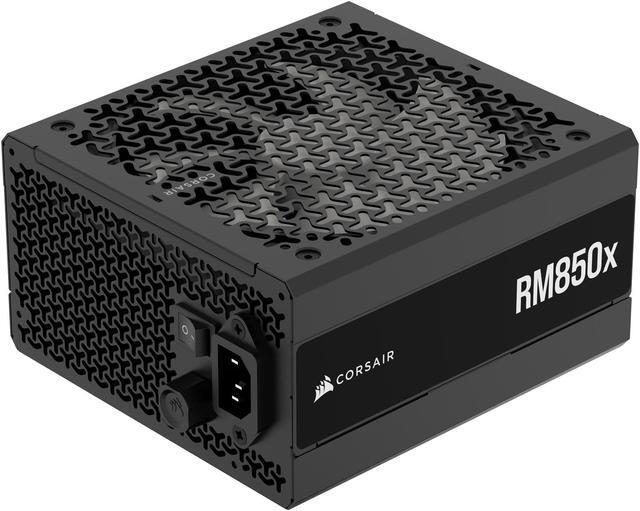
The CORSAIR RM850x is an 850W fully modular ATX 3.1 power supply with PCIe 5.1 support, a native 12V-2x6 cable, Cybenetics Gold efficiency, and low-noise cooling, making it a strong fit for modern gaming PCs and high-performance builds that need clean cabling and current-gen GPU readiness.
| Attribute | Value |
|---|---|
| Best For | ATX 3.1 desktop builds needing up to 850 W from a fully modular supply, and systems that require a native 12VHPWR (12+4) connector for high-power PCIe devices |
| Power And Certification | 850 W maximum output with Cybenetics Gold efficiency rating; ATX 3.1 compatible design |
| Form Factor & Compatibility | Full-modular ATX form factor (ATX 3.1 compatible) with a maximum PSU length of 160 mm |
| Connectors & Cables | Modular cable set includes 1× 12VHPWR (12+4) PCIe, 1× 24‑pin ATX main, 2× 8‑pin (4+4) EPS (CPU), 3× 8‑pin (6+2) PCIe, 3× PATA and 8× SATA; supplied cable lengths range from 610 mm to 850 mm per the cable harness specifications |
| Cooling & Fans | Air-cooled design with a single 140 mm fan |
| Electrical Input & Output | AC input 100–240 V, 47–63 Hz; DC rail/current ratings listed as +12V @ 70.8 A, +3.3V @ 20 A, +5V @ 20 A, +5Vsb @ 3 A |
| Dimensions & Weight | Item dimensions listed as 2.3 L × 3.39 W × 5.91 H inches; maximum PSU length 160 mm; item weight 3.9 lb; package weight 3.34 kg; package dimensions 13.5 L × 21.7 W × 30.8 H cm |
| Package Content | Includes RM850x power supply, DC cable kit, power cord, mounting screws and cable ties |
| Model Identifiers | CORSAIR RMx Series RM850x — Model/Part CP-9020270-NA (Manufacturer: Corsair); style listed as RMx (2024) - ATX 3.1 |
| Compatibility & Miscellaneous | Listed compatible device: Monitor; no batteries required or included |
Q: Should I buy the Corsair RM850x 2024 or keep an older RM850x for a new GPU build?
A: Choose the RM850x 2024 if you want native ATX 3.1 support, a direct 12V-2x6 cable for newer GPUs, and better alignment with current transient-load requirements. An older RM850x can still be sufficient for many existing systems, but the 2024 model is the more practical choice for a fresh build or a planned next-GPU upgrade because it avoids adapter use and matches newer PSU standards more closely.
Q: Is the Corsair RM750x enough, or is the RM850x the safer choice?
A: Choose the RM750x if your system has a mid-range to upper-mid-range GPU and you do not expect major upgrades. Choose the RM850x if you want more headroom for higher transient GPU power spikes, quieter operation at the same load, or a smoother path to future high-end graphics cards. For buyers deciding between the two, the RM850x is usually the better fit when long-term upgrade flexibility matters more than minimizing wattage.
Q: Should I get the Corsair RM850x or step up to the RM1000x?
A: Choose the RM850x for most performance desktops with one high-end GPU, especially if you want strong cable support and current-spec compatibility without oversizing the PSU. Step up to the RM1000x if you are pairing a top-tier GPU with a power-hungry CPU, want more overhead for future upgrades, or prefer to keep the PSU further below its maximum load during heavy gaming or workstation use. The main trade-off is extra capacity versus cost and size planning, not a basic quality gap.
Q: Corsair RM850x or Seasonic Focus GX-850 ATX 3.1: which one makes more sense?
A: Both target the same buyer: an 850W fully modular PSU for modern gaming builds. Choose the RM850x if you value the newer Corsair feature set around low-noise operation, flexible embossed cables, and the manual fan-speed control approach. Choose the Focus GX-850 if you prefer Seasonic's platform and want an alternative from another established PSU brand with the same ATX 3.1 and PCIe 5.1 positioning. In practice, this is usually a feature, pricing, and acoustic-preference decision rather than a major capability difference.
Q: Is the Corsair RM850x a good choice for a modern gaming PC with an RTX 4070 Super, 5080, or a similar high-end GPU?
A: Yes for most single-GPU high-performance builds. This RM850x is an 850W ATX 3.1 unit with a native 12V-2x6 / PCIe 5.1 GPU cable, so it is better suited to current Nvidia-class GPUs than older PSUs that rely on adapters. It is a practical fit for users building a strong gaming or creator PC who want current connector support and some upgrade headroom, but very high-draw systems may still justify stepping up to 1000W.
Q: Does this PSU support ATX 3.1 and PCIe 5.1 out of the box, or will I need adapter cables?
A: It supports both out of the box. Based on the provided product data, this RM850x is ATX 3.1 compliant and includes a native 12V-2x6 connector for PCIe 5.1 / current-gen GPU support. That makes it the better choice for buyers who want to avoid relying on older multi-plug GPU adapters.
Q: Who is the RM850x best for, and when is it more than you need?
A: It is best for mid-to-high-end desktop builders who want a quiet, fully modular 850W PSU with current ATX 3.1 and native next-gen GPU cable support. It makes the most sense for gaming, workstation, or upgrade-focused builds with stronger CPUs and GPUs. It is more than many office PCs or lower-power gaming systems need, and buyers on a tighter budget may prefer a lower-tier or lower-watt model if they do not need the extra headroom or newer connector standard.
Q: What are the main trade-offs between the RM850x and cheaper 850W ATX 3.1 alternatives like the RM850e or MSI A850GL?
A: The RM850x is the more premium-leaning option if you care about lower noise, higher-end component positioning, and enthusiast-focused usability such as the 140mm FDB fan, zero-RPM mode, Japanese 105°C capacitors, and a manual fan-speed control knob. Cheaper 850W ATX 3.1 models can still cover the same basic wattage and modern GPU compatibility, so the trade-off is usually price versus refinement rather than core functionality.
Q: Will this PSU fit most standard ATX cases, and what should buyers check before ordering?
A: It should fit most standard ATX-compatible cases, but buyers should still confirm PSU clearance and cable room before ordering. This model is 160 mm long, so fit is usually straightforward in mainstream mid-tower cases, but compact cases and some prebuilt systems can still be limiting. The key checks are case PSU length clearance, support for a standard ATX power supply, and enough space for modular cables.
Q: Is the Corsair RM850x 2024 a good buy for a modern gaming PC?
A: Yes, if you want an 850W PSU for a current mid-high to high-end build. Reddit and YouTube discussion repeatedly focus on its ATX 3.1 design, native 12V-2x6 GPU cable, quiet operation, and full modular cabling. It is a better fit for new builds than older RM850x versions if you want native support for newer GPUs without relying on adapter cables.
Q: Who is the RM850x 2024 most suitable for?
A: It is most suitable for builders who want a premium-feeling 850W PSU for a single-GPU system, especially with a newer graphics card that can use the included native 12V-2x6 cable. It also suits users who care about low noise, flexible cables, and straightforward cable management. It is less compelling if you already own a good older RM850x and do not need the newer power connector standard.
Q: Is the RM850x 2024 worth upgrading to from an older RM850x?
A: Usually only if you want the newer platform features. The practical upgrade case discussed on Reddit is native ATX 3.1 and a built-in 12V-2x6 cable for newer GPUs. If your current RM850x is working well and already powers your system reliably, the upgrade is more about connector convenience and updated standards than a major everyday performance change.
Q: What are the main trade-offs of choosing the RM850x 2024?
A: The main trade-off is that it is easier to justify for a new build than for an upgrade. Community discussion centers on the newer connector standard, quiet tuning, and cable set as benefits, but those features may not matter much if your existing PSU already meets your power and connector needs. It is a strong fit for users who value native modern GPU support, but not a necessary replacement for every older high-quality 850W unit.
Q: Should you use the included native GPU power cable instead of your graphics card adapter?
A: Yes, for a compatible modern GPU, the included native 12V-2x6 cable is the simpler choice because this PSU is designed to provide that connection directly. Reddit discussion around this model repeatedly treats the native cable as the preferred option for new ATX 3.1 builds, mainly to avoid unnecessary adapter use.


