
 here!
I’m your shopping assistant for PC builds, upgrades, and everything tech.
Got questions? Ask away!
Start a conversation
here!
I’m your shopping assistant for PC builds, upgrades, and everything tech.
Got questions? Ask away!
Start a conversation



Any questions? Ask CelesteSM will help you find out quickly.
|
CPU |
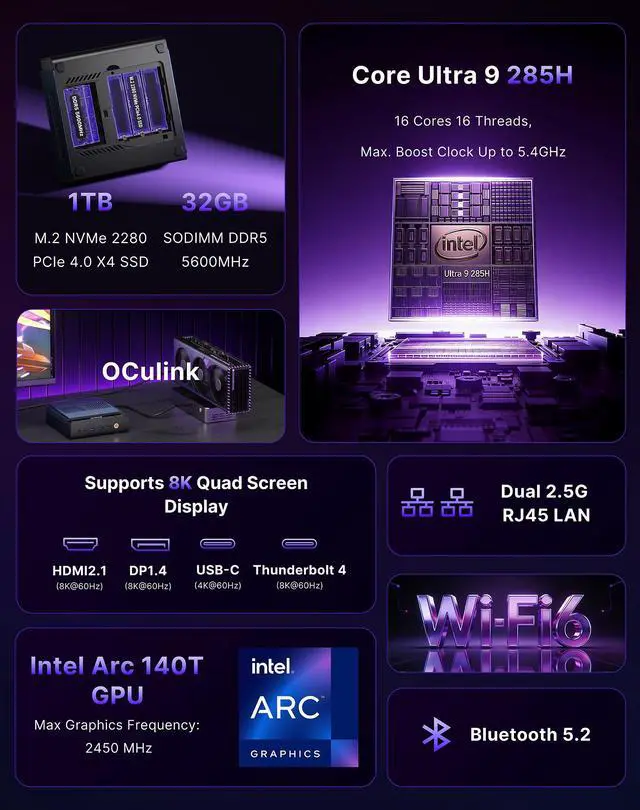
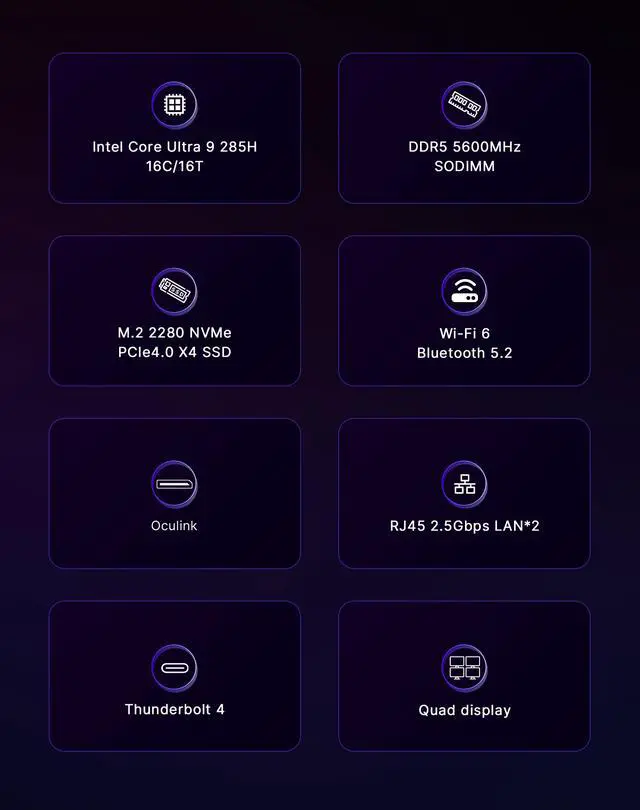
Intel Core Ultra 9 285H |
|---|---|
|
GPU |
Intel Arc 140T (Max Graphics Frequency 2450 MHz) |
|
AI NPU |
Intel Al Boost (NPU peak TOPS (Int8): 13 TOPS) |
|
RAM |
32GB DDR5(SODIMM x2,up to 128GB) |
|
SSD |
1TB M.2 2280 NVMe PCle4.0 x4(Include) |
|
Operating System |
Windows 11 Pro |
|
Other Features |
WOL Auto Power on |


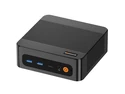
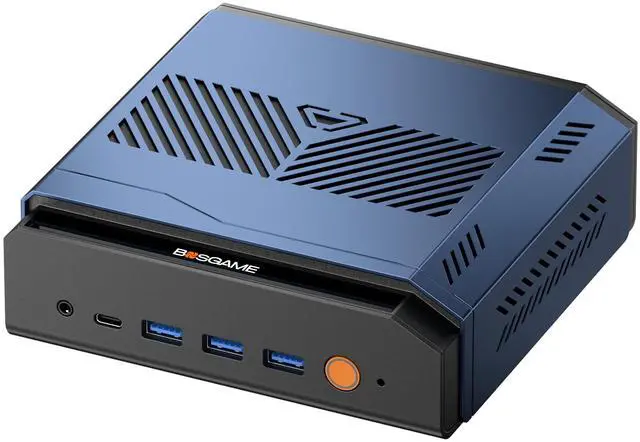
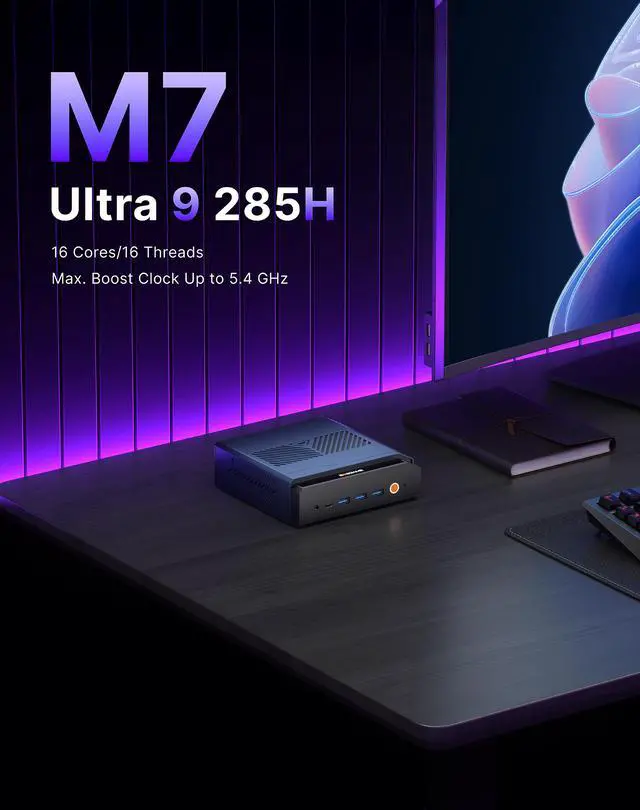
BOSGAME M7 Mini PC Powered by the 16-core Intel Core Ultra 9 285H (up to 5.4GHz), Intel Arc 140T GPU, and 13 TOPS NPU, it handles 8K editing, 3D modeling, AAA gaming, and AI workloads with ease. Equipped with 32GB DDR5 (expandable to 128GB) + 1TB PCIe 4.0 SSD (dual M.2 slots, up to 8TB each) for blazing speed and massive storage.
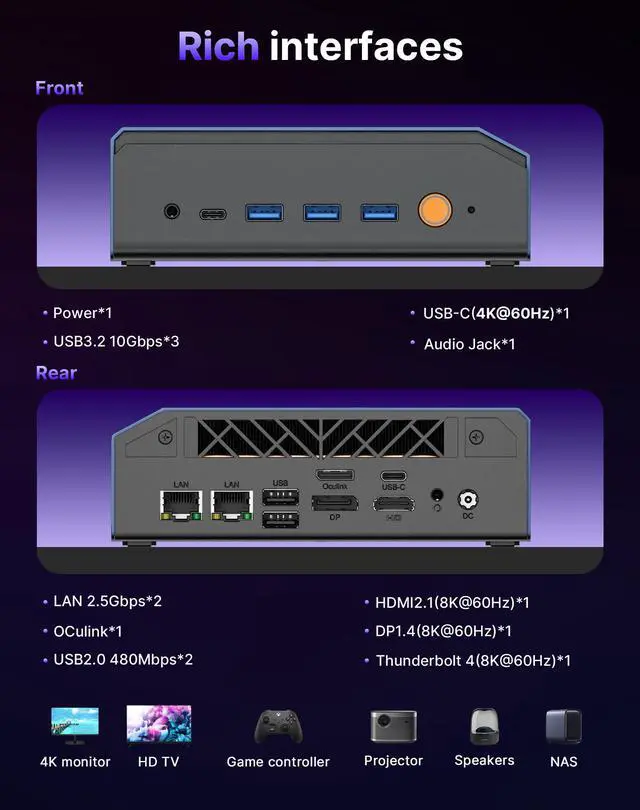
Full Connectivity: OCulink (PCIe 4.0 x4) for external GPU support; quad 8K@60Hz display output via HDMI 2.1, DP 1.4, Thunderbolt 4, and USB-C; dual 2.5G LAN, Wi-Fi 6, and Bluetooth 5.2 for enterprise-grade networking; Thunderbolt 4 (40Gbps) plus multiple USB ports for flexible expansion.
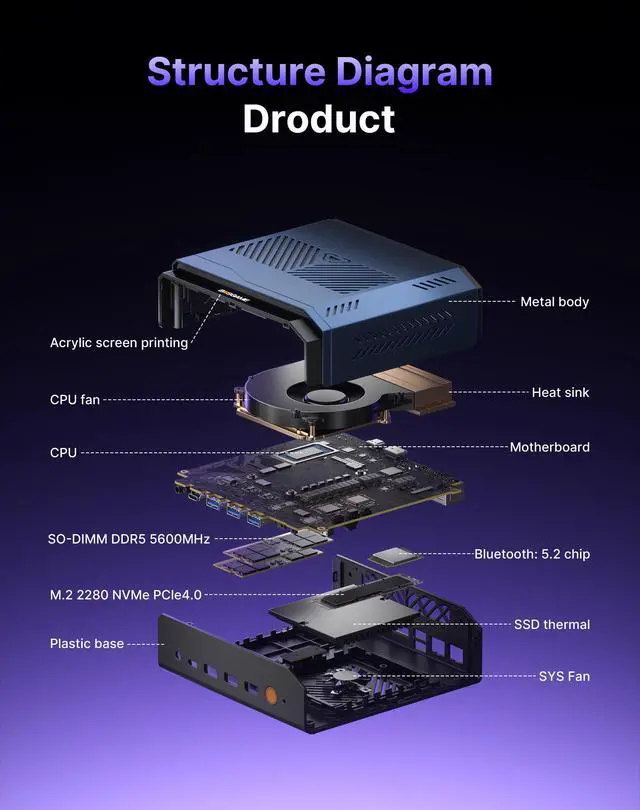
Cool & Reliable: Premium metal chassis with advanced dual-fan cooling ensures silent 24/7 operation.
Worry-free Warranty:Comes with a 1-year limited warranty,tarting from the date of the purchase. All defects due to design and workmanship are covered.
The BOSGAME DeskMini M7 is a compact mini PC with an Intel Core Ultra 9 285H, Intel Arc 140T graphics, 32GB DDR5 memory, and a 1TB NVMe SSD, suited to creators and power users handling multitasking, productivity, and graphics workloads who want the option to add an eGPU through OCulink.
| Attribute | Value |
|---|---|
| Best For | A compact desktop for AI-assisted productivity, creative workloads, and multitasking, with support for external GPU expansion |
| Processor And AI Acceleration | Intel Core Ultra 9 285H with a built-in 13 TOPS NPU for local AI workloads |
| Memory Configuration | 32GB DDR5 memory running at 5600MHz |
| Storage | 1TB SSD |
| Wired And Wireless Networking | 2.5 Gigabit Ethernet, Wi-Fi 6, and Bluetooth 5.2 |
| Audio Setup | 2-channel audio |
Q: BOSGAME M7 vs P3 Plus: which should I choose?
A: Choose the BOSGAME M7 if you want its 16-core Intel Core Ultra 9 285H platform, Arc 140T graphics, 32GB DDR5-5600 memory, Thunderbolt 4, and OCuLink eGPU connection. The P3 Plus is an alternative built around an AMD Ryzen 7 7840HS and Radeon 780M graphics; choose it if that Ryzen-and-Radeon configuration better matches your needs. The M7’s CPU performance has also been tested in Linux benchmark workloads.
Q: Should I get the BOSGAME M7 or the P6 Neo for a mini PC with integrated graphics?
A: Choose the BOSGAME M7 for its Core Ultra 9 285H processor, Intel Arc 140T graphics, and 32GB DDR5-5600 configuration. The P6 Neo offers a Ryzen 7 6800H, Radeon 680M graphics, 24GB DDR5 memory, and a 1TB SSD. Both are compact systems with integrated graphics; the M7 is the fit for buyers prioritizing its Intel platform and listed memory configuration.
Q: BOSGAME M7 vs P4 Ultra: which is a better fit for a more demanding setup?
A: Choose the BOSGAME M7 for its Core Ultra 9 285H processor, 32GB DDR5-5600 memory, Intel Arc 140T graphics, Thunderbolt 4, and OCuLink eGPU connectivity. The P4 Ultra uses a Ryzen 7 7730U with 16GB DDR4 and a 1TB SSD. Its Ryzen configuration is an option for everyday desktop use, while the M7’s listed platform and expansion connections suit users planning more intensive workloads or external-GPU expansion.
Q: Can it run several monitors for a work setup?
A: The listed specifications say the M7 can drive four independent displays at up to 8K/60Hz using its HDMI 2.1, DisplayPort 1.4, Thunderbolt 4, and full-function USB-C outputs. Check that your monitors and cables support the connections and resolutions you plan to use.
Q: Can I upgrade the memory and storage later?
A: The M7 comes with 32GB of DDR5 memory and a 1TB NVMe SSD. Its listed specifications say memory is expandable to 128GB and its two M.2 slots support drives up to 8TB each; confirm drive compatibility before purchasing an upgrade.
Q: Is it suitable for office work, multitasking, and video meetings?
A: Yes. Its Core Ultra 9 processor, 32GB of memory, 1TB SSD, and Windows 11 Pro are suited to office applications, browsing, and multitasking. It is a mini PC, so plan on using a separate monitor, keyboard, and mouse; the provided specifications do not identify a built-in webcam or microphone.
Q: Can it handle gaming or demanding graphics work?
A: It has integrated Intel Arc 140T graphics, and the listed OCuLink interface supports adding an external GPU. The provided specifications do not establish game-specific performance, so results for demanding games and graphics workloads will depend on the software, settings, and whether an eGPU is used.