




 here!
I’m your shopping assistant for PC builds, upgrades, and everything tech.
Got questions? Ask away!
Start a conversation
here!
I’m your shopping assistant for PC builds, upgrades, and everything tech.
Got questions? Ask away!
Start a conversation



Any questions? Ask CelesteSM will help you find out quickly.


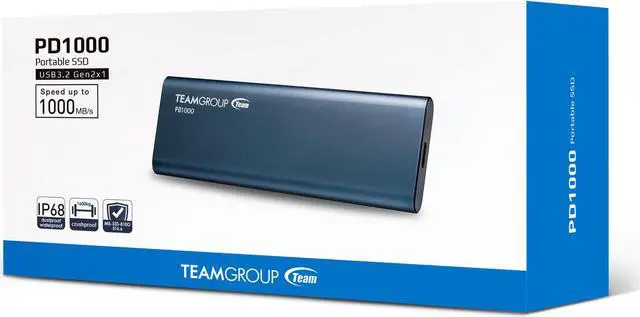
Tested by the external laboratory and rated IP68, which means it currently has the highest ratings for resisting both dust and water. It can endure up to 1 meter underwater for 60 minutes and completely isolated from dust or even if a sandstorm hits.


The unique IP68 waterproof, dustproof connector design of the PD1000 allows you to experience the genuine waterproof and dustproof function, so you don’t have to worry about losing the dust plug anymore.


PD1000 has passed the rigorous military grade test of US MIL-STD-810G 516.6 Procedure IV. The strong drop resistance ability is enough to cope with accidents such as dropping from the desktop or from hand. It can avoid accidental damage to the data and prolong service life.


Certified for withstanding 1,600kg of weight to protect your precious data. The rigid structure is designed to withstand the weight of 1,600kg, which is equivalent to the weight of a small car, providing the highest level of protection for your precious data.


PD1000 uses the latest USB 3.2 Gen 2 super speed+ interface. With read/write speed up to 1000/900 MBs, it can quickly backup a large number of multimedia files and save your time.


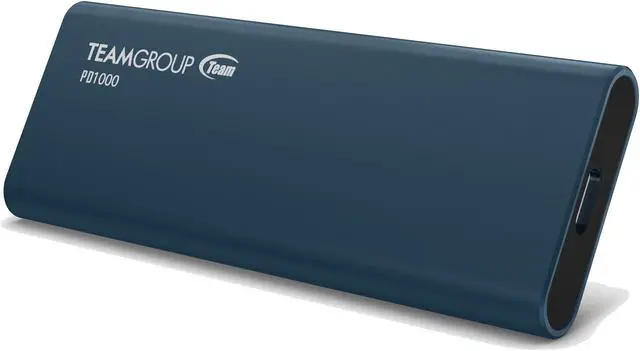
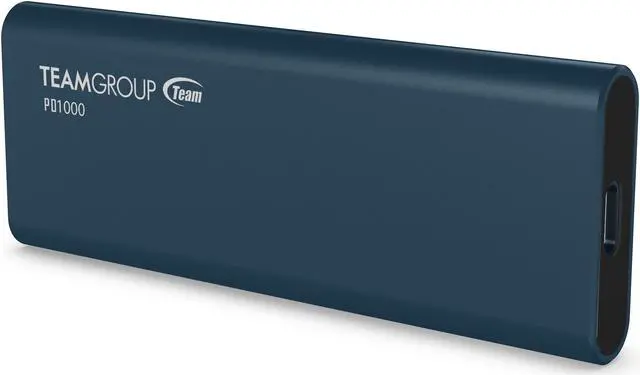
PD1000 uses aluminum alloy material with an anodized matte finish. The texture is both fine and strong, and the heat generated during the operation can be spread evenly to the product surface, maintaining the temperature below 45°C.


PD1000 is compatible with operating systems such as Android, Mac OS and Windows. It also supports hot swap and it can be directly connected to devices such as personal computers, tablets, laptops, etc. You can easily transfer and share without installing additional drivers.
Overview
Team Group PD1000 is a 1TB portable external SSD for desktop and notebook computer users who need portable storage with USB 3.2 Gen2 connectivity, fast sequential transfer speeds, and IP68 protection.
Key Features
Performance
The PD1000 delivers a maximum sequential read speed of up to 1000 MBps and a maximum sequential write speed of up to 900 MBps. USB 3.2 Gen2 provides the interface for high-speed file transfer.
Design
The portable external SSD has a navy blue finish and a business appearance with heat dissipating performance. Dimensions are 1.57 inches wide, 4.21 inches deep, and 0.43 inches high, with a weight of 0.17 lb.
Connectivity & Compatibility
The drive uses USB 3.2 Gen2 and supports desktop or notebook computers with a USB port. A USB 3.2 port is needed for USB 3.2 performance. Supported systems include Windows 10/8.1/8/7, Mac OS X v.10.5 or later, and Android 5.0 or later.
Reliability & Durability
IP68 waterproof, dustproof and pressure proof certification helps protect the drive. The product has certified military grade drop resistance and resists deformation under loads up to 1,600 kg. Operating temperature is 0°C ~ +70°C, and storage temperature is -40°C ~ +80°C.
Specifications
What's in the Box
The TEAMGROUP PD1000 is a 1TB portable external SSD with sequential read speeds up to 1,000 MB/s and write speeds up to 900 MB/s, suited to people who want fast file transfers and a rugged drive for work or travel.
| Attribute | Value |
|---|---|
| Best For | Portable personal storage and file transfers for desktop computers, laptops, and gaming consoles |
| Capacity | 1 TB |
| Interface And Included Cables | External USB 3.2 Gen 2 SSD with USB Type-C connectivity; includes USB Type-A-to-Type-C and Type-C-to-Type-C cables |
| Read And Write Performance | Sequential read speeds up to 1000 MB/s and sequential write speeds up to 900 MB/s |
| Durability | Shock resistant, waterproof, and dust resistant |
| Compatibility | Compatible with desktop computers, laptops, and gaming consoles; system requirements list Windows 7/8/8.1/10, Mac OS X 10.5 or later, or Android 5.0 or later |
| Physical Design | Aluminum enclosure in navy blue; 4.21 × 1.57 × 0.43 in, weighing 0.17 lb |
| Model Identifiers | TEAMGROUP PD1000, model T8FED6001T0C108 |
Q: TEAMGROUP PD1000 or Samsung T7 Shield for outdoor use?
A: Choose the PD1000 if its IP68 water- and dust-resistance rating and stated pressure resistance are your priority. Choose the T7 Shield if you prefer its higher published speeds—up to 1,050 MB/s read and 1,000 MB/s write versus the PD1000’s 1,000/900 MB/s—or want AES 256-bit hardware encryption. Both use USB 3.2 Gen 2, so actual transfer speeds depend on the host device and connection.
Q: Is the PD1000 or SanDisk Extreme Portable SSD better for a rugged 1TB drive?
A: Both are USB 3.2 Gen 2 portable SSDs with similar published top speeds. The PD1000 is rated IP68 and lists pressure resistance; the SanDisk Extreme Portable SSD data sheet lists IP65 water and dust resistance and speeds up to 1,050 MB/s read and 1,000 MB/s write. Choose the PD1000 if its higher ingress-protection rating is the deciding factor; choose the SanDisk if its published speed figures better fit your needs. Ratings and speed claims come from each manufacturer’s stated test conditions.
Q: Should I get the PD1000 or the standard Samsung T7?
A: Choose the PD1000 for its IP68 water- and dust-resistance rating, pressure-resistance claim, and military-standard drop testing. The standard Samsung T7 offers a slimmer, lighter design—58 g versus the PD1000’s 75 g—and AES 256-bit hardware encryption. Their published maximum read/write speeds are close: 1,000/900 MB/s for the PD1000 and 1,050/1,000 MB/s for the T7. For compact everyday carry, the T7 is the more compact option; for rated environmental protection, choose the PD1000.
Q: Will this SSD work with both Windows and Mac computers?
A: Yes. The listed system requirements include Windows 7 or later and Mac OS X 10.5 or later. It connects over USB; USB 3.2 Gen 2 is required to reach its listed USB 3.2 performance.
Q: Will it reach 1,000 MB/s on any USB port?
A: No. The PD1000 is rated for sequential reads up to 1,000 MB/s and writes up to 900 MB/s, but actual performance depends on the connected device and port. The product information specifies a USB 3.2 port for USB 3.2 performance; older or slower ports may limit transfer speeds.
Q: Is this SSD suitable for travel or outdoor use?
A: It is designed with durability in mind: the product information lists IP68 waterproof and dustproof certification, pressure resistance, and military-grade drop resistance. These ratings do not replace keeping a separate backup of important files.
Q: Can I connect it directly to an Android phone?
A: Android 5.0 or later is listed as a supported system, and the package includes USB-C-to-USB-C and USB-A-to-USB-C cables. Direct phone use depends on whether the phone supports external USB storage and supplies sufficient power; check the phone’s compatibility before relying on it.
Q: Is the PD1000 a practical way to add storage to a laptop?
A: It can be a practical, lower-cost alternative to upgrading internal storage when you are comfortable carrying and plugging in a separate drive. A Reddit discussion recommends the PD1000 for adding laptop storage, while also noting that external storage is less convenient than built-in storage.
Q: Will it reach its advertised transfer speeds on any USB port?
A: No. The product is rated for sequential reads up to 1,000 MB/s and writes up to 900 MB/s, but maximum performance requires a USB 3.2 Gen 2 connection; slower USB ports can limit speeds.
Q: Is the PD1000 suited to travel or rough handling?
A: Its IP68 rating and military-grade drop-resistance certification make it relevant for users concerned about dust, water, or drops. These protections do not replace backups, and the product data does not establish protection against every type of damage.
Q: What is the main trade-off compared with internal laptop storage?
A: The PD1000 adds 1TB of external storage, but it must be carried separately and connected when needed. Reddit commenters discussing the drive describe that setup as less convenient than internal storage, even while recommending it as an expansion option.



