Your Browsing History
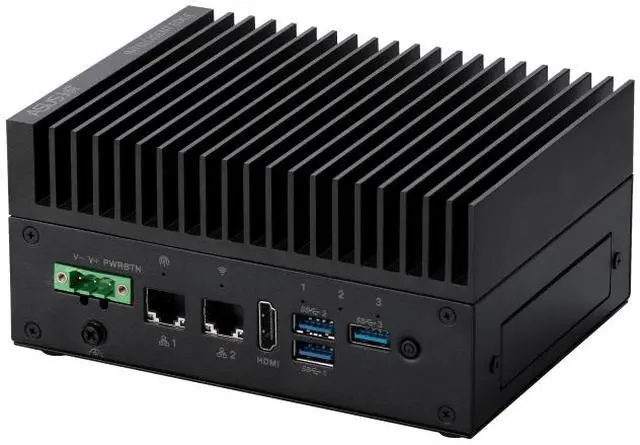
ASUS PE1100N / Orin Nano 4G/US Arm System, NVIDIA Jetson Orin, LPDDR4, eMMC, USB3, Dual LAN, HDMI, M.2 E, M.2 B, M.2 M, AEM, Dual SIM, 12-24V
- Intelligent Edge AI System with NVIDIA Jetson Orin Nano
- Fan-less design and diverse I/O in a compact size
- Ready to connect Wi-Fi, BT & 4G, 5G by optional modules
- Wide range of power input and operating temperature
- Support ASUS Expansion Module (AEM)
- OS: Ubuntu Desktop
- CPU: 6 x Arm Cortex-A78AE v8.2
- GPU: 512-core NVIDIA Ampere GPU with 16 Tensor Cores
- RAM: 4 GB 64-bit LPDDR5
- Expansion: M.2 M key 1 x 2242/2260/2280, for M.2 SSD (PCIe, OS disk, size option), M.2 E key 1 x 2230, for Wi-Fi/BT (PCIe, USB 2.0, I2C and PCM), M.2 B key 1 x 3042/3052, for 4G/5G (PCIe, USB 2.0/3.0)
- Slot: 2 x nano-SIM slots
- Display Ports: 1 x HDMI 1.4a, 3840 x 2160 @30Hz
- Power Input: 12 to 24 VDC, 3-pin terminal block (1-pin for remote power button)
+
+
Overview
Specs
Reviews
See all Q & A
Any questions? Ask CelesteSM will help you find out quickly.
Try me now
Warranty & Returns
Warranty, Returns, And Additional Information
Warranty
- Limited Warranty period (parts): 3 years
- Limited Warranty period (labor): 3 years
- Read full details
Return Policies
- Return for refund until: January 31, 2026
- Return for replacement until: January 31, 2026
- This item is covered by Newegg.com's Extended Holiday Return Policy.
- Read full return policy for details.
We want to ensure your holiday shopping this year is hassle-free. That’s why we’re automatically extending our return policies on almost every product! For purchases placed between November 1st, 2025 and December 31, 2025 you will have until January 31, 2026 to return your product.
Manufacturer Contact Info
- Manufacturer Product Page
- Manufacturer Website
- Support Phone: 1-510-739-3777
- Support Website
- View other products from ASUS
LOADING...
The ASUS PE1100N / Orin Nano 4G/US is a compact, fanless edge-AI computer with a 6-core Arm CPU, NVIDIA Ampere GPU, and 34 TOPS AI performance, suited to developers and system integrators building embedded AI or computer-vision applications.
Recommended For
- System integrators deploying compact, on-site camera or vision AI—such as vehicle, access-control, or retail monitoring—who need a Jetson-based computer rather than a general-purpose PC.
- Industrial automation and robotics teams connecting edge AI to equipment through serial, CAN, digital I/O, and dual Ethernet, with a 12–24 V power supply.
- Developers building Jetson applications for deployment in space-constrained or temperature-variable installations, where a compact fanless system and an M.2 SSD slot are useful.
- Teams operating edge systems at remote sites that need to add cellular connectivity, using an optional 4G/5G module and the system’s dual nano-SIM slots.
Real-World Use Scenarios
- At a production line, run an optimized camera-based inspection model near the equipment to flag visible defects or count items locally; the Orin Nano platform is positioned for industrial quality-control workloads, while the 4GB configuration is best matched to a defined, memory-conscious task.
- In a robotics project, process camera or sensor input on the device to support tasks such as object recognition or basic navigation; its Jetson platform and industrial connections suit embedded prototypes, but the exact workload depends on the models and sensors used.
- For a factory or building-system retrofit, connect compatible sensors and controls through serial, CAN bus, or digital I/O, then use local software to interpret inputs and trigger actions; this can bring edge processing closer to existing equipment without relying on a conventional desktop PC.
- At a remote machine or site, add a compatible optional cellular module to send status or selected results back to a central system; this supports deployments where wired networking is inconvenient, but cellular hardware and service are not included by default.
- In a retail or public-space camera installation, use local vision analytics to detect or count activity near the camera; processing at the edge can reduce the need to send every video stream elsewhere, though the number of usable streams depends on the model and application configuration.
Spec Summary
| Attribute | Value |
|---|---|
| Best For | Compact edge-AI system integration with Arm processing, NVIDIA GPU acceleration, and expansion options for storage and wireless or cellular modules |
| Processor And AI Performance | 6-core Arm Cortex-A78AE v8.2 processor with 34 TOPS AI performance |
| GPU And AI Acceleration | 512-core NVIDIA Ampere GPU with 16 Tensor Cores |
| Memory And Storage | 4 GB 64-bit LPDDR5 memory; no storage installed, with an M.2 M-key PCIe SSD slot supporting 2242, 2260, or 2280 sizes |
| Expansion | M.2 E-key 2230 slot for Wi-Fi/Bluetooth modules and M.2 B-key 3042/3052 slot for 4G/5G modules |
| Networking And Connectivity | Dual Gigabit LAN with two RJ45 ports |
| Ports And I/O | Three USB 3.2 Gen 1 Type-A ports, two configurable RS-232/422/485 DB9 ports, one CAN bus DB9 port, and four isolated digital inputs plus four digital outputs |
| Display Output | One HDMI 1.4a output supporting up to 3840 × 2160 at 30 Hz |
| Power And Operating Conditions | 12–24 VDC input via a 3-pin terminal block, with one pin for a remote power button; operates from −20°C to 50°C; storage temperature −40°C to 85°C; 10–95% non-condensing humidity |
| Physical Specifications | Compact form factor; board dimensions 146 × 105 mm and system dimensions 152 × 114 × 72 mm; weight 1.4 kg |
| Model Identifiers | ASUS PE1100N / Orin Nano 4G/US; part number 90AE0191-M002D0 |