

Your Browsing History




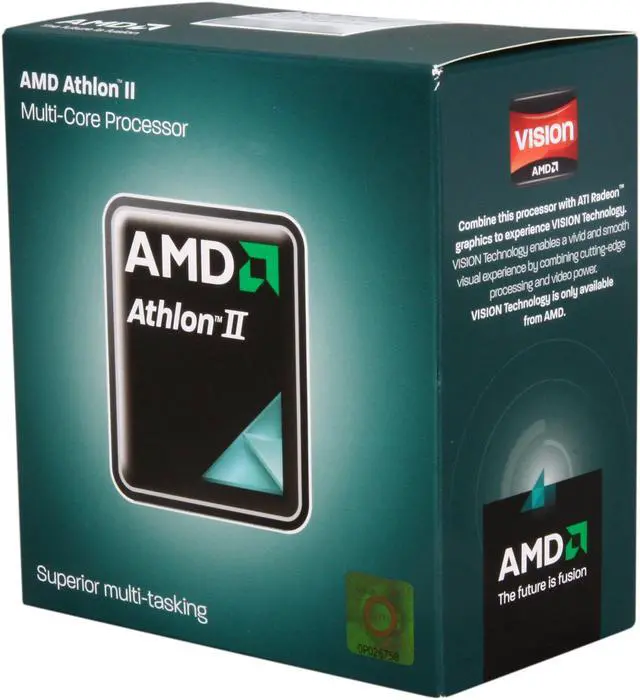

AMD Athlon II X2 245 - Athlon II X2 Regor Dual-Core 2.9 GHz Socket AM3 65W Desktop Processor - ADX245OCGMBOX
Newegg Trade-In loading
- 4000 MHz
- 45nm Regor 65W
- 2 x 1MB L2 Cache
Overview
Specs
Reviews (11)

Any questions? Our AI beta will help you find out quickly.
Try me now
Do more in less time and take advantage of true multi-core performance and true multitasking capability at a great price with the Athlon II X2 245. The Athlon II X2 245 features AMD Direct Connect Architecture for a fast, responsive PC. It is also optimized to deliver the benefits of the Microsoft Windows 7 operating system.
Energy efficiency is important to AMD, allowing you to enjoy a cool, quiet PC while saving energy and reducing heat, noise and the effect of your computer on the environment. Energy efficiency innovations include Cool’n’Quiet, AMD CoolCore and AMD Smart fetch. These technologies reduce power consumption and processor activity. You’ll experience up to 50% energy efficiency over previous AMD Athlon processors.
AMD Athlon II processors also offer support for Virtualization Technology. You can run virtual environments on one system with ease, allowing you to use legacy programs on a separate operating system. Also providing 64-bit support, this processor prepares you for the next generation of 64-bit applications. Add the convenience and power of multi-core processing and enjoy the benefits of energy efficiency with an AMD Athlon II X2 245 today!
Do more in less time and take advantage of true multi-core performance and true multitasking capability at a great price with the Athlon II X2 245. The Athlon II X2 245 features AMD Direct Connect Architecture for a fast, responsive PC. It is also optimized to deliver the benefits of the Microsoft Windows 7 operating system.
Energy efficiency is important to AMD, allowing you to enjoy a cool, quiet PC while saving energy and reducing heat, noise and the effect of your computer on the environment. Energy efficiency innovations include Cool’n’Quiet, AMD CoolCore and AMD Smart fetch. These technologies reduce power consumption and processor activity. You’ll experience up to 50% energy efficiency over previous AMD Athlon processors.
AMD Athlon II processors also offer support for Virtualization Technology. You can run virtual environments on one system with ease, allowing you to use legacy programs on a separate operating system. Also providing 64-bit support, this processor prepares you for the next generation of 64-bit applications. Add the convenience and power of multi-core processing and enjoy the benefits of energy efficiency with an AMD Athlon II X2 245 today!
Energy efficiency is important to AMD, allowing you to enjoy a cool, quiet PC while saving energy and reducing heat, noise and the effect of your computer on the environment. Energy efficiency innovations include Cool’n’Quiet, AMD CoolCore and AMD Smart fetch. These technologies reduce power consumption and processor activity. You’ll experience up to 50% energy efficiency over previous AMD Athlon processors.
AMD Athlon II processors also offer support for Virtualization Technology. You can run virtual environments on one system with ease, allowing you to use legacy programs on a separate operating system. Also providing 64-bit support, this processor prepares you for the next generation of 64-bit applications. Add the convenience and power of multi-core processing and enjoy the benefits of energy efficiency with an AMD Athlon II X2 245 today!
 AMD64 with Direct Connect ArchitectureAMD64 technology allows the Athlon II X2 245 processor to run 32-bit applications at full speed while enabling a breakthrough approach to 64-bit software applications. Moreover, all AMD Athlon II processors are built on AMD’s revolutionary Direct Connect Architecture, where the processor core is directly connected to the memory, the I/O subsystem, and any other processors in the configuration by high bandwidth HyperTransport links. This cuts down on the latency and improves overall system performance and efficiency.
 Integrated Memory ControllerThe AMD Athlon II X2 245 processor features a high-bandwidth, low-latency integrated memory controller that directly connects the processor to memory for optimum performance, low latency, and high throughput.
 HyperTransport 3.0 TechnologyHyperTransport Technology (HT or HTT) is a high-speed, low latency, point-to-point link designed to increase communication speeds between integrated circuits in computers, servers, embedded systems, and networking and telecommunications equipment. With HT 3.0 technology the AMD Athlon II X2 245 dual-core processor enjoys 4000MHz system bus speeds.
 AMD Power Management TechnologiesCPU power management technologies including AMD PowerNow! 3.0 (Cool’n’Quiet), CoolCore, and Dual Dynamic Power Management result in proven, measurable benefits for businesses and consumers, including reduced power usage, lower energy costs, and greener PC operation.
 Enhanced Virus ProtectionAll AMD processors equipped with AMD64 technology are Enhanced Virus Protection-enabled. Enhanced virus protection acts as a preventative measure causing viruses to be localized, short-lived, and non-contagious, eventually being flushed from system memory.
 AMD Virtualization (AMD-V) TechnologySilicon feature-set enhancements designed to improve the performance, reliability, and security of existing and future virtualization environments by allowing virtualized applications with direct and rapid access to their allocated memory. This helps virtualization software to run more securely and efficiently enabling a better experience when dealing with virtual systems.
 AMD64 with Direct Connect ArchitectureAMD64 technology allows the Athlon II X2 245 processor to run 32-bit applications at full speed while enabling a breakthrough approach to 64-bit software applications. Moreover, all AMD Athlon II processors are built on AMD’s revolutionary Direct Connect Architecture, where the processor core is directly connected to the memory, the I/O subsystem, and any other processors in the configuration by high bandwidth HyperTransport links. This cuts down on the latency and improves overall system performance and efficiency.
 Integrated Memory ControllerThe AMD Athlon II X2 245 processor features a high-bandwidth, low-latency integrated memory controller that directly connects the processor to memory for optimum performance, low latency, and high throughput.
 HyperTransport 3.0 TechnologyHyperTransport Technology (HT or HTT) is a high-speed, low latency, point-to-point link designed to increase communication speeds between integrated circuits in computers, servers, embedded systems, and networking and telecommunications equipment. With HT 3.0 technology the AMD Athlon II X2 245 dual-core processor enjoys 4000MHz system bus speeds.
 AMD Power Management TechnologiesCPU power management technologies including AMD PowerNow! 3.0 (Cool’n’Quiet), CoolCore, and Dual Dynamic Power Management result in proven, measurable benefits for businesses and consumers, including reduced power usage, lower energy costs, and greener PC operation.
 Enhanced Virus ProtectionAll AMD processors equipped with AMD64 technology are Enhanced Virus Protection-enabled. Enhanced virus protection acts as a preventative measure causing viruses to be localized, short-lived, and non-contagious, eventually being flushed from system memory.
 AMD Virtualization (AMD-V) TechnologySilicon feature-set enhancements designed to improve the performance, reliability, and security of existing and future virtualization environments by allowing virtualized applications with direct and rapid access to their allocated memory. This helps virtualization software to run more securely and efficiently enabling a better experience when dealing with virtual systems.
Warranty & Returns
Warranty, Returns, And Additional Information
Warranty
- Limited Warranty period (parts): 3 years
- Limited Warranty period (labor): 3 years
- Read full details
Return Policies
- Return for refund within: Non-refundable
- Return for replacement within: 30 days
- This item is covered by Newegg.com's Replacement Only Return Policy.
- Read full return policy for details.
Manufacturer Contact Info
- Manufacturer Product Page
- Manufacturer Website
- Support Phone: 1-408-749-3060
- Support Website
- View other products from AMD
LOADING...