
Introduction
The 1080p resolution remains the sweet spot for PC gaming in 2026. With a massive library of games optimized for this resolution and a huge range of monitors available at 24 to 27 inches, 1080p gaming delivers sharp visuals, high frame rates, and excellent performance per dollar. Choosing the right GPU for 1080p, however, has never been more competitive — both NVIDIA and AMD have released compelling options across every price tier.
Whether you’re building your first gaming rig, upgrading from an older card, or simply looking for the best frames per dollar, this guide breaks down the top graphics cards for 1080p gaming in 2026, with honest picks for every budget.
Why 1080p Still Makes Sense in 2026
Despite the growing popularity of 1440p and 4K monitors, 1080p gaming continues to dominate for a simple reason: value. At 1920×1080 pixels, even a mid-range GPU can push well above 100 FPS in demanding titles, making games feel buttery smooth on a 144Hz or 165Hz monitor. You do not need to spend $600 or more to enjoy a premium gaming experience at 1080p.
That said, not all 1080p GPUs are created equal. The difference between a $150 card and a $400 card shows up clearly in how well a GPU handles newer AAA titles, ray tracing effects, and AI-upscaling features like DLSS 4 and FSR 4. Knowing exactly what you need before you buy will save you from both overspending and underspending.
What to Look For in a 1080p GPU
Before comparing specific cards, here are the key specs to pay attention to when shopping for a 1080p gaming GPU in 2026:
VRAM (Video Memory): For 1080p gaming, 8GB of VRAM is the baseline in 2026. Some newer games, especially with high-texture packs enabled, can push past this limit. 12GB VRAM gives you extra headroom for texture-heavy games and light modding.
TDP and Power Efficiency: A GPU’s thermal design power affects how much heat it generates and how much electricity it consumes. In 2026, efficiency has improved dramatically across both NVIDIA and AMD lineups, but budget cards can still run hot under heavy load. Check your power supply headroom before purchasing.
Ray Tracing and Upscaling Support: NVIDIA’s DLSS 4 and AMD’s FSR 4 are both mature technologies that can significantly boost frame rates with minimal quality loss. Make sure your chosen card supports at least one of these for future-proofing.
Display Output and Connectivity: For high-refresh-rate 1080p gaming, confirm the card has DisplayPort 2.1 or HDMI 2.1 output. Most modern cards do, but double-check for older budget options still being sold.
Top GPU Picks for 1080p Gaming in 2026
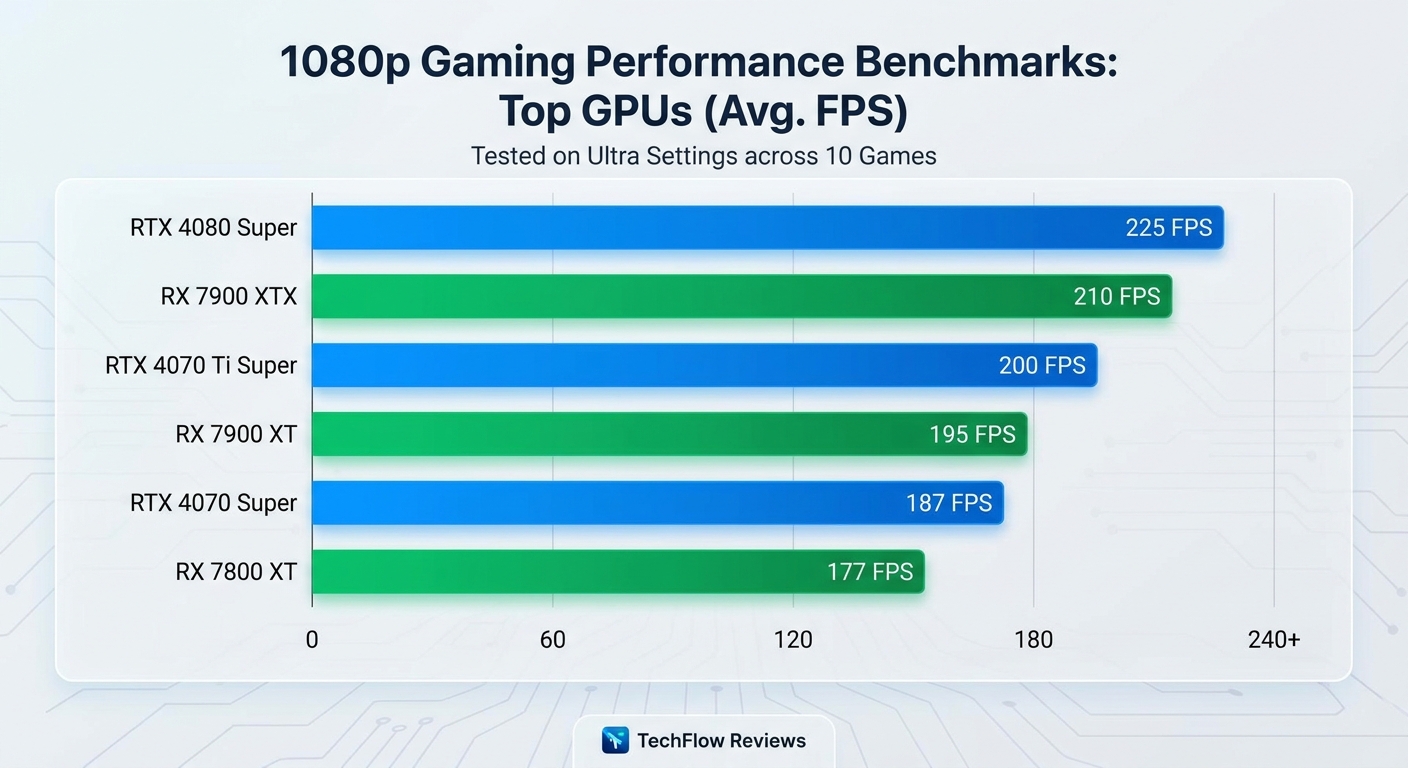
| GPU | VRAM | Avg 1080p FPS (AAA) | TDP |
|---|---|---|---|
| NVIDIA GeForce RTX 4060 | 8GB GDDR6 | ~115 FPS | 115W |
| AMD Radeon RX 7600 XT | 16GB GDDR6 | ~110 FPS | 165W |
| NVIDIA GeForce RTX 5060 | 8GB GDDR7 | ~140 FPS | 150W |
| AMD Radeon RX 7700 | 12GB GDDR6 | ~125 FPS | 170W |
| NVIDIA GeForce RTX 4060 Ti | 8GB / 16GB GDDR6 | ~130 FPS | 160W |
Detailed Picks
Best Overall: NVIDIA GeForce RTX 5060
The RTX 5060 is NVIDIA’s most compelling mainstream GPU in years. Built on the Blackwell architecture, it brings significant improvements in rasterization, ray tracing, and AI performance over the previous generation RTX 4060. With DLSS 4 Multi Frame Generation support, it can nearly double effective frame rates in supported titles, making 1080p gaming feel effortless. The 8GB GDDR7 frame buffer performs noticeably better than the 8GB GDDR6 on older cards due to higher bandwidth.
Shop NVIDIA GeForce RTX 5060 on Newegg
Best Value: AMD Radeon RX 7600 XT
AMD’s RX 7600 XT stands out with its generous 16GB VRAM buffer, which is twice what most NVIDIA competitors offer at this price. While it slightly trails the RTX 4060 in ray tracing performance, it more than holds its own in rasterization workloads and has excellent FSR 4 support. For gamers who run modded games, simulation titles, or plan to stream their gameplay, the extra VRAM is a meaningful advantage.
Shop AMD Radeon RX 7600 XT on Newegg
Best Budget Pick: NVIDIA GeForce RTX 4060
The RTX 4060 might be one generation old now, but it remains one of the most efficient GPUs available for 1080p gaming. At just 115W TDP, it sips power while delivering smooth performance in virtually every modern game at 1080p. Its DLSS 3 support also remains highly relevant, and many games have yet to even add DLSS 4 patches. If you find this card discounted, it is an outstanding budget pick.
Shop NVIDIA GeForce RTX 4060 on Newegg
Best for VRAM and Future-Proofing: AMD Radeon RX 7700
The RX 7700 bridges the gap between budget and mid-range, offering 12GB of GDDR6 memory alongside solid 1080p and even capable 1440p performance. For gamers who like to max out texture settings or keep their GPU for several years, the additional VRAM headroom makes this a smart investment. It also handles content creation workloads better than pure gaming cards at this price.
Shop AMD Radeon RX 7700 on Newegg
Final Verdict
For most 1080p gamers in 2026, the NVIDIA GeForce RTX 5060 is the clear best-in-class option if you can stretch to the $380 price point. Its Blackwell architecture, GDDR7 memory, and DLSS 4 support give it a meaningful edge for the next several years. If budget is the priority, the AMD RX 7600 XT’s 16GB VRAM and competitive pricing make it one of the best value propositions in the GPU market today. Either way, 1080p gaming in 2026 has never looked or felt better.
Read More
- TechSpot GPU Hierarchy 2026 — A comprehensive ranking of every current GPU by performance tier, updated regularly with new benchmark data.
- GamersNexus GPU Reviews — In-depth thermal, noise, and performance reviews of the latest NVIDIA and AMD graphics cards.
- Tom’s Hardware: Best Graphics Cards — Expert recommendations across budget, mid-range, and high-end GPU tiers for 2026.
- NVIDIA Official RTX 5060 Product Page — Full specs, DLSS 4 details, and partner card listings direct from NVIDIA.
- Shop All Gaming GPUs on Newegg — Browse the full selection of gaming graphics cards with filters for VRAM, price, and brand.
Related Posts
- Best GPUs for 1440p Gaming in 2026: Top Picks for Every Budget
- RTX 5000 vs. RX 9000 Series: Which GPU Should You Buy in 2026?
- Back to School: Webcams, Headsets and Mics for Online Classes
- Best NVMe SSDs for Students and Creators in 2026
- Back to School: The Best Tablets for Note-Taking and Study
Frequently Asked Questions
Common questions about choosing the best GPU for 1080p gaming in 2026.