
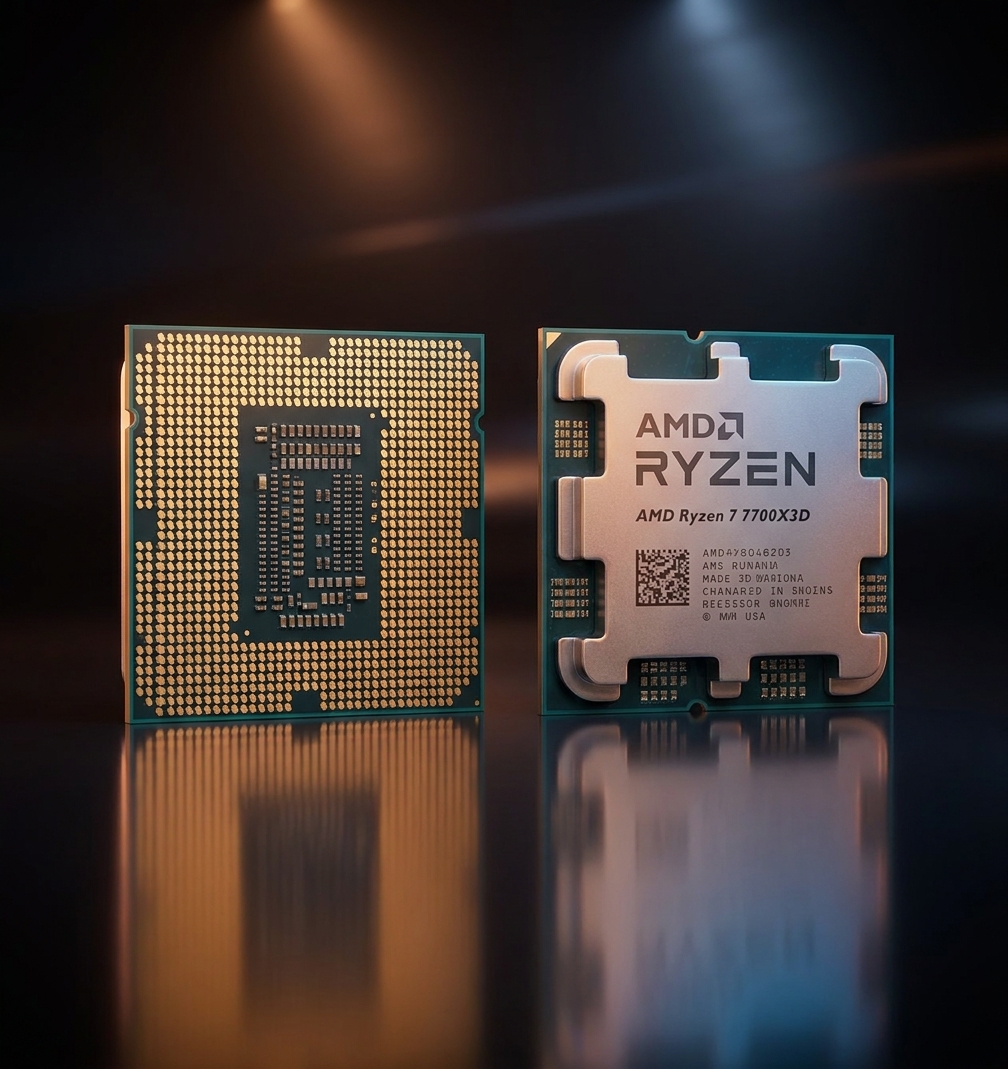
AMD’s 3D V-Cache technology made its desktop debut with the Ryzen 7 5800X3D in early 2022, and the result was a revelation: a processor that beat chips with far higher clock speeds in gaming simply by carrying three times as much L3 cache. Four years later, AMD has brought that same technology to a new era with the Ryzen 7 7700X3D on the AM5 platform. Both processors share the same 8-core configuration, the same 96MB L3 cache size, and the same core mission — to win at gaming through cache rather than clock speed. But almost everything else is different.
This head-to-head breaks down exactly what separates the 5800X3D and 7700X3D so you can decide which is right for your build.
The Contenders
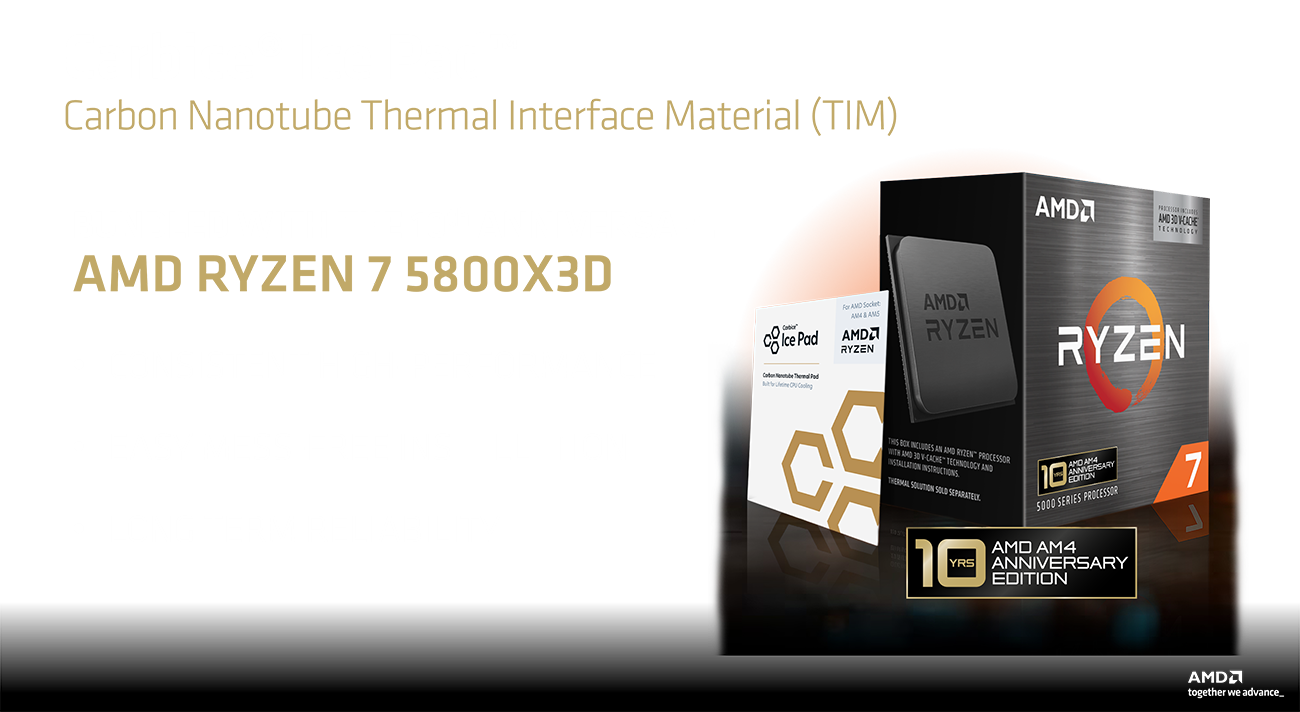
The Ryzen 7 5800X3D 10th Anniversary Edition is the definitive capstone of AMD’s AM4 platform. Built on Zen 3 architecture and a 7nm process, it pairs a proven gaming core design with 96MB of 3D V-Cache. Available starting June 25 at $349 MSRP, bundled with a Carbice Ice Pad thermal interface material.
The Ryzen 7 7700X3D is AMD’s newest V-Cache entry point for the AM5 platform. Built on Zen 4 architecture and a 5nm process, it carries the same 96MB of L3 cache but adds DDR5 memory, PCIe 5.0, and integrated Radeon graphics. Available starting July 16 at $329 MSRP.
AMD Ryzen 7 5800X3D 10th Anniversary Edition on Newegg
Side-by-Side Specifications
| Specification | Ryzen 7 5800X3D (10th Anniv.) | Ryzen 7 7700X3D |
|---|---|---|
| Architecture | Zen 3 | Zen 4 |
| Process Node | 7nm | 5nm |
| Socket | AM4 | AM5 |
| Cores / Threads | 8C / 16T | 8C / 16T |
| Base Clock | 3.4 GHz | 4.0 GHz |
| Boost Clock | Up to 4.5 GHz | Up to 4.5 GHz |
| L3 Cache | 96MB | 96MB |
| L2 Cache | 4MB | 8MB |
| TDP | 105W | 120W |
| Memory Support | DDR4-3200 | DDR5-5200 |
| Integrated Graphics | None | AMD Radeon |
| Launch MSRP | $349 | $329 |
Platform — AM4 vs AM5
The 5800X3D drops into any AM4 motherboard running A520, B450, B550, X470, or X570 chipsets with a BIOS update. If you already own an AM4 system, upgrading requires nothing more than the chip itself. The 7700X3D requires an AM5 motherboard (B650, B650E, X670, X670E, X870, X870E, B840, or B850) and DDR5 memory. At Computex 2026, AMD confirmed AM5 support through 2029 — the same runway that made AM4 so valuable.
Winner by Category
Gaming performance: Both carry 96MB L3 cache. The 7700X3D’s Zen 4 IPC and higher base clock give a slight edge in IPC-limited scenarios. Slight edge: 7700X3D.
Power efficiency: 5nm vs 7nm — the 7700X3D is more efficient per transistor. 7700X3D wins.
Platform upgrade path: 7700X3D enters AM5 with support through 2029. Best for new builds. 5800X3D wins if you already own AM4.
Out-of-box extras: 5800X3D bundles Carbice Ice Pad; 7700X3D adds integrated Radeon graphics. Depends on your needs.
Price: 7700X3D at $329 vs 5800X3D at $349. 7700X3D wins on launch price.
Which Should You Buy?
Buy the 5800X3D 10th Anniversary Edition if you are an existing AM4 owner looking to maximize gaming performance on your current motherboard. It is the most cost-effective upgrade for any AM4 system.
Buy the 7700X3D if you are building a new system or transitioning to AM5. Zen 4, 5nm, DDR5, PCIe 5.0, integrated graphics, and AMD’s confirmed AM5 support through 2029 make it the forward-looking choice.
Shop Ryzen 7 5800X3D on Newegg
Shop Ryzen 7 7700X3D on Newegg
Related Posts
- AMD Ryzen 7 5800X3D Is Back: 10th Anniversary Edition Returns to Newegg
- Best Power Supplies in 2026
- Best Gaming Laptops in 2026
- How Much Memory an AM5 Build Actually Needs in 2026
- CL36, CL30, CL28 or CL26? Picking a DDR5-6000 Latency Tier
Frequently Asked Questions
Answers to common questions when comparing the Ryzen 7 5800X3D and 7700X3D.