
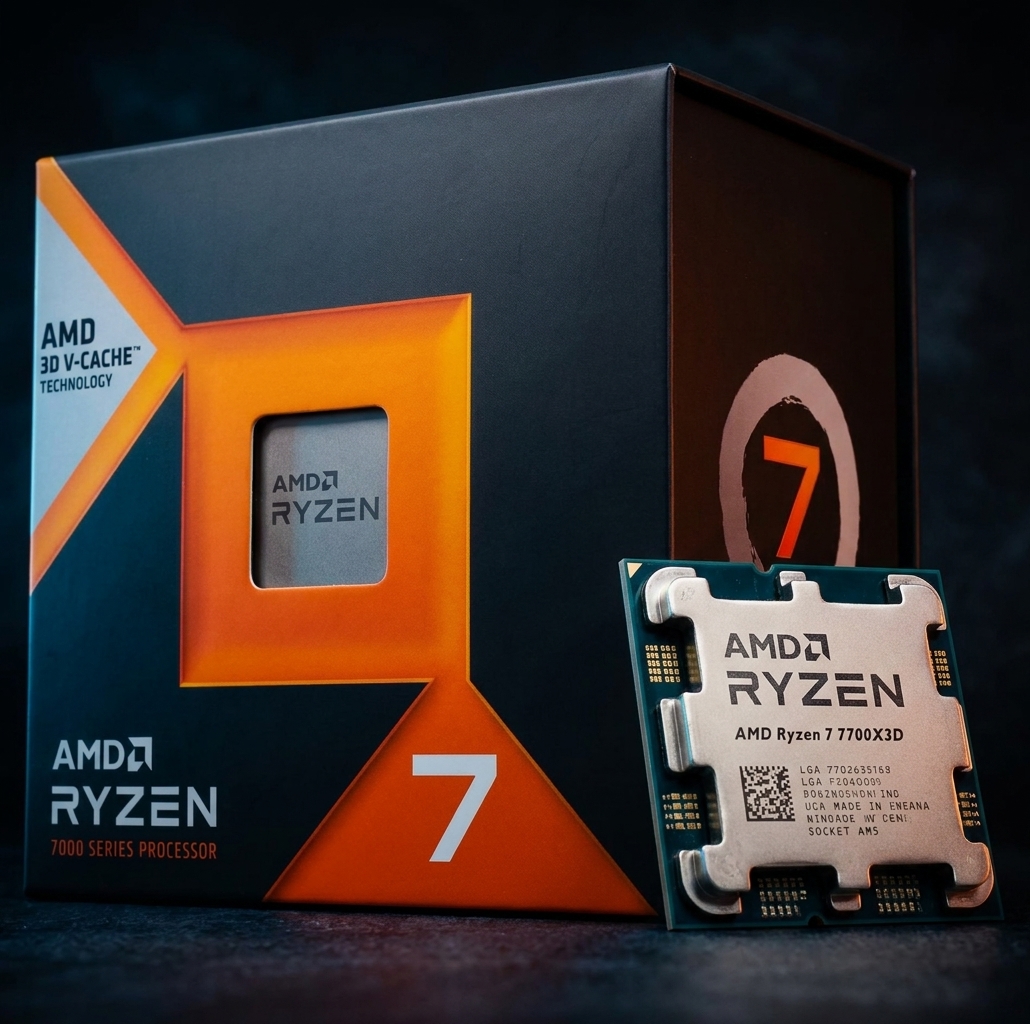
At Computex 2026, AMD made two announcements that, taken together, tell the full story of what 3D V-Cache technology has become. The Ryzen 7 5800X3D 10th Anniversary Edition celebrates the processor that started it all. And the Ryzen 7 7700X3D marks where that technology stands today: refined, generationally advanced, and now available on AMD’s next-decade AM5 platform.
This guide traces the complete journey from the 5800X3D to the 7700X3D: what changed architecturally, what the platform shift means, and how to think about upgrading if you are a V-Cache gamer.
Background: What AMD’s 3D V-Cache Technology Does
AMD’s 3D V-Cache takes L3 cache a step further by physically stacking an additional SRAM die directly on top of the CPU die using through-silicon vias — microscopic vertical connectors. This adds a large amount of L3 cache at extremely high bandwidth and low latency, because the data path is measured in microns rather than millimeters. In gaming terms, the CPU can hold more of a game’s working data in fast, on-chip cache, reducing stutter and increasing average FPS in CPU-limited titles.
Step 1: The 5800X3D — Where It All Started (2022)
The Ryzen 7 5800X3D launched in April 2022 as the world’s first desktop processor with 3D stacked cache. Built on Zen 3 at 7nm, 8 cores, 16 threads, 3.4 GHz base, boost up to 4.5 GHz. Where a standard Ryzen 7 5800X carried 32MB of L3, the 5800X3D carried 96MB — 3x increase through the stacked SRAM layer. It ran on Socket AM4, which at launch had already been in the market for six years. Millions of existing AM4 owners could drop the chip into their current motherboard, update the BIOS, and immediately access cache-stacking gaming performance with no other hardware change.
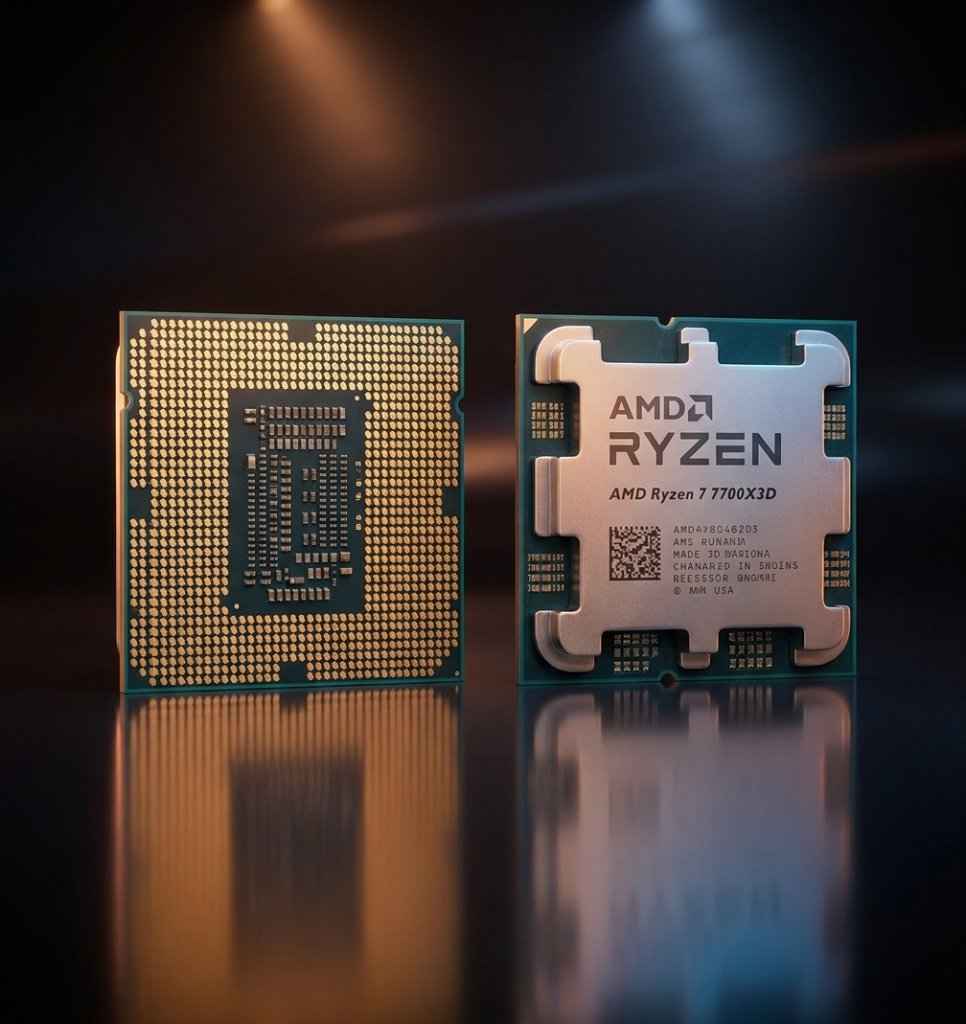
Step 2: What Changed in Four Years
Zen 4 architecture. The 7700X3D runs on Zen 4, improving IPC over Zen 3. Combined with a higher base clock (4.0 GHz vs 3.4 GHz), it accomplishes more per cycle.
5nm manufacturing. Moving from 7nm to 5nm allows higher speeds with less heat. The 7700X3D TDP is 120W vs 5800X3D’s 105W, but 5nm extracts substantially more performance per watt.
More L2 cache. 8MB vs 4MB — doubles the fast intermediate cache layer. Total cache grows from 100MB to 104MB.
DDR5 memory. The 7700X3D on AM5 uses DDR5-5200, providing higher bandwidth than DDR4-3200. When the processor does fetch from main memory, the DDR5 pathway is faster.
Integrated graphics. The 5800X3D has no iGPU. The 7700X3D includes AMD Radeon integrated graphics at 2200 MHz.
PCIe 5.0. AM5 supports PCIe 5.0 for graphics and NVMe storage, with sequential read speeds exceeding 12,000 MB/s.
Step 3: What Stayed the Same
Both processors carry 96MB of L3 cache through 3D stacked SRAM. Both are 8-core, 16-thread designs — AMD’s V-Cache strategy has remained focused on the single-CCD sweet spot for gaming. Both share the same 4.5 GHz maximum boost clock. And both use AMD’s 3D V-Cache bonding technology — the same fundamental process that made the 5800X3D remarkable is still at the heart of the 7700X3D.

Step 4: The Platform Transition — AM4 to AM5
The most significant difference is the platforms they represent. The 5800X3D is the final, highest-performance processor AMD released for AM4 in the mainstream segment. At Computex 2026, AMD celebrated AM4’s 10th anniversary and confirmed the 5800X3D 10th Anniversary Edition marks a deliberate bookend to the platform’s legacy.
The 7700X3D enters AM5. At the same event, AMD confirmed AM5 support through 2029 — meaning future Ryzen generations will continue to work on the same socket with a BIOS update, just as AM4 did for over six years. Someone building an AM5 system around the 7700X3D today is buying into a platform with at least three more years of official upgrade support.
Where to Get Them
Both available on Newegg. The 5800X3D 10th Anniversary Edition launches June 25 at $349 MSRP, bundled with Carbice Ice Pad. The 7700X3D launches July 16 at $329 MSRP.
AMD Ryzen 7 5800X3D 10th Anniversary Edition on Newegg
The V-Cache Story in One Line
The 5800X3D proved that cache beats clocks. The 7700X3D takes that proof, adds four years of architectural progress, and plants it in a platform that will keep delivering for years to come.

Related Posts
- Smart PC Upgrades with AI: Your Questions About Newegg’s PC Upgrader, Answered
- Build Your First Home NAS with Newegg’s NAS Builder: Three Real Scenarios
- How to Use Newegg’s Custom PC Builder: From Blank Page to Complete Build
- Why 8-Core X3D CPUs Are Still the Gaming Sweet Spot in 2026
- AMD Ryzen 7 7700X3D Preview: Why This AM5 Gaming CPU Is Worth Watching
Frequently Asked Questions
Answers to common questions about the evolution of AMD's 3D V-Cache technology.