
Someone posted a thread this week about an AIO pump cycling between zero and six hundred RPM every few seconds, with the CPU idling at eighty degrees in a large case with good airflow. The replies split immediately into two camps, and the second camp was not really trying to solve the problem. They were making an argument about liquid cooling in general.
I have used both for years. The honest version is that a good air cooler and a good 360mm unit land close enough on temperature that the decision comes down to other things entirely: how much you mind pump noise, whether the cooler fits, and how many moving parts you want in a machine you expect to keep for six years.
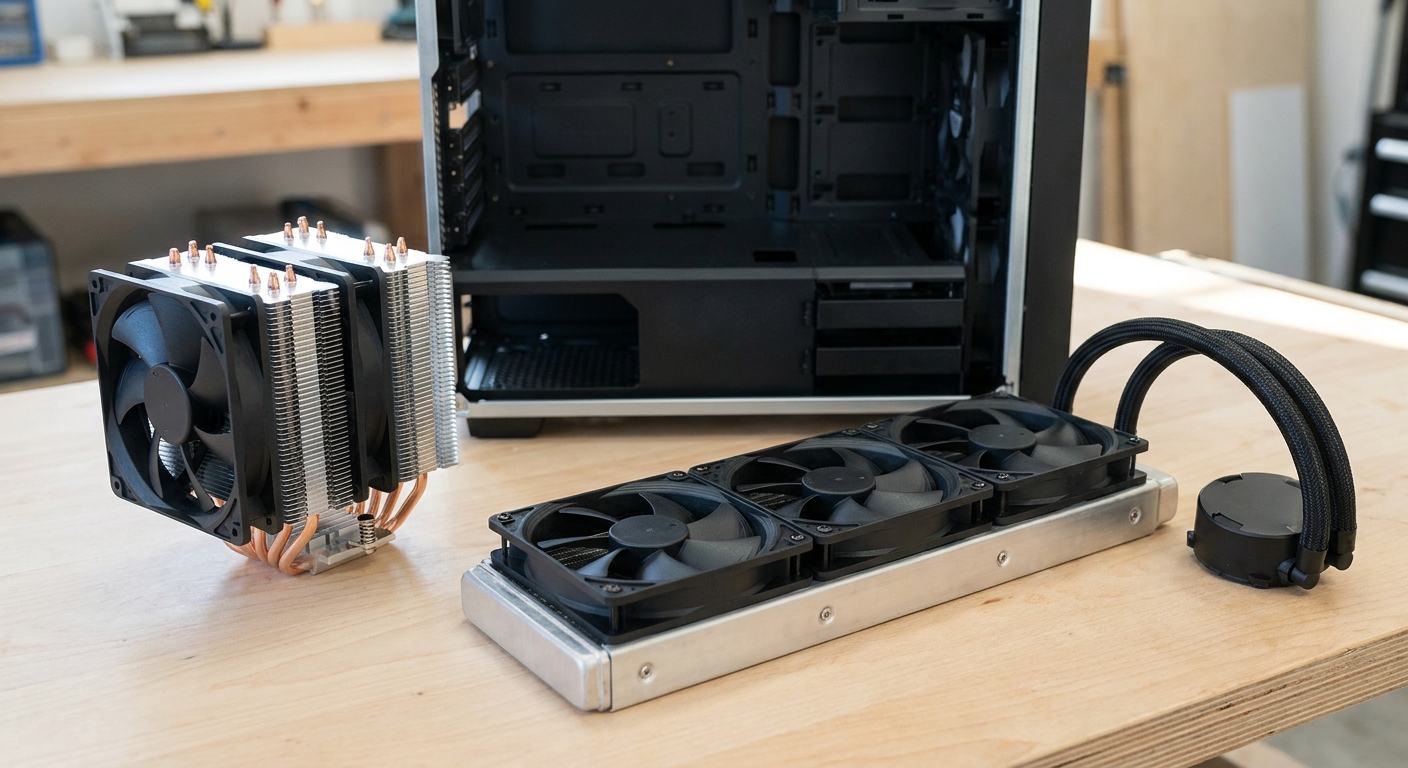
The Two Camps
Air. A block of aluminium fins, some copper heat pipes and one or two fans. Nothing circulates, nothing can leak, and the only failure mode is a fan bearing wearing out after many years, which you can replace for very little. The cost is height and bulk: these coolers are tall, they crowd the first memory slot on some boards, and they make the inside of the case harder to work in.
Liquid. A pump, a radiator and usually three fans. The radiator moves heat out to a place with more room, so you get more surface area than a tower will ever fit, and the area around the socket stays open. The cost is that a pump is a moving part with a lifespan, and when it misbehaves, it does so in confusing ways.
Both of the sub-two-hundred-watt processors most people run are comfortably handled by either.
Side by Side
| Cooler | Type | Key hardware | Fans | Height / radiator |
|---|---|---|---|---|
| Noctua NH-D15 | Air, dual tower | SSO2 bearing | 2 x 140mm PWM | 165 mm tall |
| Cooler Master Hyper 620S | Air, dual tower | 6 direct-contact heat pipes | 120mm PWM | 154 mm tall |
| MONTECH NX600 ARGB | Air, dual tower | 6 heat pipes, soldered copper base | 2000 RPM PWM | 3.17 lb |
| Cooler Master Hyper 212 Black | Air, single tower | 4 copper heat pipes | 120mm PWM | 152 mm tall |
| MSI MAG CORELIQUID A15 360 | Liquid | Pump 3400 RPM | 3 x 120mm ARGB PWM | 360 mm radiator |
| Cooler Master Atmos II 360 VRM | Liquid | Dual-chamber pump, VRM fan | 3 x 120mm ARGB PWM | 394 mm radiator |
| MSI MPG CORELIQUID P13 360 | Liquid | Pump 3400 RPM, 2.1″ LCD | 3 x 120mm ARGB PWM | 394 x 119.6 x 27 mm |
| GAMDIAS CHIONE E4 360 V2 | Liquid | Pump 2600 RPM, hydraulic bearing | 3 x 120mm PWM | 397 x 120 x 27 mm |
The Air Case
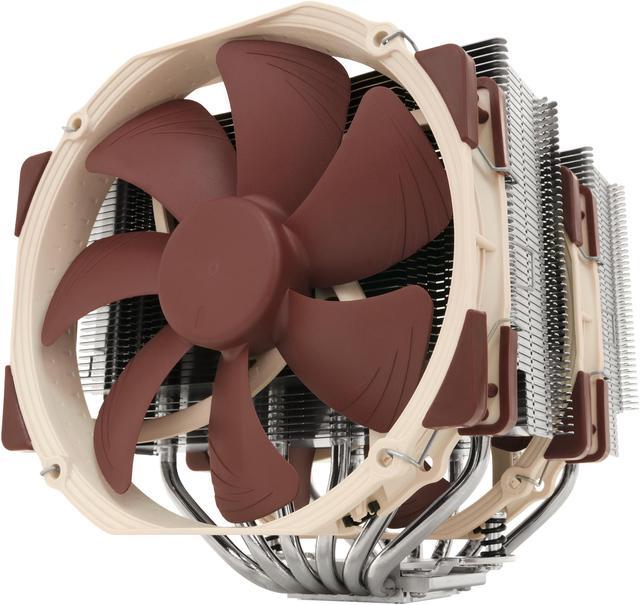
The Noctua NH-D15 is still the reference point. Two 140mm NF-A15 PWM fans on SSO2 bearings, a heatsink measuring 160 x 150 x 135mm, 165mm total height, and 1,320 grams of metal, with brackets for LGA1851, LGA1700, LGA1200 and the 115x sockets alongside AM5 and AM4. The ugly colours are a running joke and the cooler does not care.
The Cooler Master Hyper 620S is the one I recommend more often, because 154mm fits cases the Noctua does not. It is a dual-tower design with six direct-contact copper heat pipes, a 120mm PWM fan on a rifle bearing, ARGB sync, and the same broad socket support from AM4 and AM5 through LGA1851.
The MONTECH NX600 ARGB takes the same dual-tower shape with six heat pipes and a soldered copper base, a 2000 RPM PWM fan rated at 85 CFM, and a top cover that hides the fin stack. At 3.17 lb it is in NH-D15 territory for weight.
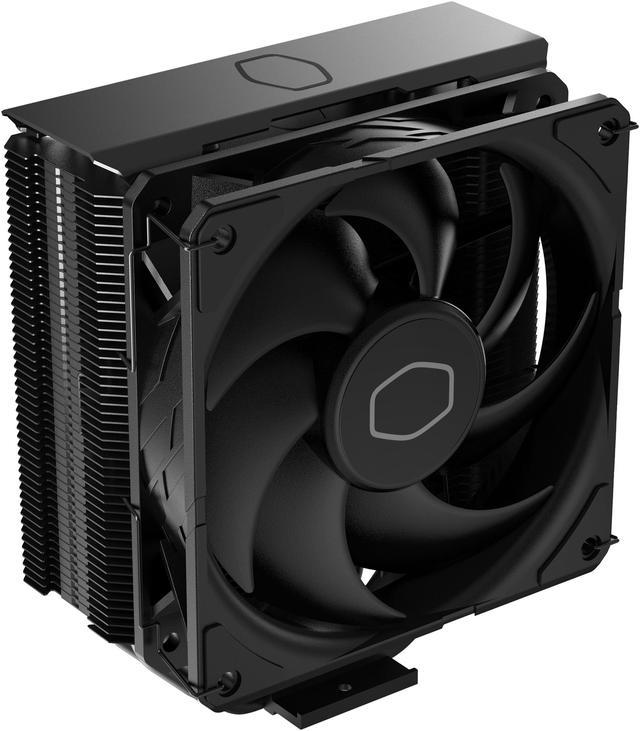
And then the Cooler Master Hyper 212 Black, which has outlived several generations of argument. Single tower, four copper heat pipes, one 120mm PWM fan on a loop dynamic bearing, 152mm tall, 1.54 lb. It is not the cooler for a 200W processor under sustained load, and it is more than enough for most of what people actually build.
The Liquid Case
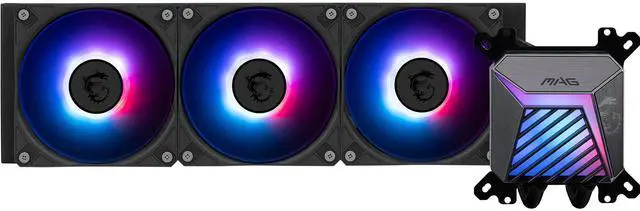
The MSI MAG CORELIQUID A15 360 is the straightforward one: a 360mm radiator, three 120mm ARGB PWM fans on rifle bearings, a pump rated at 3400 RPM, an EZ Connect cable arrangement and a bracket covering LGA1700, LGA1851, AM5 and AM4. No screen, no gimmicks.
The Cooler Master Atmos II 360 VRM adds something genuinely useful rather than decorative: a small fan on the pump block aimed at the motherboard’s VRM area, which is otherwise starved of airflow in a liquid-cooled build. Dual-chamber pump at 3400 RPM, a 394mm radiator, three ARGB PWM fans on loop dynamic bearings.
The MSI MPG CORELIQUID P13 360 is the same idea with a 2.1-inch IPS screen on the block, a 394 x 119.6 x 27mm radiator and a pump at 3400 RPM plus or minus 300. The GAMDIAS CHIONE E4 360 V2 runs its pump considerably slower at 2600 RPM on a hydraulic bearing, with a 397 x 120 x 27mm radiator and a digital display, and a slower pump is not a bad thing if noise is what you care about.
Winner by Category
A build you want to stop thinking about. Air, and specifically the Hyper 620S or the NH-D15. Fewer parts that can fail in a way you have to diagnose.
A case where the cooler will not fit. Liquid, obviously, but check the radiator length against your case’s top or front clearance first. A 394mm radiator does not go everywhere a “360mm” label suggests.
Quiet. This one surprises people: a large air cooler running slow fans is usually quieter than a 360mm unit, because the pump makes noise the air cooler simply does not have. If you go liquid and quiet matters, the CHIONE E4’s 2600 RPM pump is the gentler starting point.
A motherboard with hot VRMs. Atmos II 360 VRM. That little fan solves a real problem that liquid cooling creates.
Modest processor, sensible budget. Hyper 212 Black, and spend the difference somewhere it matters.
On the thread that started this: a pump cycling between zero and six hundred RPM is almost always a fan curve set to stop at low temperature, not a failing pump. Set the header to a fixed 100 percent and see if it settles. The current range is in Newegg’s AM5 CPU air cooler listings.
Frequently Asked Questions
Does a 360mm AIO cool better than a big air cooler? Under sustained all-core load, usually by a small margin, because a 360mm radiator has more surface area than any tower can fit. In gaming, where the processor is rarely pinned, the two land close enough that you would need a thermometer to tell them apart. Buy on fit, noise and maintenance rather than on peak temperature.
Should I plug the AIO pump into CPU_FAN or a dedicated header? Use the header your motherboard designates for a pump, commonly labelled CPU_OPT, AIO_PUMP or PUMP_FAN, and set it to full speed rather than a temperature curve. A pump set to a fan curve will slow down and speed up with load, which is the behaviour people mistake for a defect. Fan headers set to stop below a temperature threshold cause the same confusion.
How tall a cooler will fit in my case? Your case lists a maximum CPU cooler height. The coolers here run from 152mm on the Hyper 212 Black to 165mm on the Noctua NH-D15, which is enough of a spread to matter in a compact mid-tower. Memory clearance is the other check, since a wide dual-tower cooler can overhang the first DIMM slot.
Do air coolers need maintenance? Only dust removal. There is no fluid to lose and nothing to re-seat, and the fans are standard sizes you can replace individually years later. Liquid coolers are sealed units, so when the pump eventually fails the whole assembly is replaced rather than repaired.
Does liquid cooling leave the VRMs without airflow? It can. A tower cooler blows air across the area around the socket as a side effect; a liquid block does not. On a board with a heavy processor and modest VRM heatsinks that is worth thinking about, which is exactly the gap the Cooler Master Atmos II 360 VRM’s extra block fan is designed to fill.
Read More
- Tom’s Hardware: Cooling Reviews and Buying Guides — Tested air and liquid coolers with thermal and acoustic measurements.
- TechPowerUp: Noctua NH-D15 Family Review — Measured thermals and noise for Noctua’s dual-tower design.
- Noctua: NH-D15 — Manufacturer specifications including socket compatibility, dimensions and clearance notes.
- Cooler Master: Hyper 212 Black — Official product page with heat pipe layout and mounting details.
- Newegg: AM5 CPU Air Coolers — Compare current coolers by height, fan size and socket support.