"What is the difference between AMD and Intel motherboards?" It's the question at the center of every new PC build decision — and in 2026, the answer has more nuance than a simple brand comparison. AMD and Intel motherboards use entirely different socket designs, chipset ecosystems, and platform philosophies. Some differences are visible on the spec sheet; others only matter when your workload pushes the platform. Here is a complete technical comparison of what separates these two ecosystems in 2026.
The Socket: Where Compatibility Begins and Ends
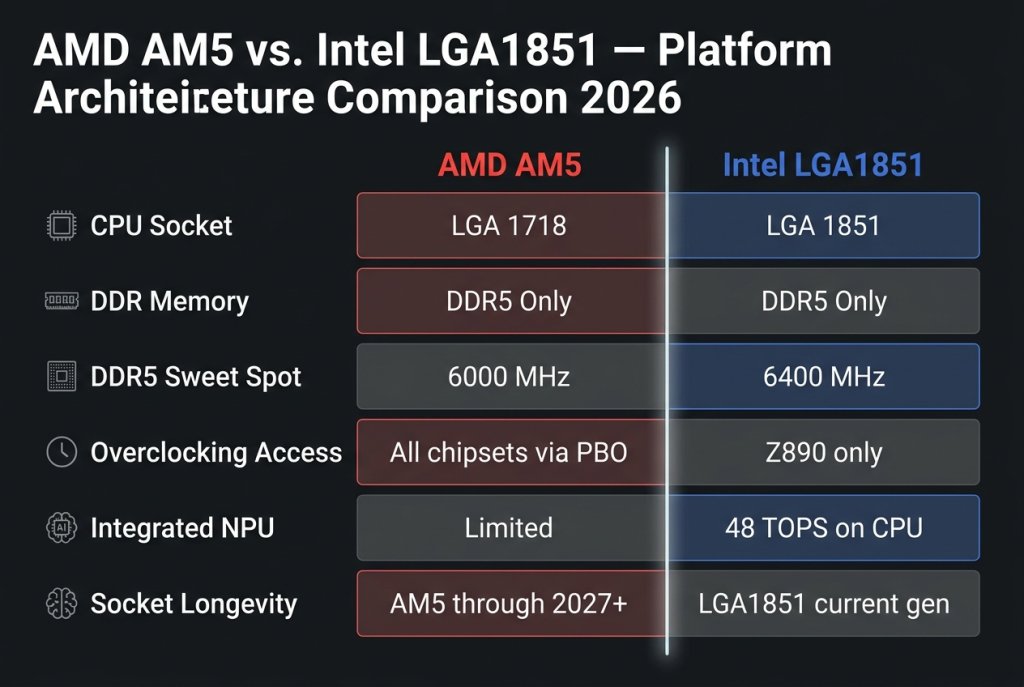
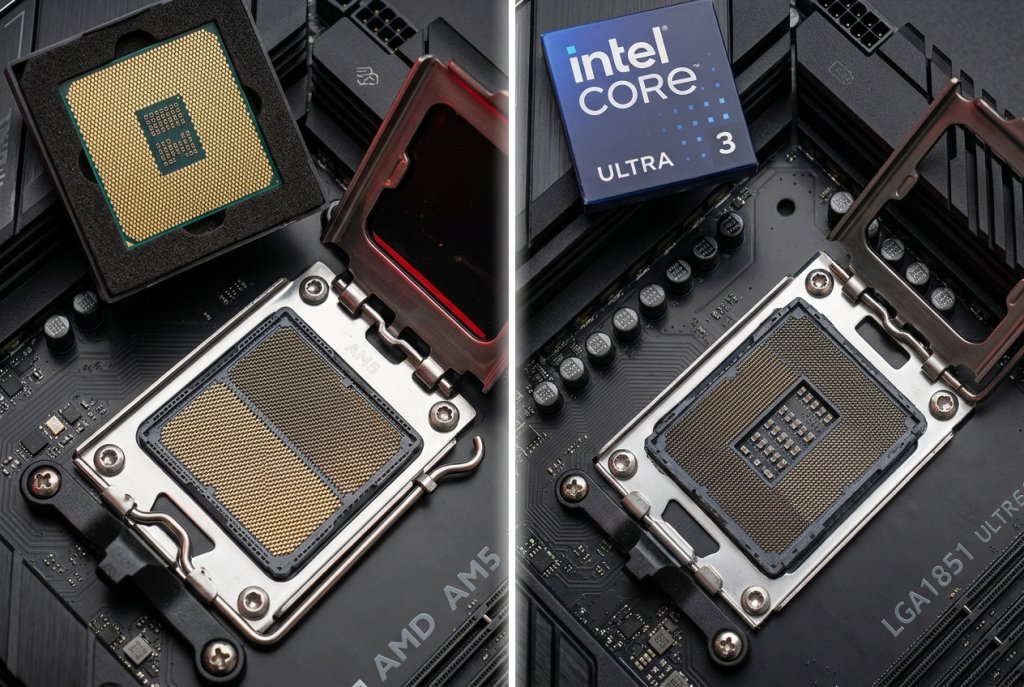
The most fundamental difference between AMD and Intel motherboards is the CPU socket. AMD's current desktop platform uses the AM5 socket — a land grid array (LGA) design with 1718 contacts, shared across all Zen 4 and Zen 5 desktop processors from the Ryzen 7000 and Ryzen 9000 series. AMD committed publicly to AM5 socket support through at least 2027, meaning a board you buy today should remain compatible with future Zen 6 desktop CPUs.
Intel's current desktop platform uses LGA1851, introduced with the Core Ultra 200S series (Arrow Lake). It follows Intel's historical pattern of new sockets arriving with new CPU generations — LGA1851 succeeds LGA1700, which succeeded LGA1200. This pattern means Intel platform upgrades typically require a new motherboard alongside the CPU, limiting in-platform upgrade flexibility compared to AMD's multi-generation AM5 commitment.
For buyers planning a CPU upgrade within the next two to three years without replacing the motherboard, AMD's AM5 platform has a clearer upgrade path in 2026.
 Chipset Hierarchy: How AMD and Intel Organize Their Platforms
Both AMD and Intel organize their motherboard chipsets into performance tiers — enthusiast, mainstream, and budget — but the specific capabilities and naming differ between platforms.
AMD AM5 Chipset Tiers (2026):
| Chipset | Target Tier | PCIe 5.0 Lanes | USB4 | Overclocking | Full PCIe 5.0 NVMe |
|---|---|---|---|---|---|
| X870E | Enthusiast flagship | Maximum | Yes | Yes | Yes (×2 slots) |
| X870 | Mainstream performance | High | Yes | Yes | Yes |
| B850 | Mid-range gaming | Moderate | Limited | Yes (via PBO) | Yes |
| B650 | Entry gaming | Basic | No | Yes (via PBO) | One slot |
Intel LGA1851 Chipset Tiers (2026):
| Chipset | Target Tier | PCIe 5.0 GPU Slot | Overclocking (K-series) | DDR5 Speed | USB4 |
|---|---|---|---|---|---|
| Z890 | Enthusiast / OC | Yes | Yes (full multiplier) | Up to DDR5-8000+ | Yes |
| B860 | Mainstream gaming | Yes | No | Up to DDR5-6400 | Limited |
| H810 | Budget | Yes | No | Up to DDR5-5600 | No |
The key distinction: Intel restricts CPU multiplier overclocking to Z890-series motherboards exclusively, while AMD allows its Precision Boost Overdrive (PBO) tuning on all AM5 chipsets — including the mid-range B850 and B650. A budget AMD build can still tune power limits and boost behavior without needing a premium chipset.
 Memory Platform: DDR5 on Both — But Different Sweet Spots
Both AM5 and LGA1851 are DDR5-exclusive platforms in 2026. Neither supports DDR4. However, the optimal DDR5 speed differs between them.
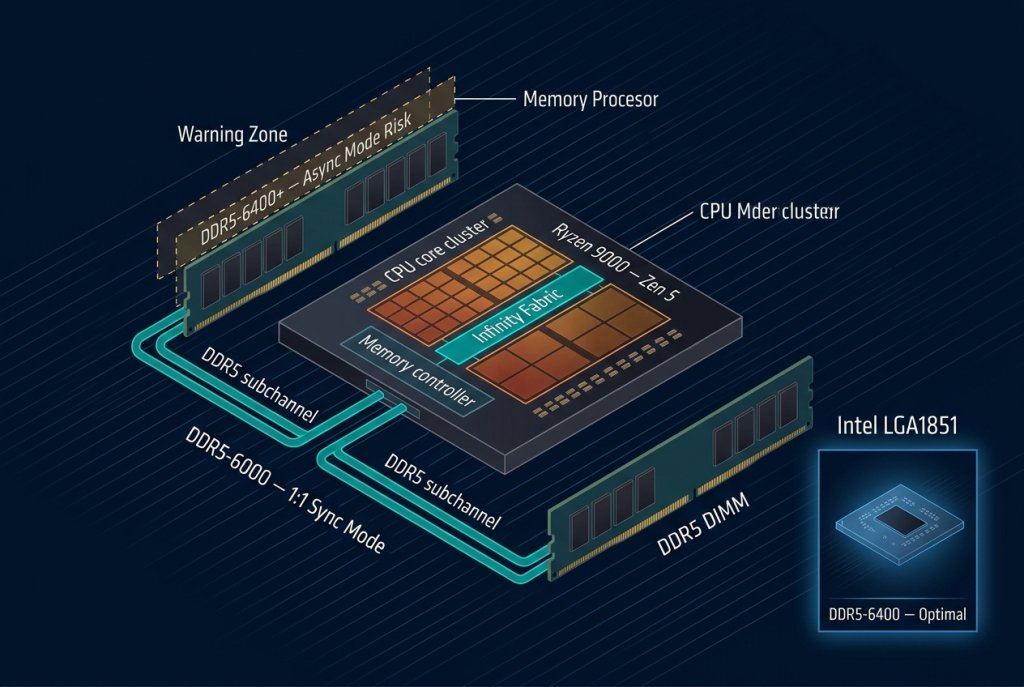
AMD's AM5 memory controller reaches its efficiency optimum at DDR5-6000, which corresponds well with the AM5 infinity fabric frequency of 3000 MHz running in synchronous 1:1 mode with the memory controller. Running DDR5 significantly above 6000 MHz on AM5 can push the infinity fabric into asynchronous mode, introducing latency penalties that partially offset the bandwidth gain. For AM5 builds, a DDR5 kit at DDR5-6000 EXPO is the platform-validated sweet spot.
Intel's LGA1851 platform benefits most from DDR5-6400, with XMP 3.0 profiles well-supported on Z890 and B860 boards. Intel's memory controller architecture is less sensitive to the 1:1/2:1 divider boundary, allowing higher speeds with fewer latency penalties. For Intel gaming builds, DDR5-6400 XMP provides a strong balance of bandwidth and latency.
Browse the full Memory selection on Newegg and filter by DDR5 standard to find kits validated for both AM5 and LGA1851 platforms at their respective optimal speeds.
PCIe Topology and I/O Connectivity
Both AM5 and LGA1851 platforms deliver PCIe 5.0 support for the primary GPU slot and at least one NVMe storage slot — a meaningful infrastructure upgrade from PCIe 4.0. However, the total PCIe lane allocation and chipset-to-CPU uplink bandwidth differ.
AMD's X870E chipset connects to the CPU via a dual PCIe 5.0 ×4 uplink (effectively 16 GB/s total), enabling the chipset to deliver high-bandwidth USB4 and additional NVMe slots without bottlenecking. Intel's Z890 chipset uses a similar high-bandwidth DMI 5.0 ×8 uplink, providing comparable throughput for attached peripherals and storage controllers.
For SSD buyers: both platforms now support PCIe 5.0 NVMe drives at sequential read speeds exceeding 12 GB/s on premium motherboards. The specific slot configuration — how many PCIe 5.0 NVMe slots are available — varies by chipset tier and board design.
 Form Factors and AI Integration in 2026
Both ecosystems offer identical form factor choices: ATX, Micro-ATX, and Mini-ITX — all compatible with standard ATX computer cases and case form factor equivalents. Most 2026-generation boards in both ecosystems include Wi-Fi 7 as standard. Browse Wi-Fi Motherboard options on Newegg to compare integrated wireless specifications across both platforms.
One meaningful hardware-level difference in 2026: Intel's Arrow Lake CPU package includes a dedicated NPU (Neural Processing Unit) rated at approximately 48 TOPS, enabling on-device AI inference for Windows Copilot features, background transcription, and AI-assisted noise cancellation without consuming GPU cycles. AMD's Ryzen 9000 desktop CPUs integrate AI engine capability within the Zen 5 architecture, but the NPU-centric AI feature integration remains more prominent in Intel's platform positioning for enterprise Windows environments.
Manufacturer Ecosystem: Who Makes the Boards
The same major manufacturers — ASUS, GIGABYTE, MSI, and ASRock — produce boards for both AMD and Intel platforms. Your choice of AMD vs. Intel does not limit you to a specific board manufacturer. Each brand offers differentiated product lines across gaming, creator, and workstation segments for both ecosystems. The more important choice is chipset tier and VRM quality — factors that apply equally to boards from all four major manufacturers.
 Platform Architecture in Summary
AMD AM5 and Intel LGA1851 are both capable, modern platforms in 2026. AM5 offers longer in-socket upgrade longevity and PBO tuning across all chipset tiers. LGA1851 provides competitive memory speed headroom, a mature Z890 overclocking ecosystem, and integrated NPU features for Windows AI workflows. The socket, chipset, and memory sweet spot are the three architectural variables that define each platform — and understanding them is the foundation of every smart motherboard decision.