
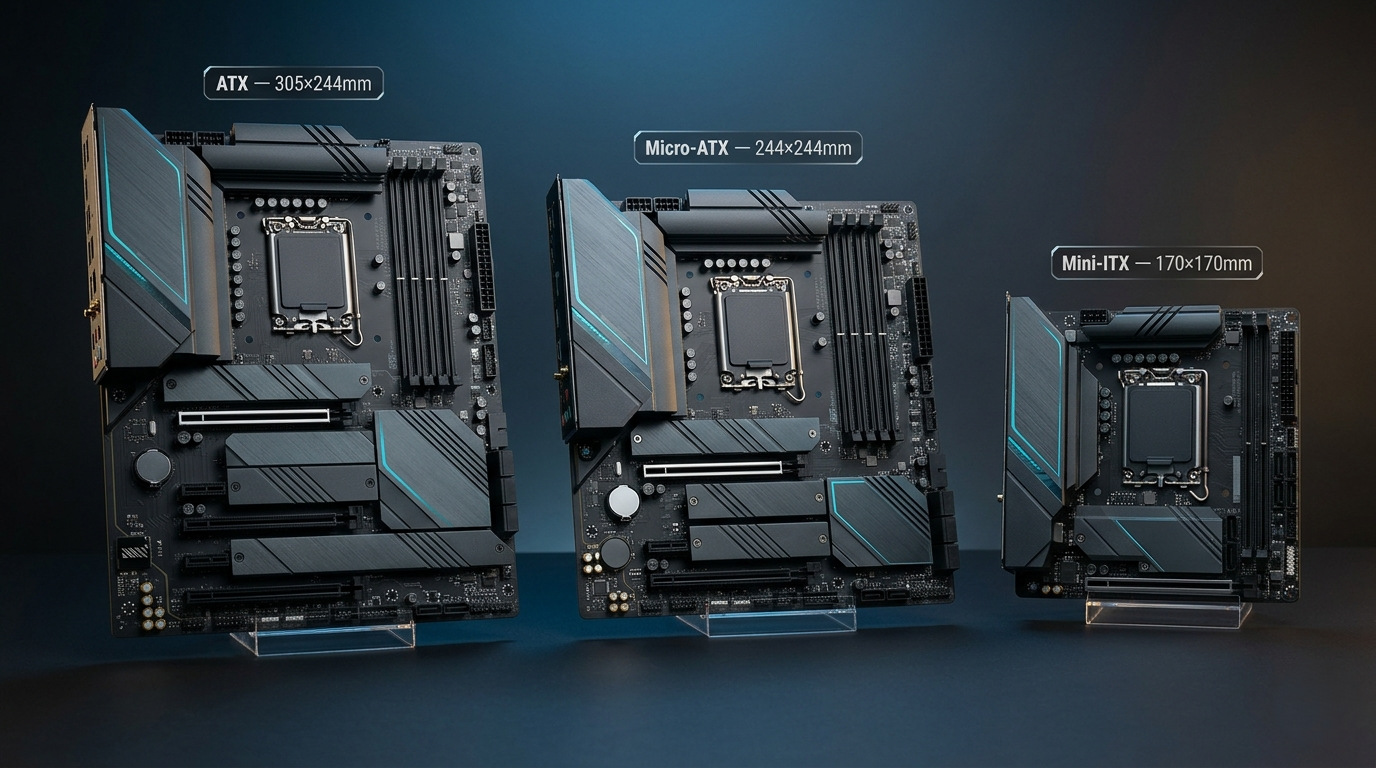
When planning a PC build in 2026, the motherboard form factor is one of the earliest decisions you need to lock in — because it determines which case you can use, how many expansion slots you get, and what your system can grow into over time. The three dominant form factors — ATX, Micro-ATX (mATX), and Mini-ITX — are all available for both AMD AM5 and Intel LGA1851 platforms, and each carries real-world trade-offs that go well beyond physical size. Understanding those trade-offs before you buy prevents costly rebuilds later.
What Motherboard Form Factor Actually Controls
Form factor is not just about dimensions. The physical size of a motherboard directly governs:
- PCIe expansion slot count — for discrete GPUs, capture cards, 10GbE NICs, and M.2 add-in cards
- DIMM slot count — determining maximum memory capacity and channel configuration
- VRM (Voltage Regulator Module) real estate — which affects power delivery quality and overclocking headroom
- M.2 NVMe slot count — tied directly to storage expansion potential
- Case compatibility — each form factor follows standardized mounting dimensions
Getting this decision right means understanding what each size can and cannot do at the component level.
 ATX: The Standard for Full-Capability Builds
The ATX form factor measures 305 × 244 mm and remains the most common choice for desktop gaming systems, workstations, and enthusiast builds in 2026. A full-size ATX motherboard typically provides:
- 4 DIMM slots — supporting up to 192 GB with 48 GB DDR5 sticks on 2026-generation boards
- 3–5 PCIe slots — including a PCIe 5.0 ×16 primary GPU slot and secondary PCIe 4.0 or 5.0 ×4 slots
- 3–5 M.2 NVMe slots — flagship boards offering up to five PCIe 5.0 NVMe slots
- 14–20+ VRM power phases on premium X870E and Z890 models
- Full rear I/O with USB4 80 Gbps, multiple USB 3.2 Gen 2 ports, and Wi-Fi 7 antenna connectors
ATX is the default recommendation for content creators who need multi-drive NVMe storage arrays, gamers who want capture card or 10GbE expansion alongside a discrete GPU, and anyone running large CPU coolers where physical clearance matters. The additional board real estate also simplifies cable routing inside a mid-tower or full-tower computer case.
2026 highlight: ASUS launched the ROG Maximus Z890 APEX this year, redefining the flagship ATX tier for Intel LGA1851 with a 24-phase VRM capable of sustaining over 400A of continuous CPU current, dual PCIe 5.0 NVMe slots with active heatsink cooling, and integrated USB4 80 Gbps on the rear panel — a practical benchmark for how far the ATX standard has advanced.
Micro-ATX: The Compact Mid-Range Workhorse
Micro-ATX boards measure 244 × 244 mm — a square format that fits in compact mid-towers and most standard ATX cases simultaneously. The reduction in size costs expansion slots, not core platform functionality:
- 4 DIMM slots retained on most mATX designs — full dual-channel DDR5 capacity unchanged
- 2–3 PCIe slots — one PCIe 5.0 ×16 GPU slot plus one or two secondary PCIe 4.0 ×4 or ×1 slots
- 2–3 M.2 NVMe slots on mid-range and above configurations
- VRM designs that are physically more compact but still achieve 12–16 power phase configurations — sufficient for mainstream AMD Ryzen and Intel Core Ultra CPUs without overclocking headroom concerns at stock settings
Browse Micro-ATX motherboards on Newegg to find options across AMD B850 and Intel B860 chipsets at competitive price points.
 Micro-ATX has gained considerable traction in 2026 as GPU physical sizes have grown. Many builders find that dropping to mATX provides a cleaner installation experience — fewer empty slots to work around, better clearance between the GPU and PCIe accessories, and a meaningfully lower board price versus ATX without sacrificing gaming performance. For a build centered on one GPU, a DDR5 memory kit, and one or two NVMe drives, a Micro-ATX board covers all practical requirements. Strong mATX options are available from MSI, ASRock, and GIGABYTE in the gaming-focused mid-range segment.
Mini-ITX: Full Performance in a Minimal Footprint
Mini-ITX boards measure 170 × 170 mm — small enough to fit in cube cases and ultra-compact enclosures. The format comes with specific constraints that matter for build planning:
- 2 DIMM slots only — dual-channel DDR5 at up to 96 GB with 2026-generation 48 GB sticks; no quad-channel option
- 1 PCIe slot — one full PCIe 5.0 ×16 GPU slot
- 2 M.2 NVMe slots on most current designs, with some premium boards adding a third via riser
- VRM physically constrained — premium Mini-ITX boards use high-current, multi-layer power stages and active cooling fins to compensate for reduced phase count
Mini-ITX motherboards pair with compact computer cases to create genuinely small systems that still accommodate full-length GPUs and 240mm or 280mm AIO cooling solutions.
The Mini-ITX segment saw meaningful momentum in 2026 as local AI inference workloads made high-performance, low-footprint systems increasingly desirable. Both ASUS and ASRock released 2026-generation AM5 Mini-ITX boards with USB4 80 Gbps rear I/O and PCIe 5.0 NVMe support — narrowing the feature gap with larger formats considerably. For Mini-ITX builds, pair your board with an SFX or SFX-L power supply sized for the case format, and plan airflow deliberately — compact enclosures reward intentional fan placement.
 Form Factor Specification Comparison
| Specification | ATX | Micro-ATX | Mini-ITX |
|---|---|---|---|
| Dimensions | 305 × 244 mm | 244 × 244 mm | 170 × 170 mm |
| DIMM Slots | 4 | 4 | 2 |
| Max DDR5 Capacity (2026) | 192 GB | 192 GB | 96 GB |
| PCIe Expansion Slots | 3–5 | 2–3 | 1 |
| M.2 NVMe Slots | 3–5 | 2–3 | 2 |
| Max VRM Phases (flagship) | 20+ | 16 | 10–12 |
| Case Compatibility | Full tower / Mid tower | Mid tower / Compact | SFF / Cube / Mini tower |
| Typical Price Range | $150–$600+ | $100–$350 | $130–$400 |
Wi-Fi and Wireless: Consistent Across All Form Factors
One area where form factor no longer creates meaningful differentiation is wireless connectivity. Wi-Fi motherboards with Wi-Fi 7 (802.11be) and Bluetooth 5.4 are available across ATX, Micro-ATX, and Mini-ITX in 2026 — the Intel BE200 or MediaTek Filogic 380 adapters fit the standard M.2 Key-E slot present on all three form factors. A Mini-ITX build can have the same Wi-Fi 7 multi-band wireless performance as a premium ATX board.
 Matching Form Factor to Your Build Goals
Three questions clarify the form factor decision:
Do you need multiple PCIe accessories beyond a single GPU? A capture card, 10GbE NIC, or PCIe 5.0 M.2 expansion card requires the slot count only ATX reliably delivers.
Are you building a straightforward gaming or creative system in a standard case? Micro-ATX delivers complete gaming capability at reduced cost and board complexity.
Is physical size or desk footprint the primary design constraint? Mini-ITX enables powerful compact builds without compromising CPU or GPU class — only storage expansion and memory maximum.
All three formats are now supported across ASUS, GIGABYTE, MSI, and ASRock for both AMD AM5 and Intel LGA1851. The SSD drives, GPU, and DDR5 memory kits you choose are form-factor agnostic. The motherboard format is the frame; the components inside are identical regardless of the board’s size.
In 2026, all three form factors deliver the complete next-generation platform specification — PCIe 5.0, DDR5, and Wi-Fi 7 — for the first time simultaneously. The decision between ATX, Micro-ATX, and Mini-ITX has never been more straightforwardly about your expansion needs and physical build goals, rather than platform capability trade-offs.