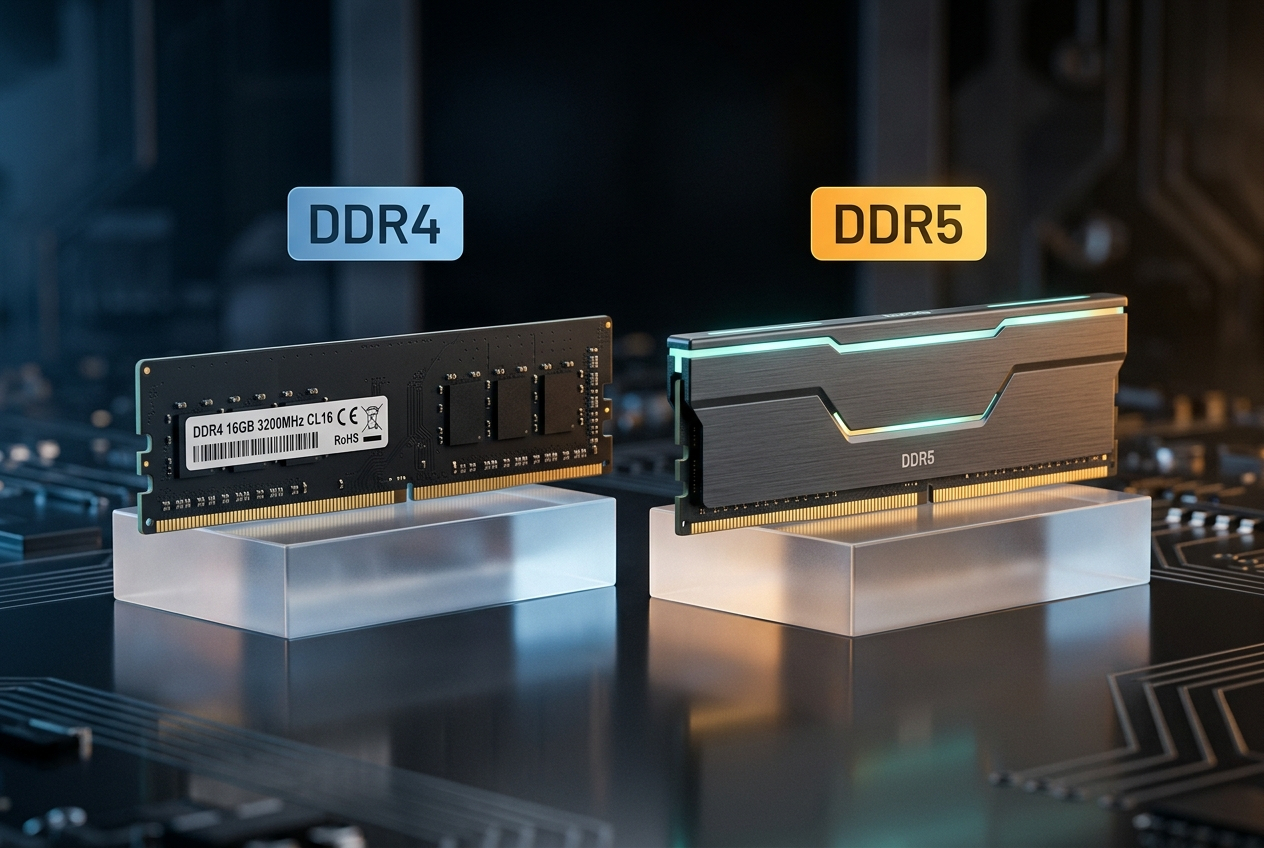
The RAM market hit a transition point in 2026 that has been building for three years. DDR5 has moved from early-adopter premium to mainstream standard: it ships with every new Intel and AMD desktop platform, speeds have matured well beyond DDR4’s ceiling, and the initial latency penalties of the first DDR5 generation have been substantially addressed by improved kits and platform firmware. At the same time, DDR4 continues to hold relevance in budget builds, legacy systems, and specific server deployments. Understanding exactly what changed between these two standards — and where those differences show up in real workloads — is the foundation of every smart RAM decision in 2026.
What DDR5 Changed at the Architecture Level
The most fundamental change in DDR5 is not speed — it is where certain functions happen. DDR4 relied on the motherboard’s memory controller to handle voltage regulation for the memory modules. DDR5 moves the Power Management IC (PMIC) onto the module itself. This on-module power management gives each DDR5 stick tighter, more precise voltage control, which is part of why DDR5 can hit higher speeds more reliably across a wider range of hardware configurations.
The second major architectural shift is on-die ECC (Error Correcting Code). DDR5 includes ECC logic built directly into each module’s chips — a first for consumer RAM. This on-die ECC does not replace full system ECC (which remains an exclusive feature of workstation and server platforms using registered DIMMs), but it does detect and correct single-bit errors within each burst operation, improving data integrity at the module level in everyday consumer builds.
DDR5 also doubled the number of independent channels per DIMM. Where DDR4 uses a single 64-bit channel per module, DDR5 splits this into two independent 32-bit subchannels, each with its own burst access logic. This design improves the memory controller’s ability to interleave requests efficiently, which contributes to the bandwidth advantage DDR5 holds over DDR4 even at equivalent frequencies.
 Speed, Bandwidth, and Latency: The Numbers That Matter
The headline DDR5 specification advantage is speed — and in 2026, that advantage has grown considerably beyond DDR4’s practical ceiling.
| Memory Standard | Common Speed Range | Peak Bandwidth (Dual Channel) | Typical CAS Latency | Access Latency (ns) |
|---|---|---|---|---|
| DDR4-3200 | 2133–3600 MHz | ~51 GB/s | CL16 | ~10 ns |
| DDR4-4800 (server) | 4800 MHz | ~77 GB/s | CL40 | ~16.7 ns |
| DDR5-5600 (baseline) | 4800–6000 MHz | ~89 GB/s | CL40 | ~14.3 ns |
| DDR5-6400 (gaming) | 6000–7200 MHz | ~102 GB/s | CL32–36 | ~10–11.25 ns |
| DDR5-8000+ (enthusiast) | 7200–8400 MHz | ~128 GB/s | CL38–40 | ~9.5 ns |
The early criticism of DDR5 — that higher CAS latency numbers negated the bandwidth gains — was accurate for the first-generation kits running at DDR5-4800 with CL40. By 2026, mainstream gaming kits running DDR5-6400 at CL32 deliver both more bandwidth and comparable or better absolute latency than DDR4-3600 CL16. The upgrade story is now genuinely complete across all performance metrics.
For AI-adjacent workloads on the CPU side — tokenization, in-memory data preprocessing, and feature engineering pipelines — memory bandwidth is the direct performance lever. A dual-channel DDR5-6400 configuration provides roughly 100 GB/s, compared to approximately 50 GB/s for dual-channel DDR4-3200. For workloads that move large datasets through the CPU, this bandwidth doubling has measurable runtime impact.
Explore the latest Desktop Memory releases on Newegg to see how DDR5 kit specifications have evolved — from baseline JEDEC-standard modules to high-frequency XMP/EXPO profiles that unlock the full performance available on current Intel and AMD platforms.
 Where DDR4 Still Makes Sense in 2026
DDR4 is not obsolete. On platforms built around Intel’s 12th and 13th Generation (Alder Lake / Raptor Lake) or AMD’s AM4 socket (Zen 3 and earlier), DDR4 is the native standard. Upgrading memory on these platforms means selecting the best DDR4 kit available — typically DDR4-3600 or DDR4-4000 for gaming builds — and squeezing the remaining headroom out of proven hardware.
For laptop users, DDR4 SO-DIMMs continue to be the standard in many mid-range and business notebooks that have not yet transitioned to DDR5 or LPDDR5. Newegg’s Laptop Memory category covers both standards, making it easy to match upgrades to the specific module type your system requires.
In the server tier, DDR4 registered ECC DIMMs remain the dominant choice for legacy rack infrastructure. Platforms built around AMD EPYC 7002/7003 or Intel Xeon Scalable 3rd Gen continue to operate on DDR4 ECC. Newegg’s Server Memory selection covers this transition comprehensively — from legacy DDR4 registered DIMMs through DDR5 RDIMM options appearing on newer EPYC Genoa and Intel Xeon Sapphire Rapids platforms.
 32GB DDR5: The 2026 Standard for Serious Builds
The question of how much RAM a modern system needs has a cleaner answer in 2026 than it did two years ago. For gaming, 16GB DDR5 remains technically sufficient for the majority of current titles — but 32GB has become the recommended baseline for builds that will remain relevant for the next several years.
The reason is AI integration at the application layer. Adobe Premiere Pro’s Sensei AI tools, game engines with AI-accelerated asset streaming, and background OS AI features (Windows Copilot, AI-assisted search indexing) have increased resident memory consumption in ways that were not predictable when 16GB was specified as “enough for gaming.” A 32GB DDR5 kit — two 16GB sticks running in dual-channel — gives both gaming and productivity headroom without requiring an immediate upgrade. Browse current Gaming RAM options on Newegg to see how 32GB DDR5 kits have evolved in both speed and form factor.
For memory-intensive professional work — 3D rendering, large-dataset analysis, virtual machine hosting — 64GB DDR5 has become the new practical minimum on workstation platforms. Check out the new releases in memory to see the latest high-capacity DDR5 kits reaching the market.
 The Platform Determines the Standard
In 2026, platform selection determines memory standard before any other variable. Intel’s LGA1851 (Core Ultra 200S series) and AMD’s AM5 socket both require DDR5 — there is no DDR4 compatibility option on either current platform. If you are building new in 2026, you are building with DDR5 by default. DDR4 remains relevant only on legacy platforms or where specific compatibility requirements make it the correct choice. Use Newegg’s Memory Finder tool to confirm compatibility between your specific motherboard, CPU socket, and memory type before purchasing.
The standard has shifted. DDR5 is now the architecture of record for modern PC building — and understanding what changed under the hood explains why the platform transition was worth the wait.