The GPU market in 2026 has reached a genuine inflection point. NVIDIA’s Blackwell-based RTX 50 series reshaped expectations for 4K performance and ray tracing, while AMD’s RDNA 4 lineup delivered the most competitive challenge to NVIDIA’s high-end dominance in years. Intel’s Arc platform, meanwhile, continues to quietly mature into a credible budget option. Whether you’re building a new rig from scratch, upgrading aging hardware, or simply trying to understand what this generation actually delivers, this guide cuts through the noise and answers the questions that matter most to buyers in 2026.
NVIDIA Blackwell: What the RTX 50 Series Actually Changes
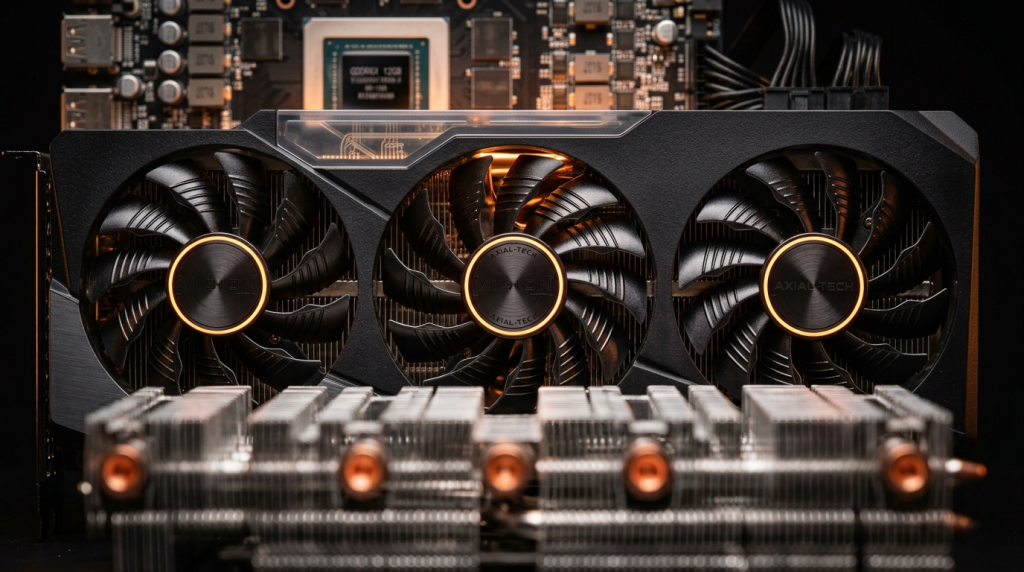
NVIDIA’s Blackwell architecture, which powers the RTX 50 series, is built on three structural improvements: redesigned Shader Execution Reordering for more efficient GPU utilization, a fifth-generation RT core pipeline that dramatically accelerates ray tracing throughput, and fourth-generation Tensor Cores powering DLSS 4’s Multi Frame Generation.
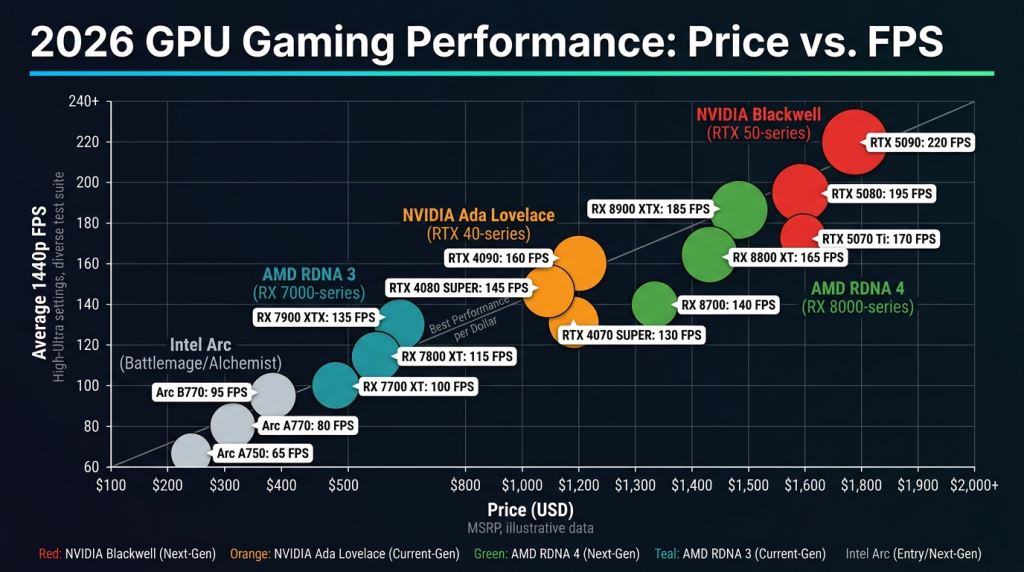
The GeForce RTX 5090 sits at the pinnacle of this generation. In rasterization benchmarks, it delivers roughly 70% more performance than the RTX 4090 at equivalent settings — and its ray tracing throughput is high enough that full path tracing in demanding titles at 4K remains smooth without requiring aggressive AI upscaling. This is the definitive no-compromise 4K enthusiast card of 2026.
The GeForce RTX 5080, by contrast, tells a more practical story. It delivers approximately 55–60% of the RTX 5090’s raw performance at roughly half the price. For virtually every 4K gaming scenario short of maximum path tracing, the RTX 5080 reaches the performance ceiling most buyers will ever require. It is where the generation’s true value begins.
 AMD RDNA 4: The Most Competitive AMD High-End GPU in Years
AMD’s RDNA 4 architecture brings the company’s most significant ray tracing improvement to date. By doubling the ray accelerator count per compute unit compared to RDNA 3, AMD has closed a meaningful gap that previously favored NVIDIA in raytraced workloads. FSR 4 — AMD’s first machine-learning upscaling model, replacing the spatial algorithm in FSR 3 — now produces image quality that rivals DLSS Quality mode in supported titles.
At the high end, RDNA 4 GPUs are competitive with Ada Lovelace-era NVIDIA cards in rasterization and have meaningfully surpassed RDNA 3 in ray tracing. For users who value Linux driver maturity, open-source tooling, and competitive pricing, RDNA 4 presents a compelling case. The Radeon RX 7900 XTX — now a full generation old — has dropped to exceptional value pricing, making it one of the best 4K bang-for-buck options currently on the market.
 Performance Comparison Across All Price Tiers
| GPU | Architecture | Target Resolution | Avg FPS (Native Raster) | Ray Tracing Tier | Est. Street Price |
|---|---|---|---|---|---|
| GeForce RTX 5090 | Blackwell | 4K Ultra | ~150 fps | Best-in-class | ~$1,999 |
| GeForce RTX 5080 | Blackwell | 4K High–Ultra | ~112 fps | Excellent | ~$999 |
| GeForce RTX 4090 | Ada Lovelace | 4K High | ~120 fps | Very Good | ~$1,299* |
| GeForce RTX 4080 Super | Ada Lovelace | 4K Medium–High | ~102 fps | Good | ~$779* |
| Radeon RX 7900 XTX | RDNA 3 | 4K Medium | ~105 fps | Improved | ~$679* |
| Radeon RX 9060 XT | RDNA 4 | 1440p High | ~118 fps | Good | ~$329 |
| GeForce RTX 4060 | Ada Lovelace | 1080p–1440p | ~95 fps | Moderate | ~$269* |
*Street pricing reflects Q1 2026 market values, not original MSRP.
 The Value Tier: Where Most Buyers Actually Shop
The $269–$499 segment is where the 2026 GPU market is most competitive. The Radeon RX 9060 XT arrives as AMD’s first RDNA 4 mainstream card and immediately becomes the mid-range benchmark to beat. With machine-learning FSR 4 upscaling, notably improved ray tracing, and strong 1440p native performance, it’s a compelling upgrade path for buyers coming off RX 5700 or GTX 1080-era hardware.
The GeForce RTX 4060 continues to hold its ground as a proven, well-supported card for 1080p to light 1440p gaming. Its DLSS 3 support, mature driver ecosystem, and widely available stock make it a reliable choice for budget-first builds. For buyers upgrading older graphics cards — anything from an RTX 3060 era or earlier — Newegg’s Graphics Card Trade-In Program provides a straightforward way to offset the cost of moving to current-generation hardware.
Ray Tracing in 2026: Now Accessible Across Tiers
Ray tracing has moved from enthusiast novelty to mainstream feature in 2026. Titles like Cyberpunk 2077: Phantom Liberty, newer open-world RPGs, and first-person shooters with hybrid ray-traced lighting use RT as a standard rendering mode on supported hardware. The entry point for playable ray tracing has dropped substantially — even mid-range GPUs with FSR 4 or DLSS 3 assistance now deliver stable experiences.
The GeForce RTX 4080 Super in particular represents an excellent 4K ray tracing value in 2026. Second-generation Ada Lovelace hardware that launched at premium pricing is now available at significantly reduced street prices, making it one of the most efficient ways to reach competent 4K ray tracing without paying Blackwell-tier prices.
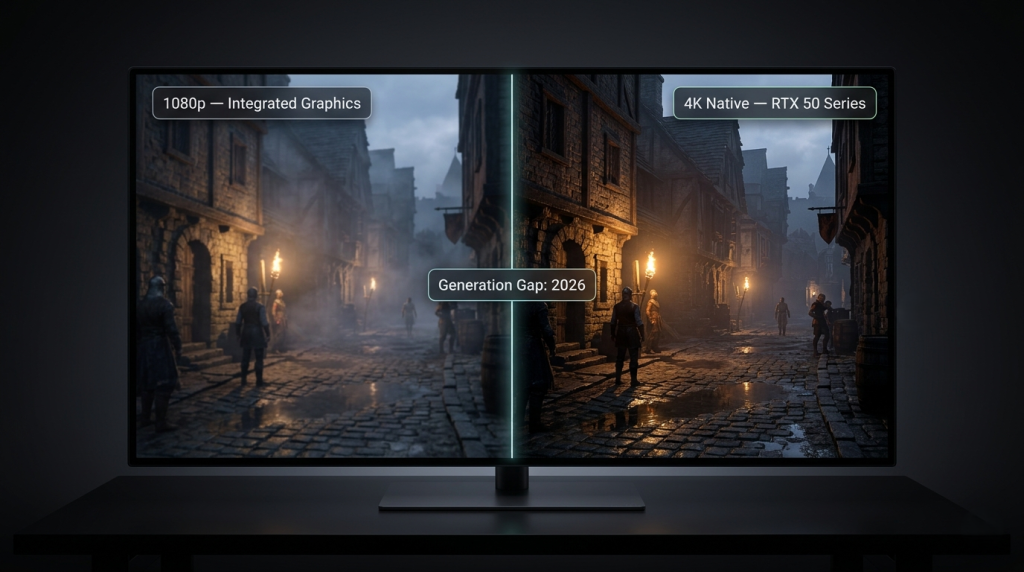 Intel Arc: The Budget Tier Gets Sharper
Intel’s Arc A-Series GPUs — particularly the Arc A750 and Arc A580 — have matured into genuinely competitive options in the sub-$200 space. Driver stability has improved substantially since launch, and XeSS upscaling now competes credibly with FSR 3 in supported titles. For 1080p gaming on a strict budget, Arc delivers surprising performance per dollar.
Buying Recommendations by Use Case
| Use Case | Top Pick | Best Alternative |
|---|---|---|
| No-compromise 4K gaming | GeForce RTX 5090 | GeForce RTX 5080 |
| Best 4K value in 2026 | GeForce RTX 4090 (current market) | Radeon RX 7900 XTX |
| Best 1440p mid-range | Radeon RX 9060 XT | GeForce RTX 4060 Ti |
| Budget 1080p gaming | Intel Arc A750 | GeForce RTX 4060 |
| 4K gaming + ray tracing value | GeForce RTX 4080 Super | Radeon RX 7900 XTX |
The 2026 GPU generation is defined by the democratization of technologies that once required flagship hardware. Browse the full GPU & Video Graphics Device catalog on Newegg — filtering by resolution target, architecture, and price range — to find the card that best fits your build and budget. Don’t overlook video card accessories to complete your installation, from PCIe power adapters to GPU support brackets. The right GPU is the one that matches your target resolution without overpaying for performance you’ll never use.