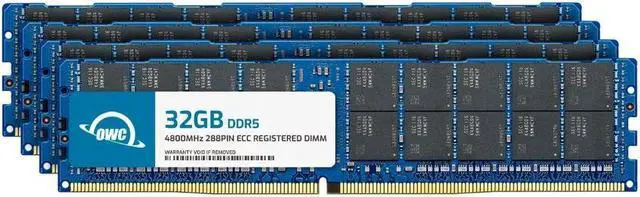
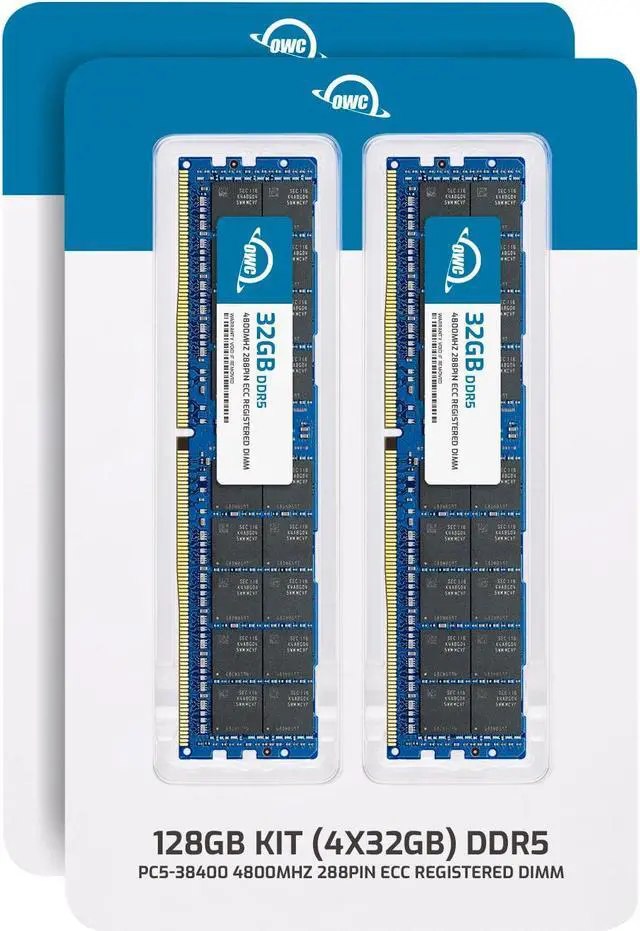
OWC 128GB DDR5-4800 ECC Registered memory is a four-module 4×32GB kit for upgrading compatible HP ProLiant DL320 Gen11, DL380a Gen11, or DX320 Gen11 servers. It suits server administrators and builders who need registered, error-correcting memory; it is intended for servers and workstations, not standard desktop computers.
Recommended For
- Operators of a listed HP ProLiant Gen11 system who need a 128GB memory addition in four 32GB ECC Registered DIMMs; confirm the server’s processor, available slots, and population rules before installation.
- Server administrators expanding memory for virtualization or multiple hosted services, where the system supports DDR5 RDIMMs and the added 128GB fits its memory plan.
- IT teams maintaining server workloads that benefit from ECC memory and want a four-DIMM kit of the same capacity and specification for an upgrade.
- System builders refreshing compatible server infrastructure who need DDR5-4800 ECC Registered memory and have verified that this kit’s rank, speed, and four-module layout fit the server configuration.
Real-World Use Scenarios
- When an IT team adds virtual machines to a compatible ProLiant host, installing this 128GB kit can provide more memory for the hypervisor to allocate, helping reduce memory pressure when the existing RAM is the constraint.
- For a DL320 Gen11 used for containerized or edge services, adding memory can give the host more room for application containers and supporting services before workloads compete for RAM.
- In a DL380a Gen11 GPU server used for AI inference or model development, additional system memory can give the CPU and host software more room for data preparation and other supporting tasks; it does not increase GPU memory.
- For virtual desktop infrastructure on a compatible DL320 Gen11, adding RAM can increase the memory available to hosted desktops and their server-side services, which may help when the current configuration is limiting the number of active sessions.
- When a compatible server is running memory-intensive engineering or graphics workloads alongside GPUs, extra system RAM can provide more room for host-side applications and data; actual performance still depends on the CPU, GPU, software, and memory configuration.