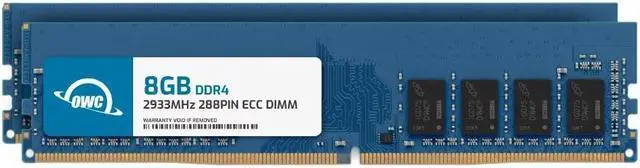
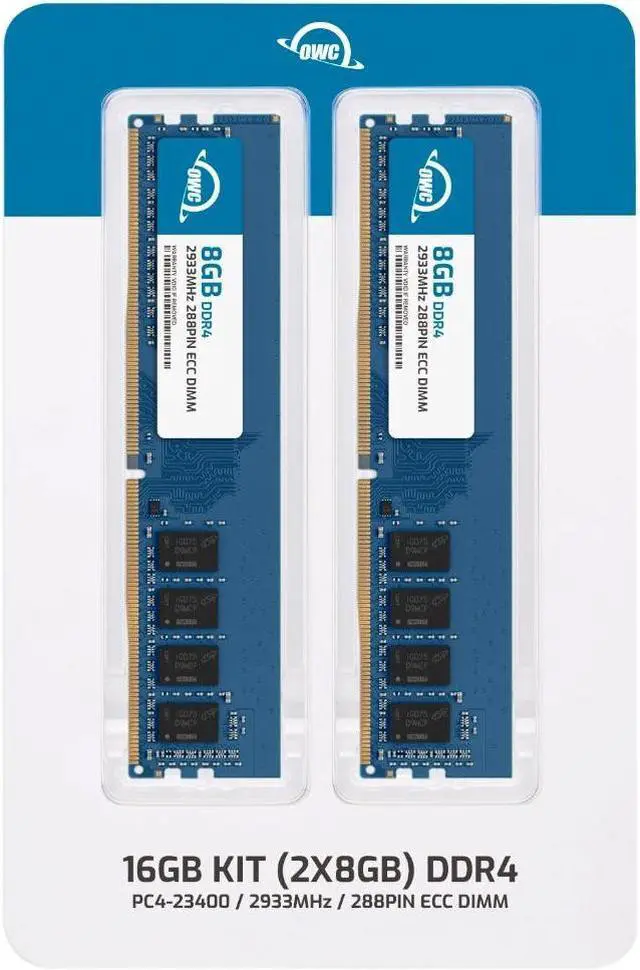
The OWC 2E9D41R8016P is a 16GB dual-channel DDR4-2933 ECC unbuffered UDIMM kit with two 8GB modules, designed for compatible workstations, servers, and NAS systems.
Recommended For
- Workstation owners upgrading a DDR4 system that specifically supports ECC unbuffered DIMMs and 2933MHz memory; the matched 2 x 8GB kit is suited to adding memory while preserving a dual-module configuration.
- Small NAS or home-server operators who want ECC memory for a platform designed for unbuffered ECC DIMMs, and whose memory needs fit a 16GB upgrade kit.
- Home-lab users running a small number of lightweight services on a compatible workstation or server, who need an ECC UDIMM upgrade rather than a high-capacity registered-memory configuration.
- Owners replacing or adding a matched pair of 8GB modules in a compatible DDR4 desktop workstation, server, or NAS that uses 288-pin ECC UDIMMs.
Real-World Use Scenarios
- On a compatible ECC-enabled workstation running long CAD, engineering, or data-processing jobs, this memory can help correct certain single-bit memory errors as they occur, reducing the chance that an error interrupts work or alters data in memory.
- In a compatible NAS used for shared files and backups, ECC can reduce the risk of certain memory errors affecting data while it is being processed; it does not replace backups, drive redundancy, or other data-protection measures.
- For an always-on small server running shared services, ECC can help correct certain memory errors without requiring an immediate restart; the benefit depends on the CPU, motherboard, and firmware supporting and enabling ECC.
- On a compatible virtualization host, ECC provides an added layer of protection while several virtual machines or services share system memory; this 16GB kit provides a fixed amount of capacity, so the host and guest memory needs still determine how many workloads it can run comfortably.
- When upgrading a compatible workstation or server with less memory, the 16GB kit can give applications more room to keep files and tasks active in memory, which may reduce reliance on slower disk paging when the previous capacity was a bottleneck.




 here!