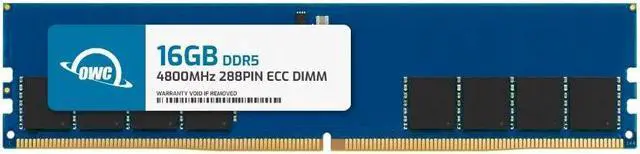
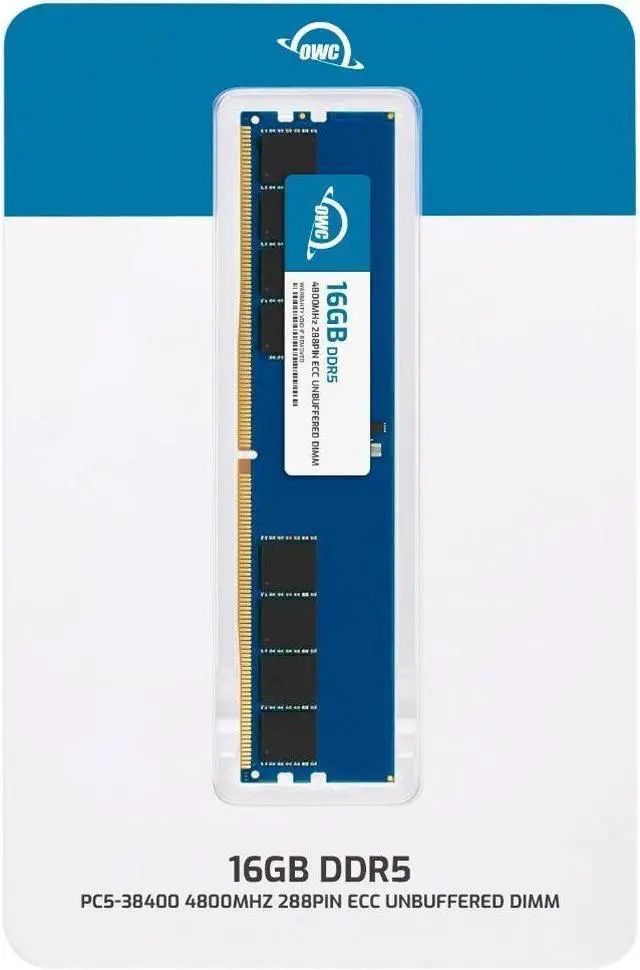
The OWC 16GB DDR5-4800 ECC Unbuffered UDIMM is a replacement memory module for Kingston part KSM48E40BS8KM-16HM, suited to compatible workstations, servers, and NAS systems that use this memory type.
Recommended For
- Workstation owners replacing or adding a 16GB DDR5-4800 ECC UDIMM in a system whose processor and motherboard support ECC UDIMMs.
- Entry-level server or NAS operators who need ECC UDIMM memory and have verified that their specific system supports this module type and 16GB capacity.
- Owners of systems currently using Kingston KSM48E40BS8KM-16HM who want a like-for-like replacement with matching DDR5-4800, ECC UDIMM, CL40, 1Rx8, and 1.1V specifications.
- Builders upgrading a compatible desktop-form-factor system who specifically need a 288-pin unbuffered ECC module rather than registered server memory.
Real-World Use Scenarios
- Replacing a failed or unavailable Kingston KSM48E40BS8KM-16HM in a compatible workstation or server: the OWC module is listed as a replacement, helping restore the system without switching to a different memory type. Confirm the system’s memory compatibility before installing.
- Running long workstation jobs such as engineering or data-processing workloads: in a system that supports and enables ECC UDIMM, this module can help detect and correct certain memory errors during computation; it does not make the system immune to data errors.
- Operating a compatible NAS for shared files and backups: ECC memory can help catch or correct certain memory errors while the NAS is handling data, provided the processor and motherboard support ECC; it is not a substitute for backups or data-integrity checks.
- Running a small home or office server with virtual machines or containers: if the platform supports this ECC UDIMM, installing it can add 16GB of memory for those workloads, subject to the system’s total capacity and memory-configuration limits.
- Keeping multiple professional applications and larger files open on a compatible workstation: adding this module can provide more memory capacity when the system has an available slot and supports the resulting configuration, reducing the need to close applications when memory is constrained.




 here!