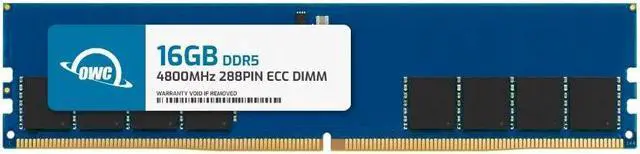
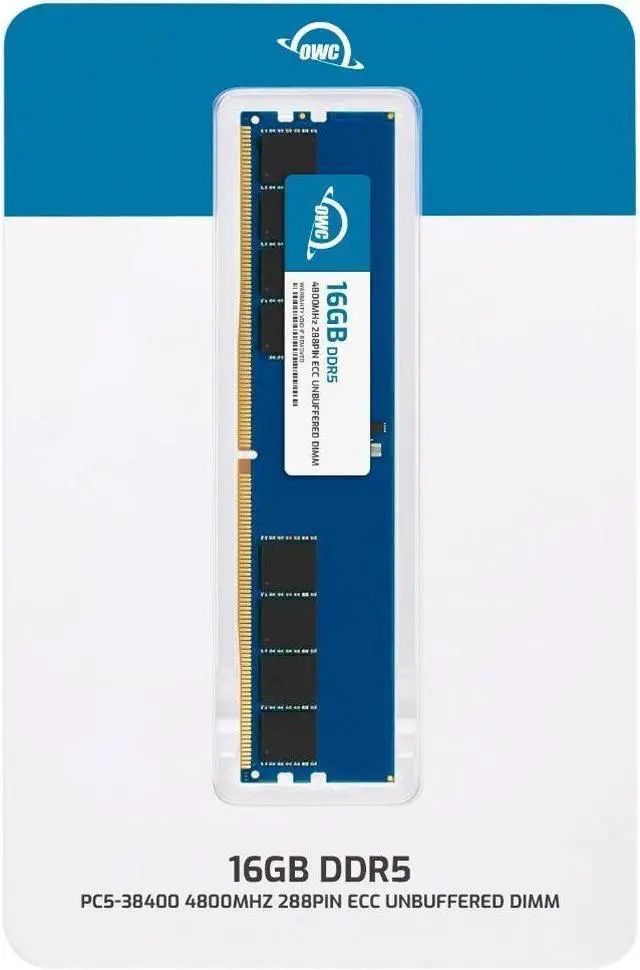
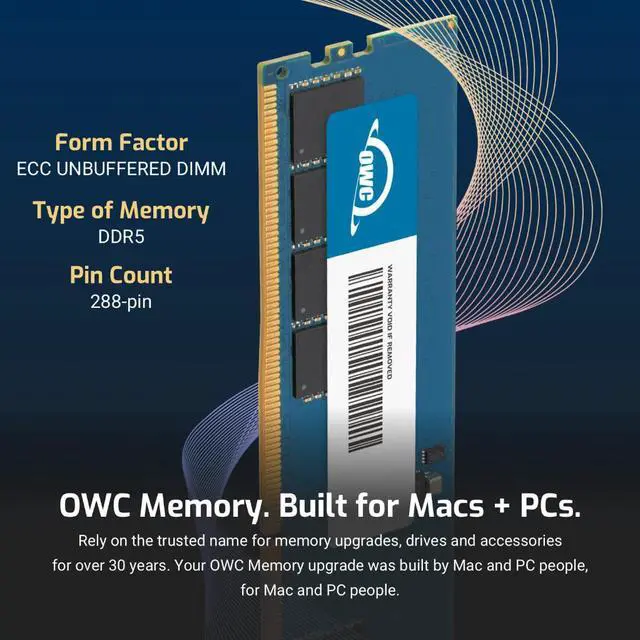
The OWC 16GB DDR5-4800 ECC Unbuffered UDIMM is a desktop memory module for compatible workstations, servers, and NAS systems that support 288-pin ECC UDIMMs. It runs at 4800 MT/s with CL40 timing and is listed as a replacement for Micron MTC10C1084S1EC48B and MTC10C1084S1EC48BR modules.
Recommended For
- Workstation users running long or memory-sensitive workloads who need ECC error correction, provided their processor and motherboard support ECC unbuffered memory.
- Home-lab and NAS builders running small, always-on systems who want ECC UDIMM memory and whose system specifically supports DDR5 ECC unbuffered DIMMs.
- Owners of compatible systems using Micron MTC10C1084S1EC48B or MTC10C1084S1EC48BR who need a 16GB replacement module with matching DDR5-4800 ECC UDIMM characteristics.
- Small-server builders who need ECC in an unbuffered configuration and have verified their board and CPU support that memory type; it is aimed at smaller systems rather than maximum-capacity server builds.
Real-World Use Scenarios
- Replacing a failed Micron MTC10C1084S1EC48B/BR module in a compatible workstation or server can restore the system’s ECC memory configuration; confirm the system supports DDR5 ECC UDIMMs before installing it.
- In a compatible TrueNAS or ZFS storage server, this ECC module can help detect and correct certain in-memory bit errors during file and storage operations; it is an added data-integrity measure, not a substitute for backups or other protections.
- In an ECC-capable workstation that is running short on memory, adding this 16GB module can provide more room for open applications and larger files, potentially reducing slowdowns caused by memory pressure.
- For a small home or office NAS built around a motherboard and CPU that support DDR5 ECC UDIMMs, this module can provide ECC memory for routine file-serving workloads; many NAS systems use different memory types, so check compatibility first.
- In a lightweight home-lab server running a few services or a small virtual machine, adding memory can give the host and guest more room to operate; whether 16GB is enough depends on the workloads and their memory needs.