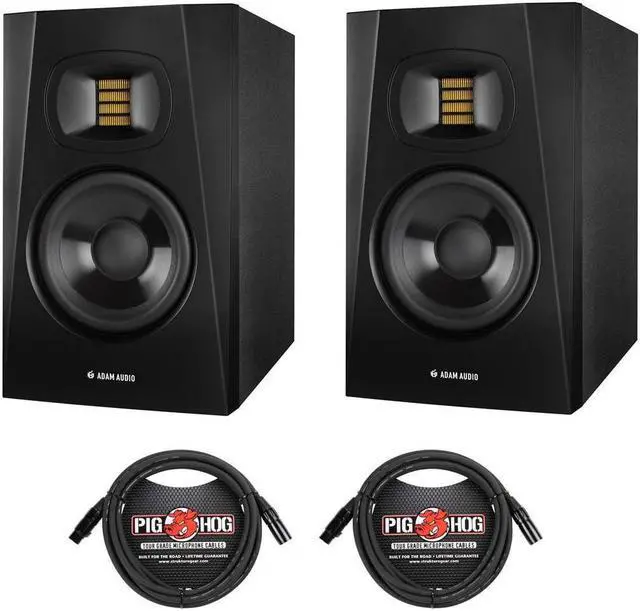
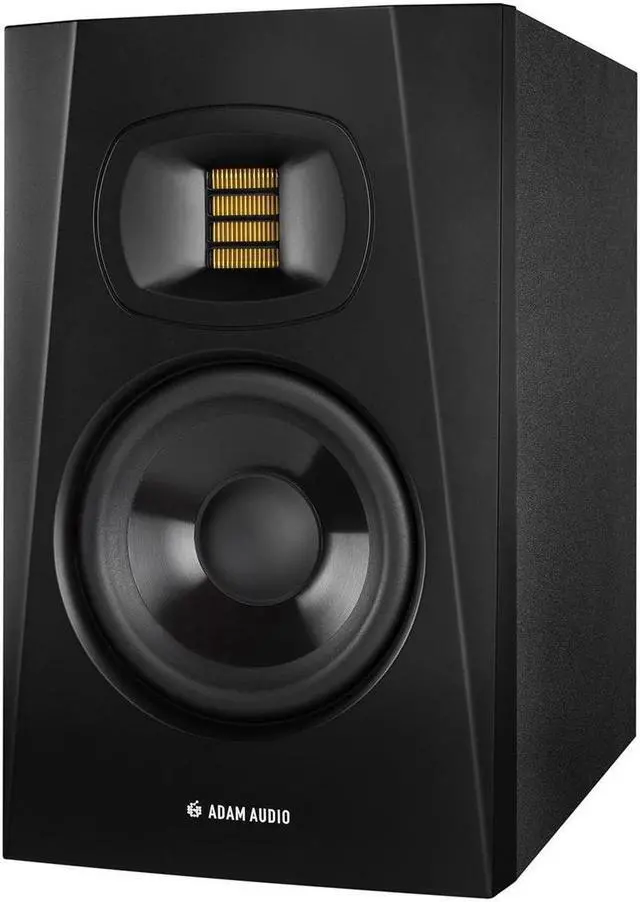
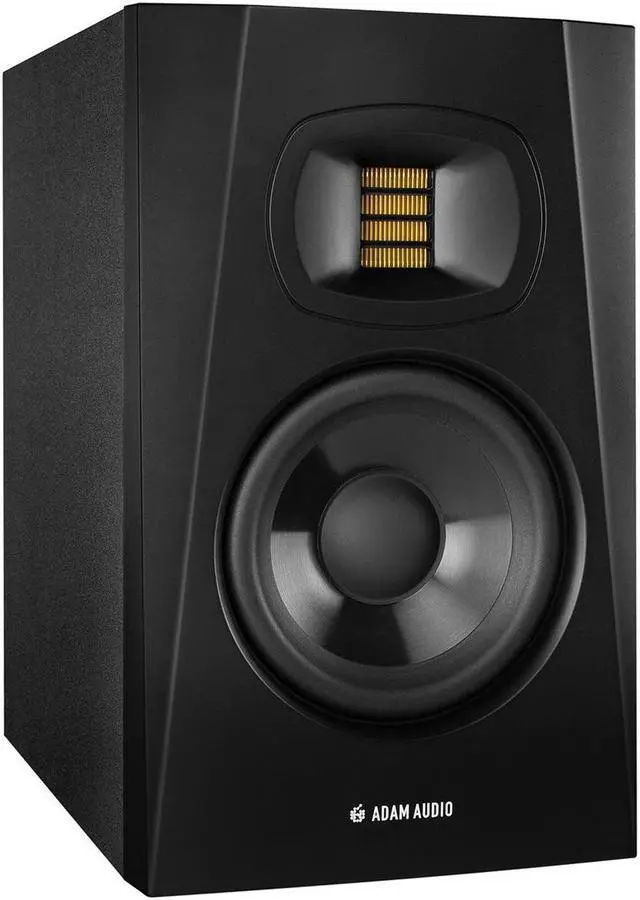
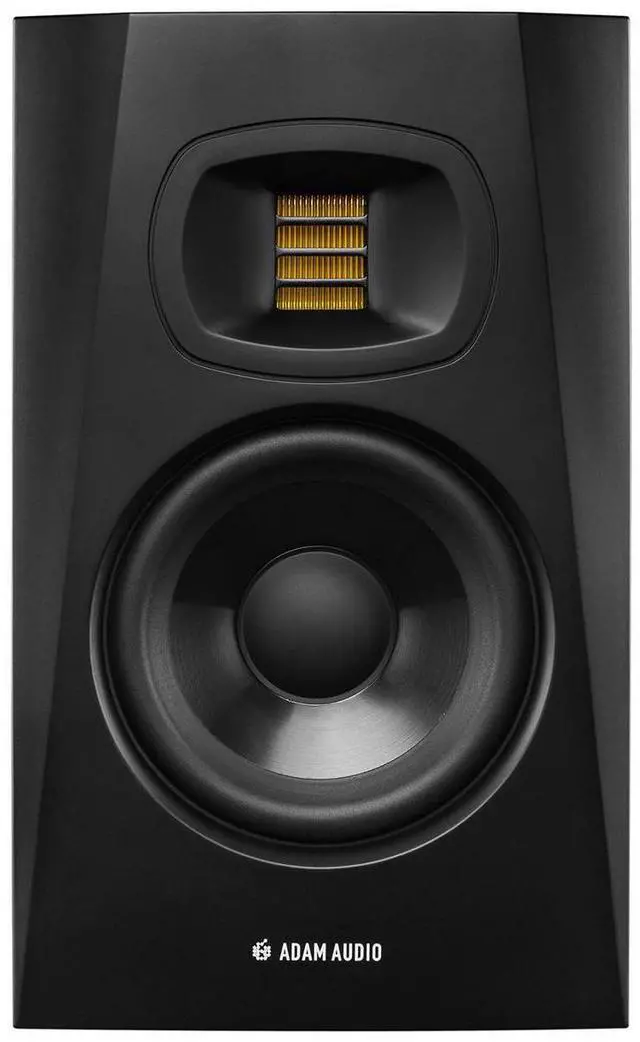
Clarity. Precision. Honesty. Detail. The T5V is a highly affordable two-way nearfield monitor and optimized for small control rooms. With its 5" woofer the bass-frequency response of the T5V extends to 45 Hz. The new U-ART tweeter, a breakthrough solution for use in high-resolution recording and mixing on a budget, goes up to 25 kHz and is mated to a precision waveguide with the same dispersion-control attributes as the High Frequency Propagation (HPS) waveguide used in ADAM Audio's flagship S Series monitors. The waveguide's highly uniform dispersion of high frequencies provides an incredibly wide sweet spot that frees you from being glued to a rigid mix position while working.
A beveled cabinet with a rear-firing bass reflex port and a small footprint allows placement anywhere in your room, no matter how small, and contains built-in DSP-controlled driver crossovers and equalization as well as multi-way analog connections. Powered with a 50 W Class D amplifier for the woofer and a 20 W Class D amplifier for the U-ART tweeter, the T5V produces SPLs of up to 106 dB per pair. Excellent acoustic characteristics, small dimensions and an outstanding cost/performance ratio make this studio monitor perfectly suited for use in small control rooms in music, video and broadcast production.
If you need to hear more bottom end, the T5V is compatible with the ADAM Audio T10S subwoofer.
Future Proof Innovations: State of the Art TechnologyADAM Audio monitors have earned a worldwide reputation as the preeminent tool for sound engineers based on technological innovations that we've established in the field of loudspeaker technology. U-ART TweeterThe U-ART 1.9" tweeter design is based on that used in the X-ART and S-ART tweeters employed respectively in the AX Series and S Series monitors. HPS WaveguideThe S-ART tweeter comprises the latest iteration of ADAM's respected folded accelerated ribbon design, produced to tighter tolerances than ever before. PW/MADAM units use the new technology for both the amp and the power supply section (i. e. no more transformers) combined with state of the art input and filter sections to achieve the best in multi-channel active studio monitoring.





 here!
here!