




 here!
I’m your shopping assistant for PC builds, upgrades, and everything tech.
Got questions? Ask away!
Start a conversation
here!
I’m your shopping assistant for PC builds, upgrades, and everything tech.
Got questions? Ask away!
Start a conversation
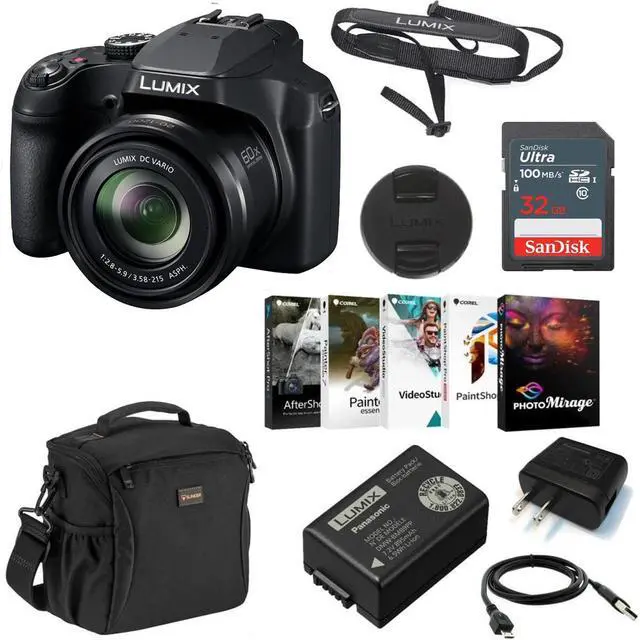
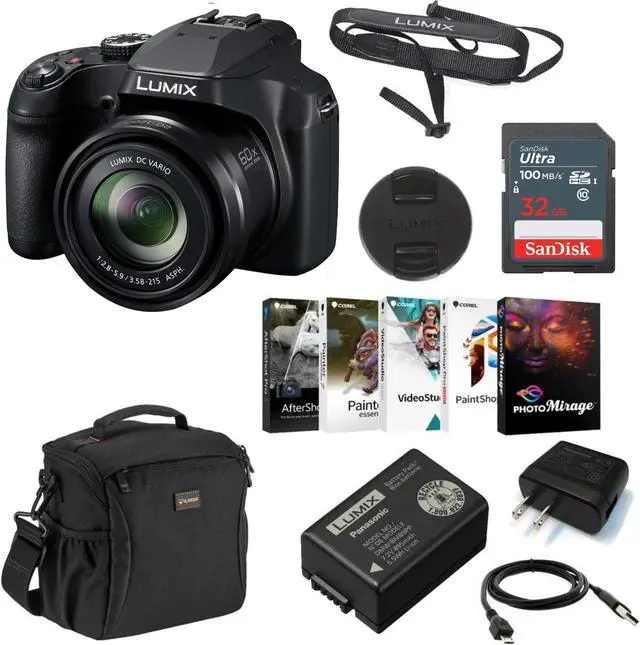
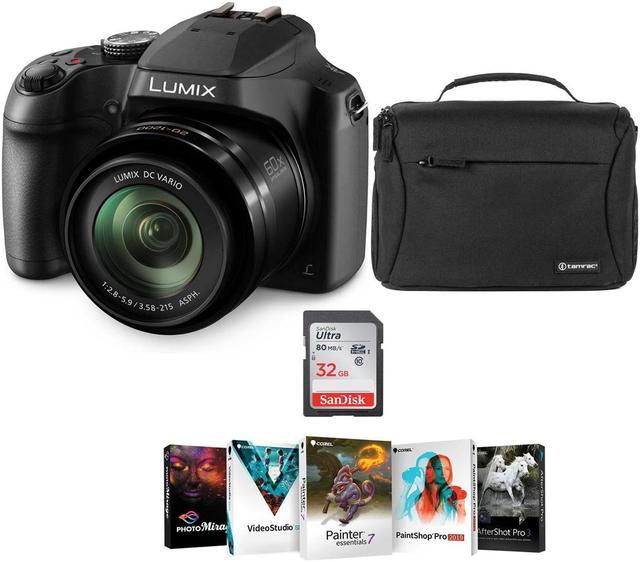
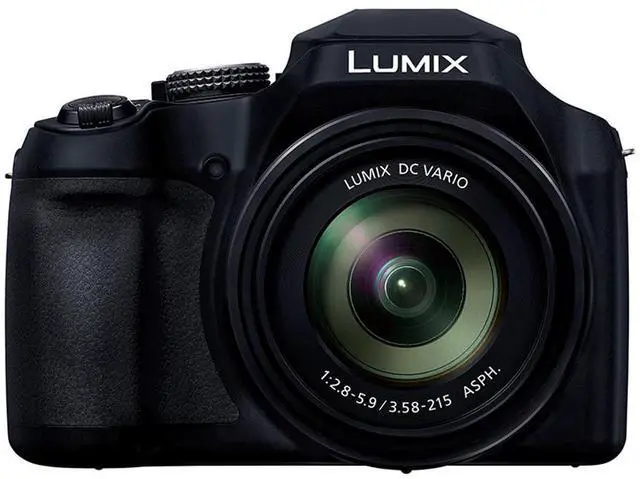


The Panasonic Lumix DC-FZ80 is a point-and-shoot superzoom camera with a 60x optical zoom lens, suited to travelers and wildlife or outdoor photographers who want wide-angle and distant-subject framing without changing lenses.
| Attribute | Value |
|---|---|
| Best For | Travel photography and videography requiring a compact camera with a long-range optical zoom |
| Image Sensor And Resolution | 1/2.3-inch MOS sensor with 18 MP sensor resolution and 18.1 MP effective still resolution |
| Lens And Zoom | 3.6–215 mm lens, equivalent to 20–1200 mm, with 60x optical zoom and f/2.8 aperture |
| Focus And Stabilization | Contrast-detection autofocus with 30 detection points and optical image stabilization |
| Display And Viewfinder | 3-inch LCD screen and electronic viewfinder with 2360-dot resolution and 0.74x magnification |
| Exposure And Shooting | Manual, Program AE, Aperture Priority AE, and Shutter Priority AE modes; ISO 80–12800; 1-second to 1/2000-second shutter range; exposure compensation from −5 to +5 EV; burst shooting up to 10 fps for 10 frames |
| Flash And Timer | Hotshoe flash with auto, red-eye reduction, forced-on, off, and slow, first-curtain, and second-curtain sync modes; 10-second self-timer |
| Video Capture | 4K (2160p) video at 24, 25, or 30 fps, with recording time up to 29 minutes 59 seconds |
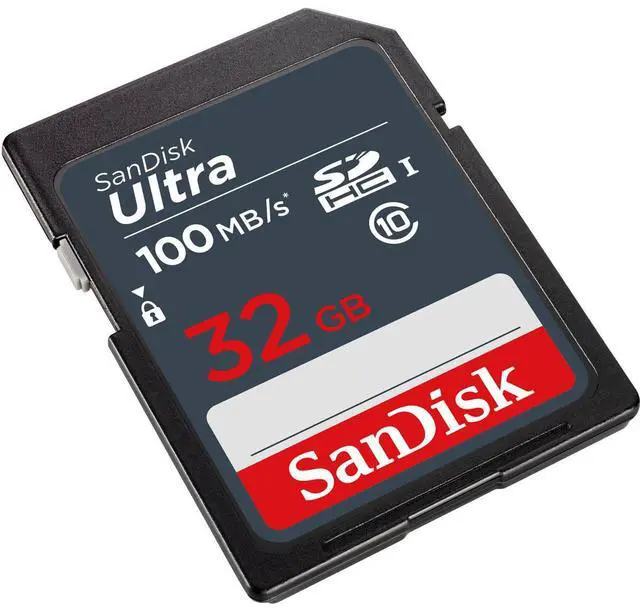
| Storage And File Formats | 32 GB flash memory in a single SD/SDHC/SDXC slot; Class 10, UHS-I, U1-or-higher, V30-or-higher media; supports JPEG and RAW still images |
| Connectivity | Wi-Fi, Micro HDMI (Type D), and Micro-USB 2.0 connectivity |
| Battery And Included Items | One included lithium-ion battery; package items listed include a lens cap, USB cable, and shoulder strap |
| Size And Weight | 5.1 inches wide, 3.7 inches tall, 4.7 inches deep; weighs 1.35 pounds |
| Model Identifiers | Panasonic Lumix DC-FZ80, FZ series; model number GG184 |
Q: Panasonic FZ80 vs FZ80D: which should I choose?
A: Choose the FZ80D if you want the updated 2.36-million-dot viewfinder and USB-C charging. Choose the FZ80 for its 60x, 20–1200mm-equivalent zoom and 4K Photo features; reviews report that the two models share the same sensor and have similar core imaging performance.
Q: Panasonic FZ80 vs FZ300: which is better for wildlife?
A: Choose the FZ80 when extended reach is the priority: its lens covers 20–1200mm equivalent. Choose the FZ300 when you prefer a constant f/2.8 aperture across its 25–600mm-equivalent range. Both are Panasonic bridge cameras with 4K features.
Q: Panasonic FZ80 vs FZ1000: which should I get for image quality or zoom reach?
A: Choose the FZ80 when maximum optical reach is the priority, with a 20–1200mm-equivalent lens. Choose the FZ1000 when you prefer its larger 1-inch sensor and 25–400mm-equivalent f/2.8–4 lens.
Q: Who is the Lumix DC-FZ80 best suited for?
A: It suits travelers and casual photographers who want a built-in lens with a very long zoom for distant subjects. The trade-off is that the lens is fixed, so it cannot be swapped for other lenses.
Q: Can you change or upgrade the lens on the DC-FZ80?
A: No. The DC-FZ80 has a fixed lens built into the camera, so it cannot be replaced with an interchangeable lens.
Q: Can the DC-FZ80 record 4K video, and can I attach an external microphone?
A: It records video up to 4K, but it does not have an external microphone input. It is suitable for casual video capture, but not for setups that require a microphone connected directly to the camera.
Q: Is the DC-FZ80 small enough to carry in a jacket pocket?
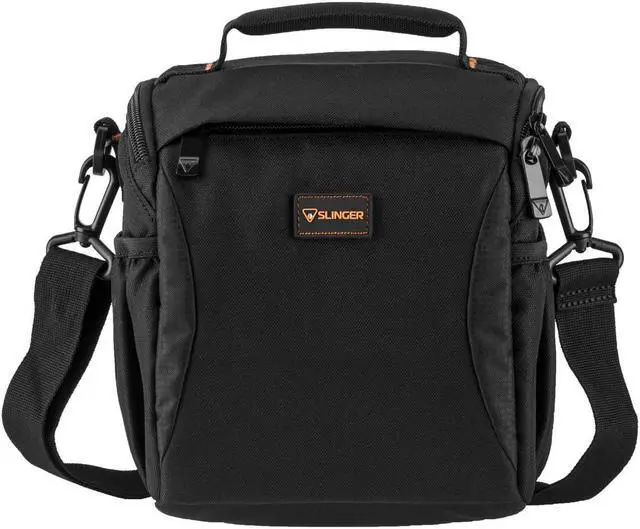
A: It is not a jacket-pocket camera. Plan to carry it in a camera bag or use its strap; its built-in long-zoom lens makes it larger than a typical pocket point-and-shoot.
Q: Who is the Panasonic Lumix FZ80 best suited for?
A: It suits beginners and casual wildlife or travel photographers who value a very long built-in zoom and do not want to change lenses. Community discussions describe it as most useful for distant or relatively still subjects in good light; it is a less suitable fit when low-light image quality or tracking fast-moving subjects is a priority.
Q: Is the FZ80 worth buying for its zoom?
A: It may be worth considering if a very broad zoom range from one fixed lens is your main priority. That convenience comes with trade-offs: discussions note weaker low-light performance and less satisfying image quality at maximum zoom. If balanced image quality matters more than reach, commenters suggest considering a larger-sensor camera instead.
Q: Is the FZ80 good for low-light photography?
A: It is not a strong choice when clean low-light photos are important. Users point to its small sensor as a limitation, especially in shaded areas or at long zoom; a tripod can help with still subjects, but it will not remove the camera’s low-light trade-off.
Q: Is the FZ80 practical for travel?
A: It can be practical for trips where long reach and a single fixed lens are more important than top image quality. A travel discussion reported useful results on land but difficulty keeping shots steady at high zoom on a moving boat, so it may be less dependable for distant subjects from unstable platforms.


