




 here!
I’m your shopping assistant for PC builds, upgrades, and everything tech.
Got questions? Ask away!
Start a conversation
here!
I’m your shopping assistant for PC builds, upgrades, and everything tech.
Got questions? Ask away!
Start a conversationShipped by Newegg
 Top Rated Top Rated Top Rated



Make informed decisions with expert advice. Learn More




Any questions? Ask CelesteSM will help you find out quickly.
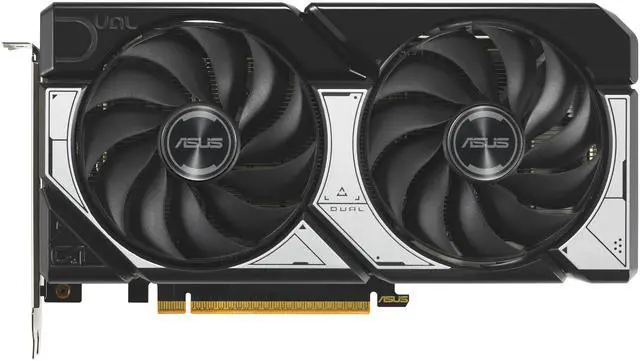
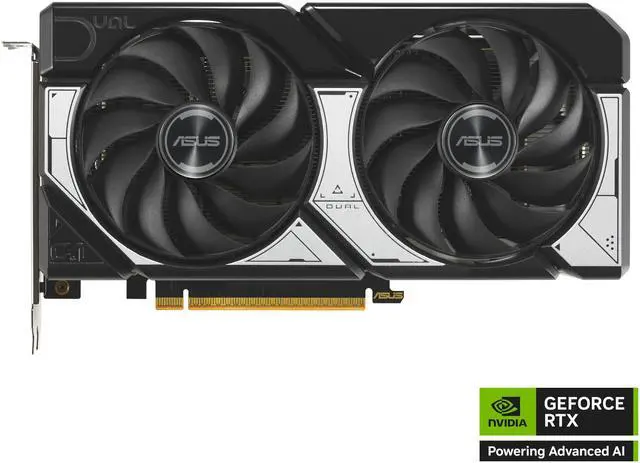
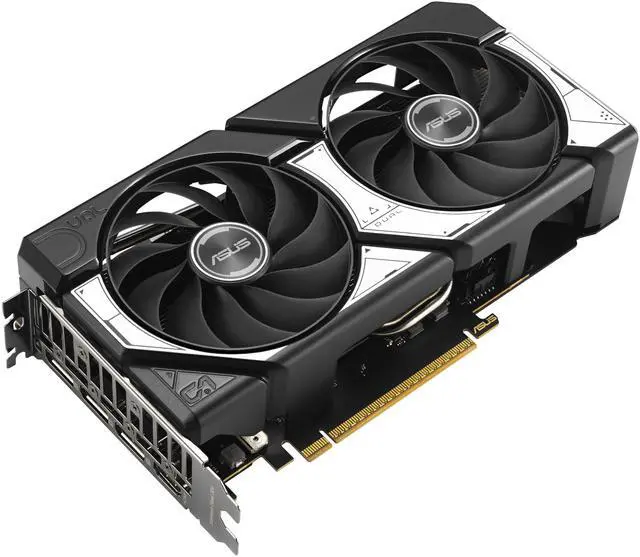
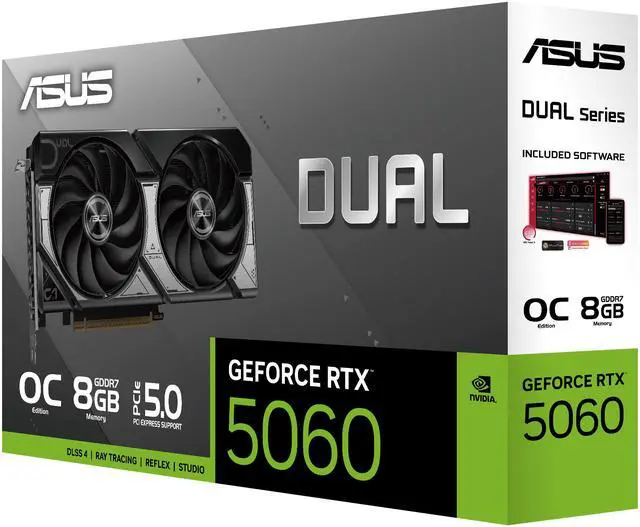
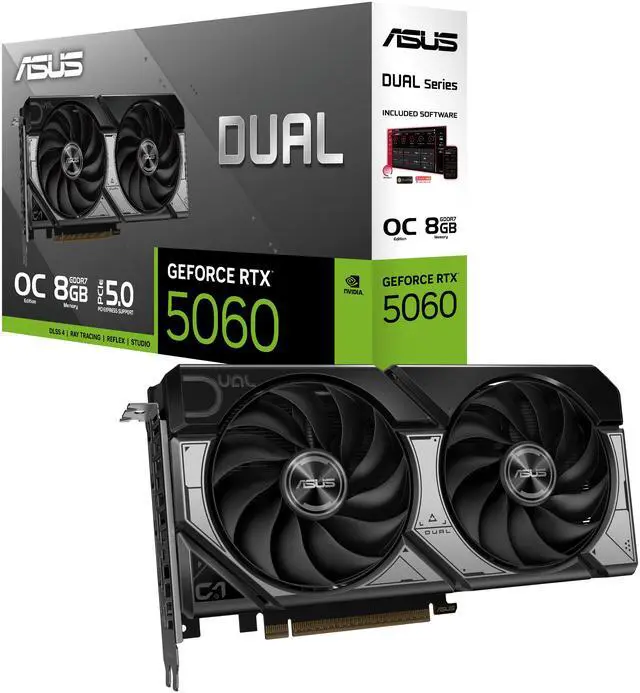
The ASUS Dual GeForce RTX 5060 O8G is an 8GB GDDR7 desktop graphics card built for mainstream PC gamers and creators who want current-gen NVIDIA performance, modern display connectivity, and an easy fit in many ATX builds. Best for 1080p to entry-level 1440p gaming, multi-monitor setups, and everyday content creation workloads.
| Attribute | Value |
|---|---|
| Best For | Desktop users who need an NVIDIA GeForce RTX 5060 card for gaming, VR, and multi-monitor setups (supports up to 4 displays) in ATX builds |
| Model Identifiers | ASUS Dual — model DUAL-RTX5060-O8G (Part Number 90YV0N12-M0AA00) |
| Interface And Bus | PCI Express 5.0 x8 interface, occupies 2.5 expansion slots |
| GPU And Architecture | NVIDIA GeForce RTX 5060 (NVIDIA GeForce RTX 50 Series) using Blackwell architecture |
| Clocks And Compute | 3840 CUDA cores; default boost clock 2535 MHz, OC boost clock 2565 MHz |
| Memory Configuration | 8 GB GDDR7 memory on a 128-bit bus with an effective memory clock of 28 Gbps |
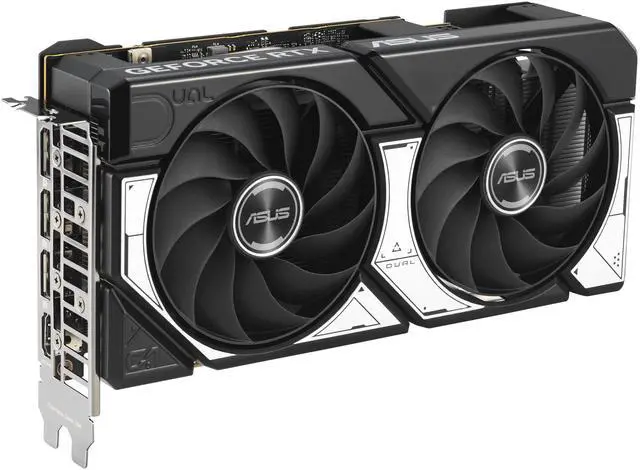
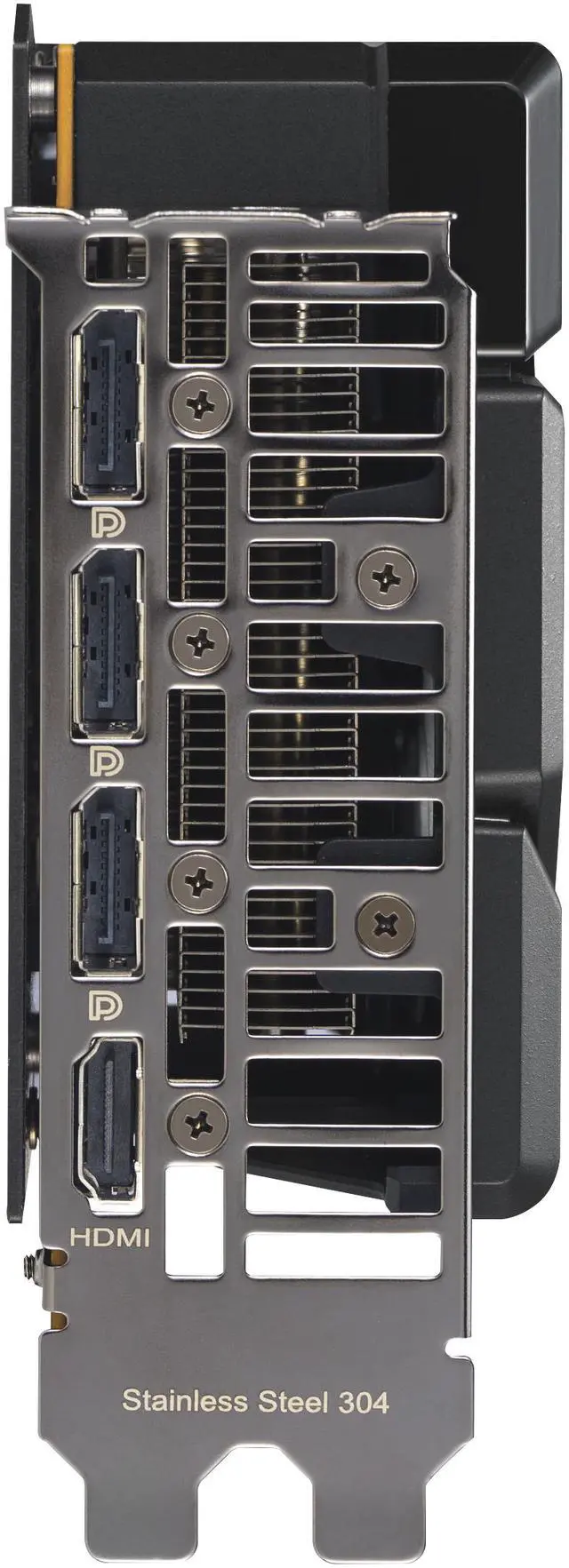
| Display Outputs And Max Resolution | 1× HDMI 2.1b and 3× DisplayPort 2.1b, supports up to 7680×4320 and up to 4 simultaneous displays |
| Cooling And Fans | Dual-fan cooling solution (2 fans) |
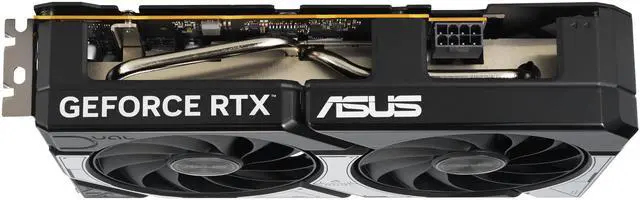
| Power And Requirements | 8-pin power connector with a recommended 550 W PSU |
| Features And Compatibility | DirectX 12 Ultimate and OpenGL 4.6 support; HDCP ready; VR ready; no SLI or CrossFireX support; intended for desktop systems |
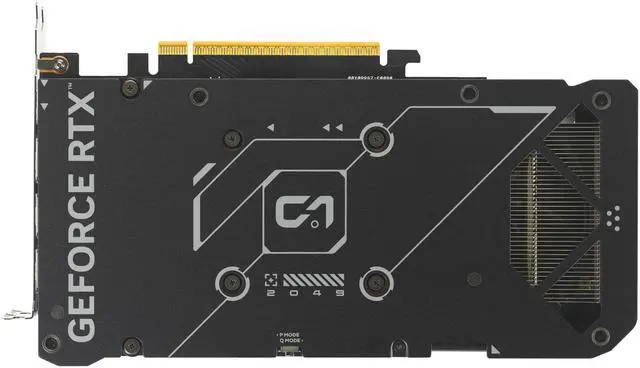
| Dimensions And Weight | Card dimensions 228 × 123 × 50 mm (8.98 × 4.84 × 1.97 in), max GPU length 228 mm, 2.5-slot width; item weight 1.4 lb; package (box) dimensions 6.9088 L × 22.1996 W × 37.4904 H cm, package weight 1.111 kg |
| Package Contents | Includes speedsetup manual and thank-you card; unit count 1 |
| Regulatory And Safety | Safety attestation true; California Proposition 65 warning present; no batteries required or included |
Q: Should I choose the ASUS Dual RTX 5060 8GB or an RTX 4060 8GB for 1080p gaming?
A: Choose the ASUS Dual RTX 5060 8GB if you want a newer 1080p card with higher baseline performance, GDDR7 memory, and access to NVIDIA's newer Blackwell-era features such as Multi Frame Generation support in supported games. Choose an RTX 4060 8GB if the price difference is large and your priority is minimizing build cost. Across official positioning, review coverage, and community discussion, the RTX 5060 is generally treated as the more capable 1080p option, while both cards still share an 8GB VRAM limit that matters in heavier modern titles.
Q: Is the ASUS Dual RTX 5060 8GB a better buy than an RTX 5060 Ti for most users?
A: The ASUS Dual RTX 5060 8GB is the better fit when you want to stay focused on mainstream 1080p gaming, lower total system cost, and a compact dual-fan card. An RTX 5060 Ti makes more sense if you want more performance headroom, especially for higher settings, heavier ray tracing workloads, or a 16GB configuration that is more comfortable in VRAM-demanding games. Review coverage consistently places the non-Ti RTX 5060 below the 5060 Ti, so the choice usually comes down to whether your budget favors value now or extra margin for tougher games.
Q: Should I get the ASUS Dual RTX 5060 8GB or a used RTX 4060 Ti 16GB?
A: Choose the ASUS Dual RTX 5060 8GB if you want a new card with current-generation features, warranty coverage, and a straightforward 1080p-first upgrade. Choose a used RTX 4060 Ti 16GB if both options are priced similarly and your game library includes newer titles that benefit from more VRAM. Community discussions and review patterns commonly frame this as a features-versus-memory decision: the RTX 5060 brings newer generation capabilities, while the 4060 Ti 16GB can be the safer pick for memory-heavy workloads and games.
Q: Is upgrading from an RTX 4060 to the ASUS Dual RTX 5060 8GB worth it?
A: It is usually worth it for a new build or for buyers choosing between the two cards today, but it is a more selective upgrade for someone who already owns an RTX 4060. The RTX 5060 is commonly positioned as faster and more feature-complete, yet both cards remain 8GB class GPUs aimed mainly at 1080p gaming. If your current RTX 4060 already meets your performance target, many community recommendations lean toward waiting for a larger step up, such as a higher-tier model or a card with more VRAM.
Q: Is the ASUS Dual RTX 5060 8GB a better choice than a larger triple-fan card for a compact gaming PC?
A: Yes, this ASUS Dual RTX 5060 8GB is the better choice when case fit, simpler installation, and mainstream power requirements matter more than maximizing cooler size. Its 228 mm length, 2.5-slot design, and single 8-pin power connector make it easier to place in many compact or mainstream ATX and mATX builds than longer triple-fan alternatives. A larger triple-fan card can still make sense if your case has room and your priority is extra thermal or acoustic headroom under sustained load.
Q: Is the ASUS Dual RTX 5060 8GB a good fit for 1080p gaming, or should I look at a stronger card for 1440p?
A: Yes for 1080p, with trade-offs at 1440p. This card is best suited to mainstream 1080p gaming, where an 8GB GDDR7, 128-bit design is typically easier to justify. For 1440p, it can still work, but the 8GB VRAM and 128-bit memory bus make it a more compromise-heavy choice for newer AAA games, high texture settings, or longer-term use. Buyers focused mainly on 1440p longevity should compare it against models with more memory or a wider memory subsystem.
Q: Will this graphics card fit in most PC cases?
A: Usually yes, but you should verify clearance before buying. The card is relatively compact for a modern GPU at 228 mm long and 2.5 slots thick. That makes it easier to fit than many larger triple-fan cards, but small-form-factor and slim cases can still be restrictive. The key checks are GPU length, available slot width, and whether front radiators or drive cages reduce clearance.
Q: Do I need to upgrade my power supply for this card?
A: Maybe. ASUS lists a 550W recommended power supply and this card uses a single 8-pin power connector. If your current PSU is a quality 550W unit or better with the required 8-pin GPU cable, you may be fine. If you have an older, lower-wattage, or low-quality PSU, an upgrade is more likely to be necessary. This is one of the most common graphics-card buying questions because compatibility depends on total system power, not just the card itself.
Q: Is this a better buy than a larger triple-fan RTX 5060 model?
A: It is a better buy if you want a smaller, simpler card and do not need the biggest cooler. The main advantages here are size, easier fit, and a mainstream single-8-pin power setup. A larger triple-fan alternative may run somewhat cooler or quieter under sustained load, but it also takes more space and may cost more. For buyers who value compactness and broad case compatibility, this ASUS Dual model is the more practical option.
Q: Can this card run multiple monitors and modern high-resolution displays?
A: Yes. It supports up to four displays and includes 1 HDMI 2.1b plus 3 DisplayPort 2.1b outputs. That makes it suitable for common multi-monitor gaming or productivity setups. The practical limit is your monitor mix and cable requirements, not the number of ports alone.
Q: Is the ASUS Dual RTX 5060 8GB a good buy for 1080p gaming?
A: It is a reasonable 1080p-focused option if you want a compact current-generation NVIDIA card and mainly play esports, older games, or modern games at balanced settings. The main trade-off is the 8GB VRAM and 128-bit memory bus, which make it a weaker long-term choice for newer AAA games at ultra settings or heavier texture packs.
Q: Who is the ASUS Dual RTX 5060 8GB best suited for?
A: It fits buyers who want an NVIDIA card for mainstream 1080p gaming, a shorter dual-fan design, and standard power requirements. It is also more suitable for smaller mid-tower builds because the card is 228 mm long, uses one 8-pin connector, and has a 550W recommended PSU. It is less suitable for buyers specifically prioritizing maximum VRAM headroom for future AAA titles.
Q: What are the main trade-offs of choosing this RTX 5060 model instead of a higher-VRAM alternative?
A: The main benefit is getting a newer NVIDIA GPU in a compact, simple dual-fan design. The main compromise is memory capacity: 8GB is enough for many 1080p workloads today, but it is more likely to become the limiting factor before the GPU core does in newer, heavier games. If you care more about longevity than compactness or NVIDIA features, a 12GB or 16GB alternative is usually the safer decision.
Q: Is the ASUS Dual RTX 5060 8GB worth paying extra for over another basic RTX 5060 model?
A: Usually only if the price gap is small and you specifically want ASUS, this card's size, or its cooler layout. For buyers comparing one RTX 5060 to another, community discussion tends to treat large premiums within the same GPU tier as poor value because gaming performance differences are usually modest.


