




 here!
I’m your shopping assistant for PC builds, upgrades, and everything tech.
Got questions? Ask away!
Start a conversation
here!
I’m your shopping assistant for PC builds, upgrades, and everything tech.
Got questions? Ask away!
Start a conversationShipped by Newegg







Any questions? Ask CelesteSM will help you find out quickly.


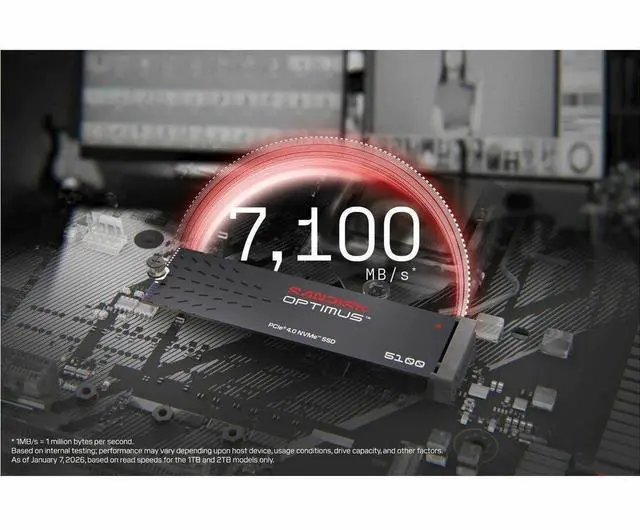
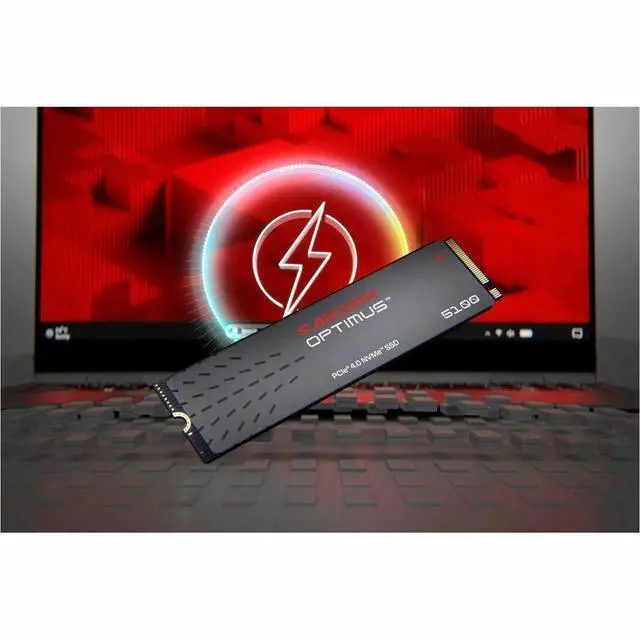
Launch creator applications fast with uncompromising PCIe 4.0 read speeds up to 7,100MB/s(1), (1TB and 2TB models(2)) and write speeds up to 6,700MB/s(1) (1TB-4TB models(2)).

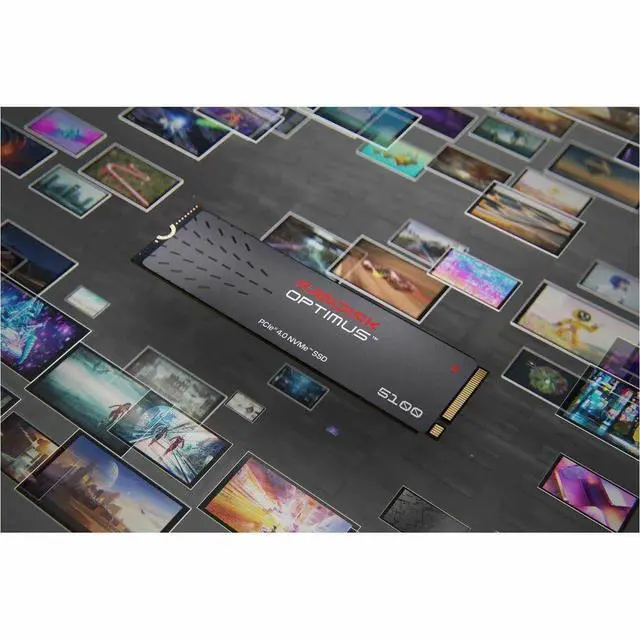
Make more room for your 4K videos and high-resolution images with capacities from 500GB(2) up to 4TB(2) on M.2 2280 built with our trusted 8th generation SANDISK BiCS QLC 3D CBA NAND.

With an all-new power-efficient design, your drive delivers high performance with low power consumption, giving you more time to be productive on the go.

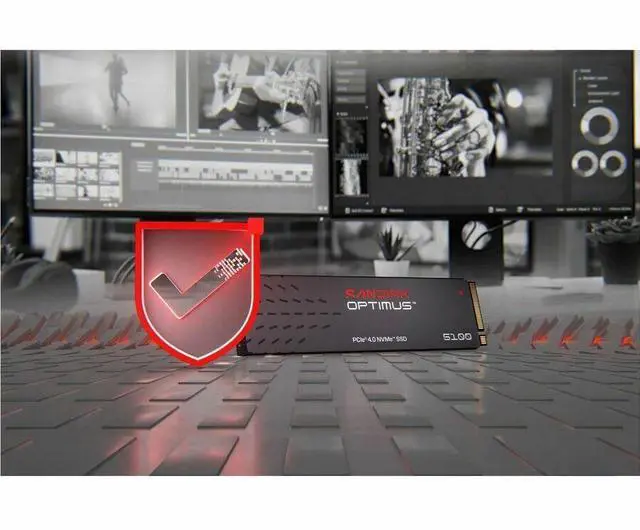
With up to 1,200TBW(3) (4TB model(2)) endurance rating, your drive is designed for video editing and productivity suites.

Monitor your SSD’s performance and check for updates with the downloadable SANDISK Dashboard application(4) (Windows only).

For reliable transfer of your data to your new SSD (separate cable/enclosure may be required).


(1) 1MB/s = 1 million bytes per second. IOPS = input/output operations per second. Based on internal testing; performance may vary depending upon host device, usage conditions, drive capacity, and other factors.
(2) 1GB = 1 billion bytes and 1TB = 1 trillion bytes. Actual user capacity may be less depending on operating environment.
(3) TBW (terabytes written) values calculated using JEDEC client workload (JESD219) and vary by product capacity.
(4) Available for download; see the Sandisk website for more details.
(5) Download, installation, and administrative privileges required. Includes 5-year license for your compatible drive. Redeem within 90 days of purchase. Terms and conditions apply. User account registration may be required. May not be combined with other offers. Offer limited; see official Sandisk website for more details. Offer subject to change.
SANDISK, the SANDISK logo, SANDISK Optimus, and nCache are registered marks or marks of Sandisk Corporation or its affiliates in the U.S. and/or other countries. Acronis and True Image are registered marks of Acronis International GmbH in the United States and other countries. The NVMe word mark is a mark of NVM Express, Inc. PCIe is a registered mark of PCI-SIG. Windows is a registered mark of the Microsoft group of companies. All other marks are the property of their respective owners. Product specifications subject to change without notice. Pictures shown may vary from actual products.
2026 Sandisk Corporation or its affiliates. All rights reserved.
Overview
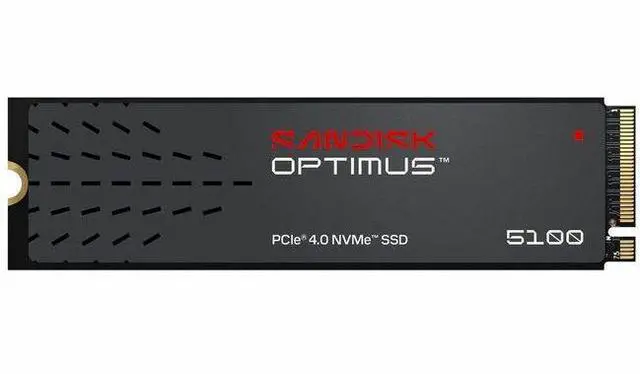
The SanDisk Optimus 5100 is a 2TB internal solid state drive designed for systems that support an M.2 2280 drive with a PCI-Express 4.0 x4 interface and NVMe protocol. It combines QLC 3D CBA NAND memory components with sequential read speeds up to 7100 MBps.
Key Features
Performance
The drive delivers maximum sequential performance of up to 7100 MBps read and up to 6700 MBps write. Maximum 4KB random performance reaches up to 1,000,000 IOPS read and up to 1,300,000 IOPS write. Power consumption is 4 mW idle and average active power is 4.1W for read and 4.1W for write.
Design
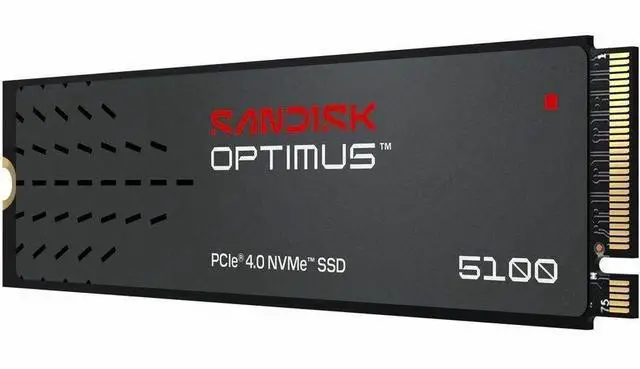
The drive uses an M.2 2280 form factor and is supplied without a heatsink. It measures 2.38mm in height, 22mm in width, and 80mm in depth, with a weight of 5.7g.
Connectivity & Compatibility
The SanDisk Optimus 5100 uses a PCI-Express 4.0 x4 interface and NVMe protocol in an M.2 2280 form factor. Compatibility depends on system support for these interface, protocol, and form-factor specifications.
Reliability & Durability
The drive is rated for 900TB terabytes written and a 1,750,000-hour MTBF. Operating temperature is 0°C ~ +85°C, while storage temperature is -40°C ~ +85°C. Maximum shock resistance is 1,500G @ 0.5 ms half-sine. Operating vibration is 5 gRMS, 10-2000 Hz, 3 axes; non-operating vibration is 4.9 gRMS, 7-800 Hz, 3 axes.
Specifications
We want to ensure your holiday shopping this year is hassle-free. That’s why we’re automatically extending our return policies on almost every product! For purchases placed between November 1st, 2026 and December 31, 2026 you will have until January 31, 2027 to return your product.
The SanDisk Optimus 5100 is a 2TB M.2 2280 NVMe SSD for compatible PCs, with PCIe 4.0 x4 and rated sequential speeds up to 7,100 MB/s read and 6,700 MB/s write. It suits users upgrading storage for fast everyday computing, gaming, or large-file workflows.
| Attribute | Value |
|---|---|
| Best For | Gaming, personal, and business storage in desktop or laptop PCs |
| Capacity | 2TB of solid-state storage |
| Interface And Form Factor | M.2 2280 internal SSD with PCIe 4.0 x4 and NVMe |
| Read And Write Performance | Sequential read up to 7,100 MB/s and write up to 6,700 MB/s; 4K random read up to 1,000,000 IOPS and write up to 1,300,000 IOPS |
| Endurance And Reliability | Rated for 900TB written and 1,750,000 hours MTBF |
| Power And Operating Conditions | Idle power 4mW; average active read and write power 4.1W each; operating temperature 0°C to 85°C and storage temperature −40°C to 85°C |
| Shock And Vibration Resistance | Shock resistance up to 1,500G at 0.5ms half-sine; operating vibration 5gRMS at 10–2,000Hz across 3 axes and non-operating vibration 4.9gRMS at 7–800Hz across 3 axes |
| Physical Specifications | 80 × 22 × 2.38mm; weighs 5.7g; supplied without a heatsink |
| Compatibility | Listed for PC and Windows systems, desktop and laptop devices, and Sony PlayStation 5 and Microsoft Xbox Series S consoles |
| Model Identifiers | SanDisk Optimus 5100; model SDSP51200TAN-000E0 |
Q: SanDisk Optimus 5100 or Optimus GX 7100 for a 2TB gaming drive?
A: Choose the Optimus 5100 for general storage and gaming when its QLC design and listed speeds of up to 7,100/6,700 MB/s meet your needs. Choose the Optimus GX 7100 if you prefer TLC NAND and a drive positioned for gaming: its 2TB model is rated up to 7,250/6,900 MB/s and 1,200 TBW, compared with the 5100’s 900 TBW. Both are M.2 2280 PCIe 4.0 x4 drives; the GX’s listed peak speeds are modestly higher, not a guarantee of faster results in every workload.
Q: SanDisk Optimus 5100 or Crucial P310 2TB?
A: Both are M.2 2280 PCIe 4.0 QLC SSDs with up to 7,100 MB/s sequential reads. The Optimus 5100 is rated for up to 6,700 MB/s writes and 900 TBW; the P310 2280 is rated for up to 6,000 MB/s writes and 440 TBW. Based on those published specifications, choose the Optimus 5100 if its price is competitive and you value the higher rated write speed and endurance; compare current prices and warranty terms before buying.
Q: Is the Optimus 5100 a worthwhile upgrade from the WD Blue SN5000?
A: It can be worthwhile if you want a newer drive with higher published performance: SanDisk’s comparison of the WD Blue SN5100 with the SN5000 reports over 30% higher sequential read performance and a 37% higher PCMark 10 score for the 2TB SN5100. If your SN5000 already has enough capacity and performs well for your workloads, those figures alone do not establish that an upgrade will noticeably improve everyday use.
Q: Should I get the Optimus 5100 or a Crucial P310 for a handheld or compact laptop?
A: Check the device’s required M.2 size before choosing. The Optimus 5100 is an M.2 2280 drive, while the Crucial P310 is also available in M.2 2230, a shorter format used by some compact devices. Choose the 2230 P310 only if the device requires that size; choose the Optimus 5100 when the system supports M.2 2280 and you want its 2TB capacity and listed 900 TBW endurance.
Q: Will this SSD work in my laptop or desktop?
A: It can work in a laptop or desktop with an available M.2 2280 slot that supports PCIe NVMe SSDs. Check the device’s specifications before buying; this drive is PCIe 4.0 x4, and the host system determines compatibility and achievable speed.
Q: Will it fit in a laptop, and does it come with a heatsink?
A: The drive is a 22 × 80 mm M.2 2280 module and does not include a heatsink. It may fit a laptop with a compatible M.2 2280 NVMe slot, but check the laptop’s slot dimensions and thermal provisions before installation.
Q: Is this a good choice for gaming and large files?
A: Its 2TB capacity and PCIe 4.0 x4 interface suit users who want substantial internal storage and fast transfers. The listed sequential speeds are up to 7,100 MB/s read and 6,700 MB/s write; actual performance depends on the computer and workload.
Q: Is the SanDisk Optimus 5100 a good choice for gaming?
A: It is a reasonable option for game storage if your PC supports an M.2 2280 NVMe drive. Its 2TB capacity and PCIe 4.0 interface suit a game library; the main caveat is its QLC NAND, which is a consideration for write-heavy use rather than ordinary game loading.
Q: Is the 2TB Optimus 5100 worth buying at its price?
A: It depends on the price. The drive is rated for up to 7,100 MB/s reads and 6,700 MB/s writes, but those peak figures alone do not establish better everyday performance. Compare its price with alternatives, especially TLC drives, if the cost is similar.
Q: Is it a good fit for frequent large file writes?
A: It may not be the best fit if you regularly write large amounts of data. This 2TB model uses QLC NAND and is rated at 900 TBW; Reddit discussion identifies write-heavy use as a trade-off for the Optimus 5100 line. Compare TLC models and endurance ratings for sustained workloads.


