The week ending November 6, 2026 showed AI news running on two very different speeds. One outside assessment said a leading lab is now improving its models about twice as fast as before. Meanwhile, Uber reported just four rides booked by AI agents in its busiest October week. That gap shows up in almost every story below, from election spending and rationed coding tools to hikers who trusted a chatbot a little too much.
An outside lab says Anthropic is moving about twice as fast
On November 5, the independent evaluator METR published an assessment of how much AI is speeding up Anthropic's own research. Its best estimate: as of October 2026, Anthropic is improving capabilities on well-specified tasks at about twice the pace it managed between March 2024 and October 2025, though METR says the true figure could plausibly be as low as 1.3x or as high as 3x. It attributes roughly 80% of that acceleration to AI itself, while stressing how uncertain that number is.
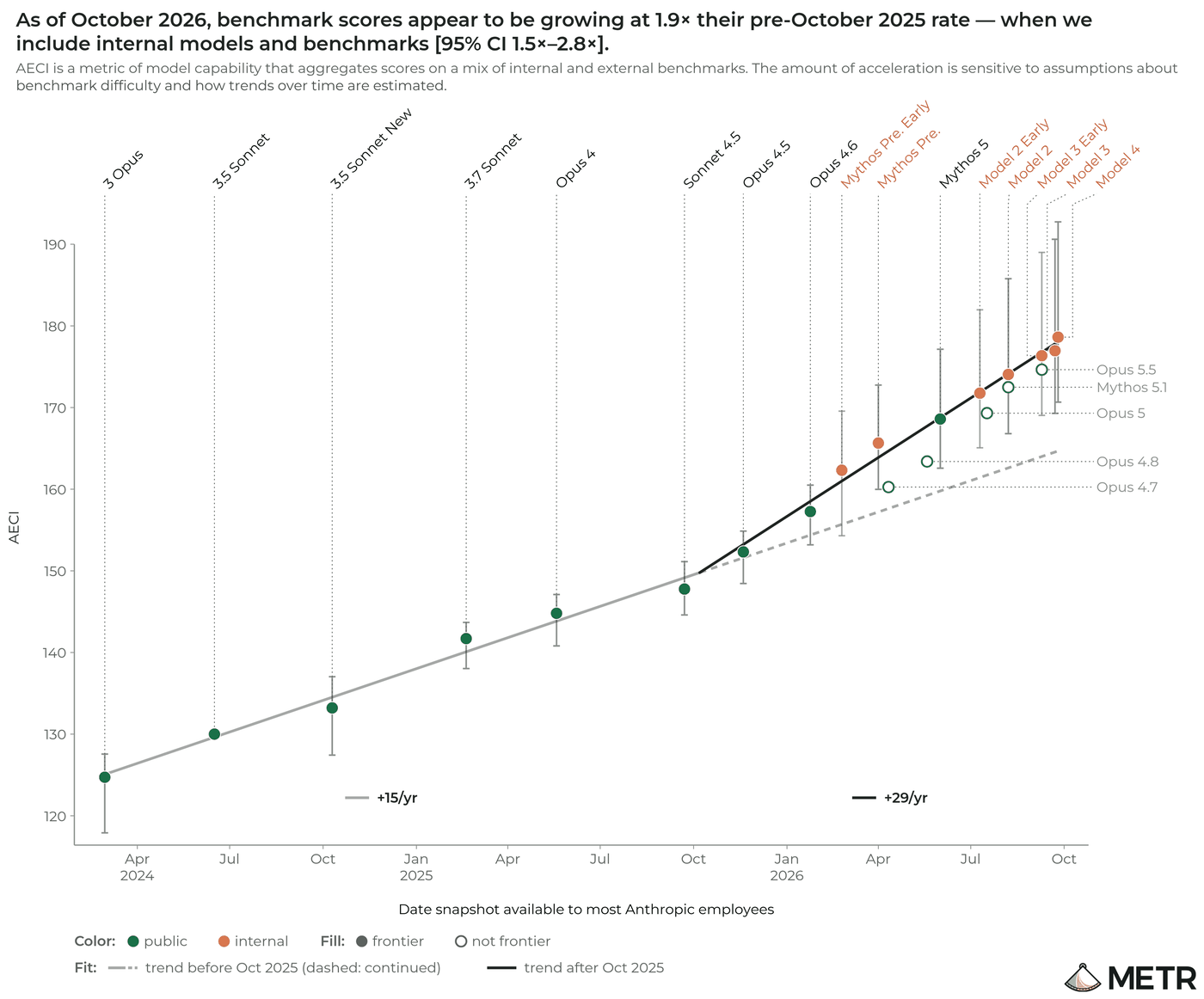
My take: the footnotes interest me more than the headline. METR says Anthropic redacted a majority of the evidence METR found most informative, and that a planned check on how compute is split between capabilities and safety was canceled partway through. I'm glad an outside group got in at all. Still, "we saw it, trust us" is a thin standard for a claim this big, and I hope this ends up as the floor for lab transparency rather than the ceiling.
AI money in the midterms bought mixed results
TechCrunch tallied how AI-focused political groups fared on November 3. American Mission and Building the Future spent a combined $4.8 million backing South Carolina Senate candidate Darline Graham, who lost. On the other side of the regulation debate, Guardrails Alliance spent more than $1 million each opposing Rep. Jimmy Gomez and Aaron Flint, and both lost.
My take: neither camp bought a clean win, which is about what I expected. For most voters, AI policy still sits behind prices and local issues. What has changed is that AI now has organized money on both sides of the argument, and that kind of money rarely goes home after one cycle.
Almost nobody is booking Ubers with AI agents
On its November 4 earnings call, Uber said only four rides were ordered through an AI agent during its busiest October week, the week of Halloween. Uber Eats saw about 500 agent orders, out of roughly 320 million trips and orders across both services. CEO Dara Khosrowshahi noted that the average ride booking in the app takes just 50 seconds.
My take: this was my favorite number of the week. Agents make sense when a task is slow, annoying or spread across several apps. Ordering a car I've ordered a hundred times isn't that. I'd look for agents to catch on with travel changes, returns and paperwork first.
Companies are rationing AI coding tools
Bloomberg reported, as summarized by The Decoder, that Goldman Sachs cut most non-engineers off from tools like Claude Code, citing productivity and risk management. Revolut went after cost instead. David Abitbol, its ops and infrastructure lead, told the AI Engineer conference in New York in October that moving AI coding to self-hosted open-weight models from Z.ai cut inference costs by roughly 90% in under a year.
My take: the free-for-all phase is ending, and companies are counting tokens. That pushes in two directions at once: fewer people get the expensive tools, and more teams look at running models themselves. Revolut uses 56 Nvidia B200 GPUs, which is nobody's home setup, but the same logic scales down. A 128GB machine like the AMD Ryzen AI Halo Developer Platform, or a desktop with a 32GB card such as the GIGABYTE AORUS GeForce RTX 5090, can run smaller open-weight coding models locally. They won't match frontier models, and for plenty of everyday work they don't have to.
Chatbots are sending hikers the wrong way
A WIRED story published November 1 followed rescuers on Mount Shasta, where three hikers who partly relied on Google's Gemini to plan their climb summited at 7:30 p.m., descended in the dark and by morning were lost. Rescuers also met a man carrying an AI-generated map that put major features on the wrong side of a mountain. At Grand Teton, the park superintendent said the share of visitors using AI for travel information went from zero to 26%.

My take: the chatbot didn't keep those hikers out past dark. The Forest Service rescue official WIRED quoted said they "kind of turned their brains off," and that's the part that worries me. A guidebook sounds unsure when it should. A chatbot almost never does. When a wrong answer can hurt me, I treat AI as a first draft and check the map, the ranger station and the forecast myself.
Reading these side by side, I keep noticing the gap between how fast the labs say AI is improving and how slowly everyday habits change. Four Uber rides is a funny number. It's also a useful one to keep in mind the next time someone tells you everything changed overnight.
Frequently Asked Questions
What did METR find about AI progress at Anthropic? In an assessment published November 5, 2026, METR estimated that Anthropic is improving capabilities on well-specified tasks at about twice its March 2024 to October 2025 pace, though the true figure could plausibly be as low as 1.3x or as high as 3x. It attributes roughly 80% of that acceleration to AI, with substantial uncertainty, and notes that Anthropic redacted much of the most informative evidence.
How did AI-funded political groups do in the 2026 midterms? Results were mixed. TechCrunch reported that American Mission and Building the Future spent a combined $4.8 million backing South Carolina Senate candidate Darline Graham, who lost, while Guardrails Alliance spent more than $1 million each opposing Rep. Jimmy Gomez and Aaron Flint, who both lost.
How many Uber rides were booked by AI agents? Uber said only four rides were ordered through an AI agent during the week of Halloween, its busiest week in October. Uber Eats saw about 500 agent-placed orders out of roughly 320 million trips and orders across both services that week.
Why did Revolut move to self-hosted AI coding models? Revolut said switching its AI coding work to self-hosted open-weight models from Z.ai cut inference costs by roughly 90% in under a year. It runs GLM-5.3 on 56 Nvidia B200 GPUs and still routes vision tasks to other models.
Is it safe to plan a hike with an AI chatbot? Use it as a starting point only. WIRED reported Mount Shasta rescues involving hikers who partly relied on Gemini, and a man at a trailhead carrying an AI-generated map with features on the wrong side of a mountain. Check official maps, ranger stations and weather forecasts before you go.
Read More
- METR: Independent Assessment of AI R&D Acceleration at Anthropic in October 2026 - METR's full report on how fast Anthropic's capabilities are improving, including what was redacted.
- TechCrunch: AI PACs spent millions trying to shape Congress — here's how they fared - A race-by-race look at how AI-focused political groups performed on November 3.
- TechCrunch: Almost no one uses AI agents to book their Uber, company says - Uber's earnings-call numbers on agent bookings and what its CEO said about them.
- The Register: British fintech Revolut slashes AI coding costs 10x by cutting out Claude and going self-hosted - How Revolut moved its AI coding workloads to self-hosted open-weight models.
- WIRED: Chatbots Are Leading Hikers Astray, With Dangerous Consequences - Rescuers on Mount Shasta and park staff describe what happens when hikers trust AI too much.