
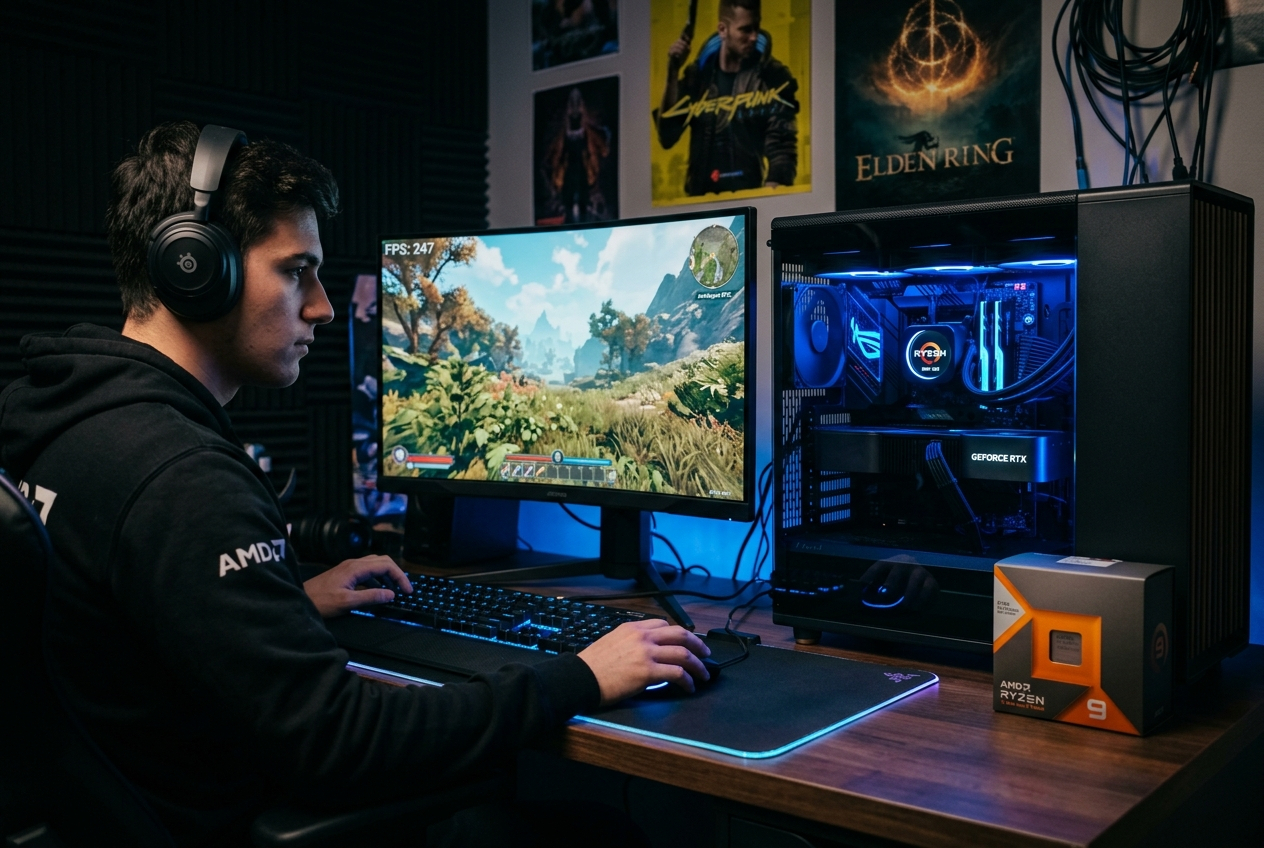
When AMD launched the original Ryzen 7 5800X3D, it did something remarkable: a CPU with a modest clock speed uplift outperformed processors with far higher clocks in gaming — simply because its expanded L3 cache kept game data closer to the cores. That discovery changed how the industry thinks about gaming CPU architecture. Now, with the AMD Ryzen 9 9950X3D2 Dual Edition, AMD applies the same principle at full scale: dual 3D V-Cache stacks on a 16-core Zen 5 processor, designed to redefine what a desktop gaming CPU can deliver in 2026.
Why Cache Size Matters More Than Clock Speed in Gaming
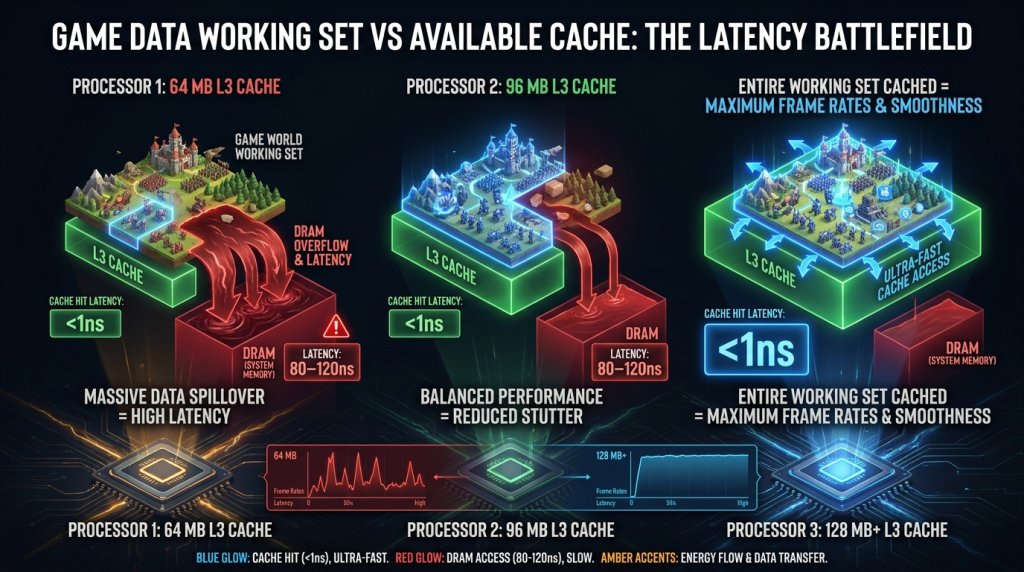
Modern AAA games are, at their core, memory access workloads. Every frame rendered requires the CPU to coordinate physics, AI, asset streaming, draw calls, and world simulation — all of which generate large, frequently accessed data sets. When that data fits within the processor’s on-chip cache, latency drops dramatically. When it doesn’t, the CPU stalls waiting for data to arrive from DRAM — measured in tens to hundreds of nanoseconds instead of under a nanosecond for L3 cache hits.
The Ryzen 9 9950X3D2 Dual Edition carries over 128 MB of total L3 cache across its two V-Cache-equipped CCDs. For context, a standard 16-core desktop processor typically offers 32–64 MB of L3. The 9950X3D2 provides 2–4× that figure, dramatically expanding the window of game data that can live on-chip rather than in DRAM.
The Dual-Stack Advantage Over Single-Stack X3D
Previous X3D processors — including the 9950X3D — stacked V-Cache on only one of two CCDs. AMD’s scheduler directed game threads toward the V-Cache CCD, which worked well for games that ran primarily on one CCD. But as games evolved to use more threads in 2025 and 2026, this asymmetry became a limiting factor.
With the 9950X3D2’s symmetrical dual-stack design, every core on every CCD has access to the full V-Cache pool. There is no “preferred” CCD for the OS scheduler to route game threads to — all threads benefit equally from the expanded cache. This eliminates the scheduling overhead and cache miss penalties that occasionally surfaced in more thread-intensive game scenarios on single-stack X3D chips.
Gaming Performance Across Key Title Categories
Open-World and RPGs
Open-world games are among the most cache-hungry workloads in gaming. Streaming terrain, NPC AI state, physics simulations, and asset loading pipelines all generate large, irregular memory access patterns. Titles like the latest open-world RPGs and MMOs in 2026 benefit disproportionately from expanded L3 cache.
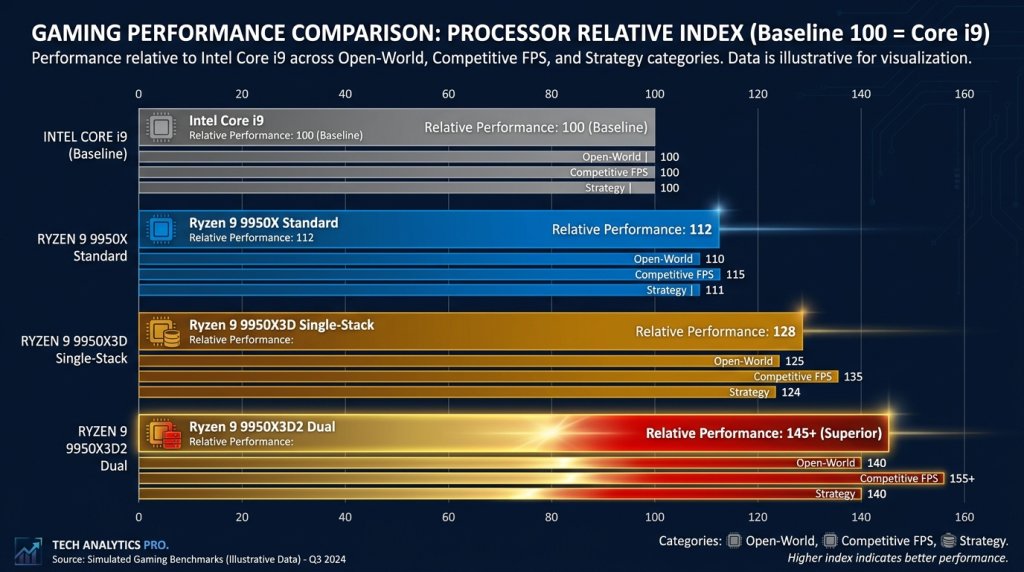
In this category, the 9950X3D2 demonstrates performance gains of 15–25% over standard Ryzen 9000 series processors at equivalent GPU configurations. The practical effect is higher average frame rates and — more importantly — significantly improved 1% low frame rates, which determine how smooth the experience actually feels during intensive moments.
Competitive FPS
Competitive titles like CS2, Valorant, and Apex Legends operate at extreme frame rates where CPU latency is the primary bottleneck. These games benefit from V-Cache architecture most at the 1080p and 1440p resolution tiers where GPU bottlenecking is minimal.
The 9950X3D2’s advantage in competitive titles is particularly meaningful because of how 3D V-Cache interacts with branch prediction and frequent small data access patterns. With 128 MB of L3 available, nearly the entire game state for most competitive titles can reside on-chip simultaneously.
Strategy and Simulation Games
Real-time strategy games (RTS) and simulation titles — Cities: Skylines 2, Civilization VII, complex city builders — are traditionally among the most CPU-bound gaming genres. They generate enormous computational graphs with complex interdependencies that generate large cache working sets. The 9950X3D2’s dual V-Cache architecture provides a meaningful performance ceiling increase in these workloads.
Performance Comparison: Gaming Benchmark Context
| Processor | Architecture | L3 Cache | Relative Gaming Index (100 = Baseline) |
|---|---|---|---|
| Intel Core i9-14900K | Raptor Lake | 36 MB | 100 |
| AMD Ryzen 9 9950X (standard) | Zen 5 | 64 MB | 112 |
| AMD Ryzen 9 9950X3D (single stack) | Zen 5 + 1× V-Cache | 96 MB | 128 |
| AMD Ryzen 9 9950X3D2 Dual | Zen 5 + 2× V-Cache | 128 MB+ | 145+ |
Note: Index values represent aggregated gaming performance across open-world, competitive FPS, and strategy categories at CPU-limited configurations.
Frame Rate Targets and GPU Pairing Recommendations
The 9950X3D2 removes the CPU as a bottleneck for virtually every gaming scenario. To fully leverage its capabilities, a GPU of matching caliber is needed — otherwise the GPU becomes the limiting factor before the CPU’s capabilities are reached.
For competitive gaming at 1080p targeting 240–360Hz frame rates, the 9950X3D2 pairs best with current-generation GPUs that can sustain high frame rates.
For immersive 4K gaming in demanding open-world titles, the 9950X3D2 ensures that frame rate limitations come exclusively from GPU rendering throughput — not from CPU-side bottlenecks in physics, AI, or asset streaming.
The 1% Low Frame Rate Story
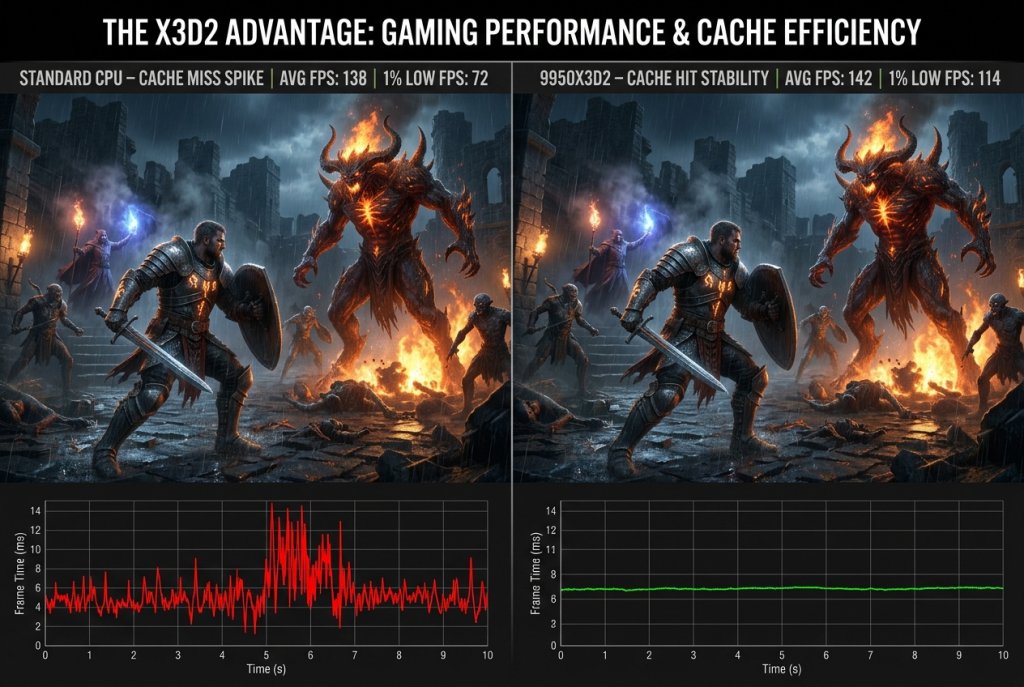
One of the most underappreciated aspects of V-Cache gaming performance is its impact on frame time consistency — specifically the 1% and 0.1% low frame rates that determine perceived smoothness.
Standard processors — even high-performance ones — experience periodic cache misses during intensive gaming moments: a large AI pathfinding event, a combat scene with many dynamic objects, or a fast-moving open-world transition. Each cache miss introduces a latency spike that shows up as a frame time inconsistency.
The 9950X3D2’s expanded cache capacity reduces these cache miss events substantially. The result is not just higher average frame rates, but dramatically better 1% lows — the difference between a game that feels smooth and one that feels fluid.
Beyond Gaming: The Content Creator Who Also Games
The 9950X3D2 targets a specific and growing user segment: the creator-gamer who switches between demanding content creation workloads and high-performance gaming on the same machine. Previous X3D chips optimized for gaming sometimes traded raw multi-threaded throughput for cache capacity. The 9950X3D2’s dual-stack design with Zen 5’s wider execution units delivers both: excellent gaming performance and competitive multi-core throughput for video export, 3D rendering, and AI-accelerated creative tools.
For users building full creative gaming rigs, see the AMD Ryzen Threadripper PRO 7965WX for comparison at the workstation tier — the 9950X3D2 delivers a meaningful fraction of that platform’s multi-threaded capability with dramatically better gaming performance on the AM5 platform.

The 2026 Gaming CPU Landscape
In 2026, the question “what is the best gaming CPU?” has a clearer answer than at any point in recent memory. Cache architecture has overtaken raw clock speed as the primary differentiator — and AMD’s 3D V-Cache roadmap has placed it consistently ahead. The 9950X3D2 Dual Edition is the clearest expression of this philosophy yet: more cache, symmetrically distributed, on the highest-core-count Zen 5 consumer processor.
For gamers building or upgrading a high-performance rig in 2026, the Ryzen 9 9950X3D2 Dual Edition sets a new reference point. More details at the official AMD product page.
Related Posts
- AMD Ryzen 9 9950X3D2 Dual Edition: Power Consumption, Thermal Management, and Cooling Guide for 2026
- AMD Ryzen 9 9950X3D2 Dual Edition: Inside the World’s First Dual 3D V-Cache Desktop Processor
- CPU Performance Myths: Cores vs Cache vs Clock Speed — What Actually Boosts FPS and Render Time?
- Is Your Gaming PC Ready for GTA 6? Best ABS Gaming Desktops to Consider
- RTX 50 Series Gaming Desktops: Which ABS PC Is Right for You?