
I have been building AM5 machines since the platform launched, and for most of that time the memory advice was boring in a good way: buy a DDR5-6000 kit with an EXPO profile, turn the profile on, stop thinking about it. That advice still works. What changed this year is that AMD added a second kind of profile, and G.SKILL’s Trident Z5 NeoX RGB is the line built around it.
The short version: EXPO ULL does not raise the clock. Every kit here is still DDR5-6000. What it does is ship tighter sub-timings at that same speed, validated by the vendor, in a profile you enable from the BIOS exactly like a normal EXPO profile. Same frequency, less waiting.
What the NeoX Lineup Actually Is
Ten SKUs, all 32GB as 2 x 16GB, all DDR5-6000, all listing “AMD EXPO ULL / AMD EXPO” as their profile support. That last detail matters more than it looks: each module carries both a ULL profile and a conventional EXPO profile, so if the tight one does not agree with your board you have somewhere to fall back to without buying different memory.
What separates the SKUs is one number and its voltage cost.
| Tier | Timing as published | Voltage | Finishes |
|---|---|---|---|
| CL36 | 36-36-36-76 | 1.35V | Mirror black, matte black, matte white |
| CL30 | 30-38-38-32 | 1.35V | Matte black, matte white |
| CL28 | 28-36-36-32 | 1.40V | Mirror black, matte black, matte white |
| CL26 | 26-36-36-32 | 1.45V | Matte black, matte white |
The One I Would Buy
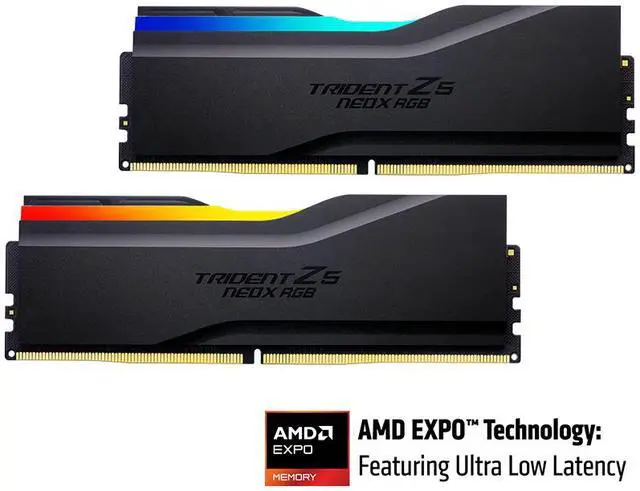
The Trident Z5 NeoX RGB CL26 in matte black is the headline part and the one I would put in a build I was trying to make quick rather than cheap. CL26-36-36-32 at DDR5-6000 is a genuinely tight primary set for a retail kit, and the trade is written on the box: 1.45V rather than the 1.35V the CL36 and CL30 kits run at.
Whether that voltage bothers you is a real question, not a rhetorical one. It is within what these modules are specified and warrantied for, so it is not risky in any meaningful sense. It does mean slightly more heat in a cramped case, and it means the modules sit closer to their ceiling if you later want to tune by hand.
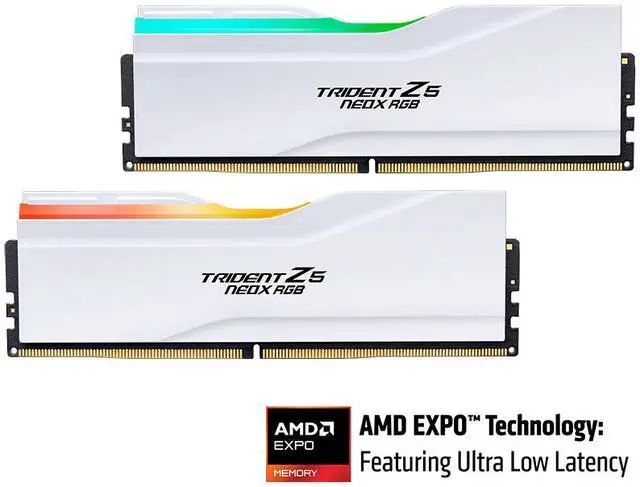
The same CL26 kit in matte white is the identical part in a different finish, which is the whole reason the lineup has three colours.
The One Most People Should Buy
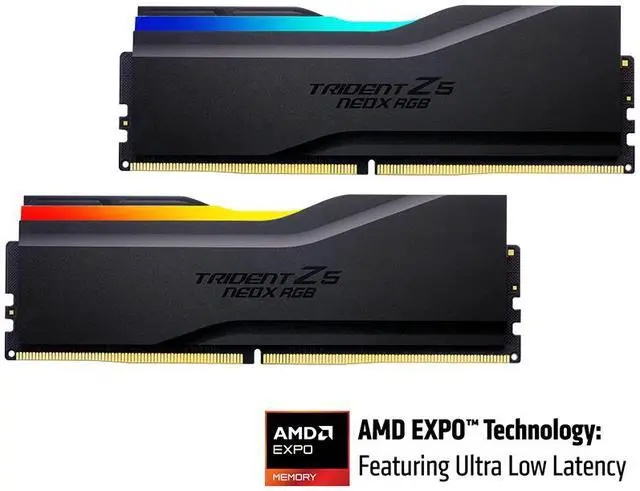
The NeoX RGB CL30 kit is where I would land for a normal gaming build. 30-38-38-32 at 1.35V, which is the same voltage as the mainstream kits people have been buying for two years, with a noticeably tighter profile than the CL36 tier.
Between those two sits the CL28 kit at 1.40V. It is the tier I find hardest to argue for, not because it is bad but because it is squeezed: you are paying a voltage step over CL30 for two clocks of latency, and if you care enough to want those two clocks you probably want CL26 anyway.
At the other end, the CL36 kit is the entry to the line at 36-36-36-76 and 1.35V. Note the fourth figure there is shorter than the 96 you see on the older kits below, which is the only visible sign in the spec table that this is a NeoX part and not a Neo one.
The Standard EXPO Kits Are Not Obsolete
It would be misleading to write this as though the previous generation stopped being good. The Trident Z5 Neo RGB 32GB CL36 kit is DDR5-6000 at 36-36-36-96 and 1.35V, and it carries both AMD EXPO and Intel XMP 3.0 profiles. That second profile is the reason I still reach for these: if there is any chance the kit ends up in an Intel board later, a dual-profile kit is simply more useful than a ULL part that only speaks EXPO.
If you want more room than 32GB without jumping to a 64GB kit, the Neo RGB 48GB kit as 2 x 24GB is the sensible middle step, at DDR5-6000 CL40 and 1.35V. The looser timing is what 24GB modules cost you, and for the kind of work that wants 48GB rather than 32GB it is not the number that decides anything.
And for a white build on a budget that does not stretch to the NeoX tier, the Trident Z5 Neo 32GB CL30 in white covers it at 30-36-36-96 and 1.35V, again with both EXPO and XMP 3.0.
How I Would Choose
AM5 build, want the tightest retail profile available and do not mind 1.45V: NeoX RGB CL26, black or white. Normal gaming build where you want the new profile without the voltage step: NeoX RGB CL30. Building on a budget, or the kit might see an Intel board one day: the Neo RGB CL36 or the white Neo CL30. Need more than 32GB but not 64: the 48GB Neo RGB kit.
One practical note before you order. EXPO ULL is new, and new profiles want current firmware. Check your board maker’s BIOS page before the memory arrives rather than after, because the difference between “this does not work” and “this needed an update” is a very frustrating evening. The full G.SKILL range is in Newegg’s Trident Z5 NeoX listings.
Frequently Asked Questions
What is AMD EXPO ULL and how is it different from regular EXPO? EXPO is AMD’s one-click memory profile standard, the equivalent of Intel’s XMP. ULL stands for ultra low latency, and it is an extension rather than a replacement: instead of pushing the clock higher, a ULL profile ships tighter sub-timings at the same DDR5-6000 speed. You enable it from the BIOS the same way you enable any EXPO profile.
Do the NeoX kits work in an Intel motherboard? The spec sheets list AMD EXPO ULL and AMD EXPO only, with no Intel XMP profile, so on an Intel board these modules would run at their default JEDEC speed rather than DDR5-6000. If there is a chance the memory moves to an Intel system later, a dual-profile kit like the Trident Z5 Neo RGB CL36 is the safer purchase.
Is 1.45V safe for daily use? It is the voltage the CL26 kits are specified, validated and warrantied at, so it is not an overclock you are taking on yourself. What it does mean in practice is a little more heat in the DIMM slots, which is worth a thought in a small case or under a large air cooler that sits over the first slot.
Will I actually notice CL26 over CL30 in games? Honestly, in most games, not as a feeling. Memory latency shows up in frame time consistency and in CPU-limited situations more than in average frame rate, and the gap between two adjacent latency tiers at the same speed is small. It is a real difference, measurable, and it is not the thing that will transform how a build feels.
Why is every NeoX kit 32GB and DDR5-6000? Because that is what the line launched as: ten SKUs, all 2 x 16GB at DDR5-6000, across four latency tiers and three finishes. DDR5-6000 has been the comfortable operating point for AM5 memory controllers, and holding the speed constant is the whole premise of a low-latency profile. For other capacities you are looking at the wider Trident Z5 Neo range.
Read More
- AMD: EXPO Memory Technology — AMD’s own description of the EXPO profile standard and supported platforms.
- VideoCardz: G.SKILL Brings AMD EXPO ULL to Trident Z5 Royal NeoX — Launch coverage of the DDR5-6000 CL26 EXPO ULL kits.
- Tom’s Hardware: RAM Reviews and Buying Guides — Ongoing memory coverage including latency and platform testing.
- TechPowerUp: Memory Review Database — Indexed DDR5 kit reviews with measured latency and bandwidth.
- Newegg: G.SKILL Trident Z5 NeoX RGB — Compare the full lineup by latency tier, capacity and finish.