
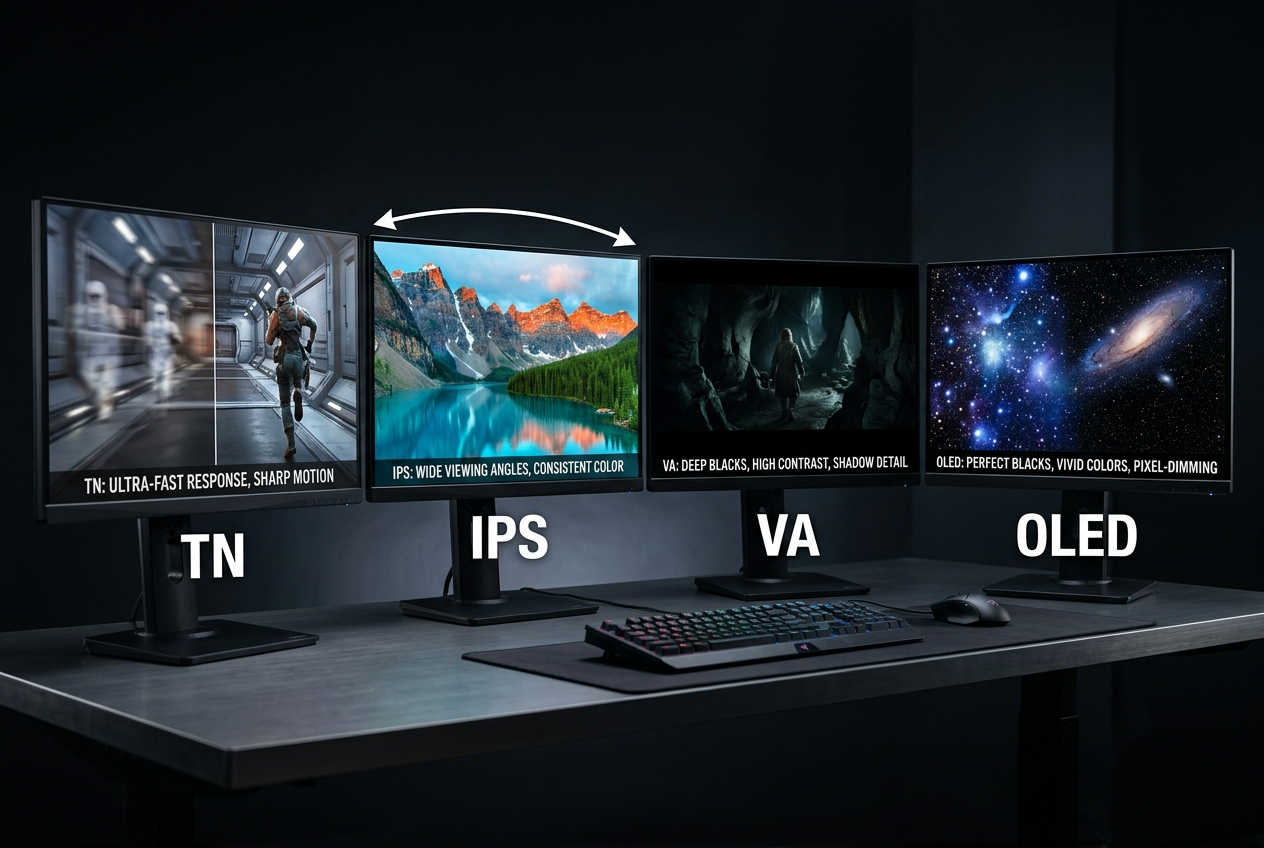
The panel technology inside a gaming monitor determines almost everything you experience: how colors look, how fast motion appears, how much the image shifts when you view it off-center, and how deep the blacks get. Yet most buyers focus exclusively on resolution and refresh rate, overlooking the foundational technology underneath.
So what panel types are used in gaming monitors — and which one is right for you? In 2026, the answer spans four major technologies: TN, IPS, VA, and OLED, each with distinct strengths, weaknesses, and ideal use cases.
TN (Twisted Nematic): The Competitive Speed Legacy
TN panels are the oldest LCD technology in gaming monitors, and in 2026 they remain in use for a single reason: raw speed. TN panels achieve response times as low as 0.5ms — faster than any IPS or VA equivalent — and support refresh rates of 360Hz and beyond.
Strengths:
- Lowest pixel response times available
- Highest achievable refresh rates (360Hz+)
- Lowest input lag among LCD panel types
Weaknesses:
- Poor color accuracy (typically 6-bit + FRC, not true 8-bit)
- Narrow viewing angles — color and contrast shift noticeably off-axis
- Weak black levels compared to VA and OLED
Who should consider TN: Competitive esports players who prioritize the absolute lowest input latency and highest refresh rate above all else. For 24–26 inch competitive monitors in 1080p configurations, TN panels remain a specialized choice for elite-tier players.

In 2026, however, TN’s dominance in competitive gaming has eroded significantly. Fast IPS technology has closed the response time gap to under 1ms, making TN’s speed advantage much narrower than it once was.
IPS (In-Plane Switching): The All-Rounder
IPS panels have become the dominant technology in the mid-to-high gaming monitor market in 2026. The reasons are straightforward: IPS delivers the best combination of color accuracy, viewing angle consistency, and speed among LCD technologies.
Strengths:
- Accurate, vivid color reproduction (true 8-bit, wide color gamut)
- 178° horizontal and vertical viewing angles with minimal shift
- Fast response times (as low as 1ms on modern Fast IPS / Nano IPS variants)
- Excellent HDR compatibility with Mini-LED backlight implementations
Weaknesses:
- IPS glow — a characteristic backlight bleed visible in dark rooms at corners
- Black levels not as deep as VA or OLED
Who should consider IPS: The broadest category of buyers — gamers who want good color for content creation alongside gaming, anyone who shares their screen with others, and users who do both gaming and productivity work on the same display. The 4K gaming monitor market is heavily IPS-driven in 2026.
Fast IPS variants — Nano IPS, IPS Black, and AUO AHVA — each address specific weaknesses. IPS Black panels, for example, achieve black levels roughly twice as deep as standard IPS, significantly reducing the glow issue while maintaining IPS color accuracy.
VA (Vertical Alignment): The Contrast Champion
VA panels occupy a specific niche in 2026: the best contrast ratio among LCD technologies. While IPS and TN panels typically achieve contrast ratios of 1,000:1, VA panels routinely hit 3,000:1 to 6,000:1 — producing visibly deeper blacks and richer shadow detail.
Strengths:
- Highest contrast ratio among LCD panel types (3,000:1–6,000:1)
- Deep black levels without the cost of OLED
- Good color reproduction (generally 8-bit)
- Well-suited to curved monitor designs

Weaknesses:
- Response time smearing — “ghosting” in fast motion scenes due to slower pixel transitions
- Narrower viewing angles than IPS (though wider than TN)
- Color accuracy can vary between products
Who should consider VA: Users who watch movies and single-player games with cinematic qualities — RPGs, horror games, atmospheric adventures — where deep blacks and high contrast matter more than pixel-perfect motion clarity. VA panels in 33-inch and larger configurations are particularly compelling for immersive entertainment setups.
OLED: The New Standard for Premium Gaming in 2026
OLED (Organic Light-Emitting Diode) is no longer a niche technology confined to flagship televisions. In 2026, OLED gaming monitors have entered the mainstream premium segment, and OLED/QLED gaming monitors have become the benchmark by which all other displays are measured.
Strengths:
- Perfect blacks — every pixel is its own light source; off pixels emit zero light
- Infinite contrast ratio — mathematically unmeasurable (true black vs. any luminance)
- Sub-0.1ms response time — fastest pixel transitions of any display technology
- Exceptional HDR — peak brightness and perfect local dimming without backlight bleed
- Wide color gamut — naturally covers DCI-P3 and wide color spaces

Weaknesses:
- Burn-in risk — static UI elements (HUD, taskbars) can cause permanent image retention over years of use; modern ABCs (Automatic Brightness Limiters) and pixel-shift algorithms mitigate but don’t eliminate this
- Lower peak brightness than Mini-LED IPS in some configurations
- Historically higher cost than LCD equivalents (narrowing rapidly in 2026)
Who should consider OLED: Gamers who want the absolute best visual experience and are willing to manage usage habits to protect against burn-in. For HDR gaming, OLED delivers an experience that LCD technologies cannot fully replicate — true shadow detail, brilliant highlights, and silky motion in a single package.
In 2026, QD-OLED (Quantum Dot OLED) has further elevated the technology: combining OLED’s perfect blacks with quantum dot color enhancement for higher peak brightness and wider color coverage than standard WOLED panels.
Side-by-Side Panel Comparison
| Feature | TN | IPS | VA | OLED |
|---|---|---|---|---|
| Response Time | 0.5–1ms | 1–3ms | 3–8ms | <0.1ms |
| Contrast Ratio | ~1,000:1 | ~1,000:1 | 3,000–6,000:1 | Infinite |
| Color Accuracy | Poor (6-bit) | Excellent (8-bit) | Good (8-bit) | Excellent |
| Viewing Angles | Poor | Excellent | Good | Excellent |
| Black Level | Poor | Moderate | Good | Perfect |
| HDR Quality | Poor | Good (Mini-LED) | Moderate | Excellent |
| Burn-in Risk | None | None | None | Present |
| Max Refresh Rate | 360Hz+ | 360Hz+ | 240Hz | 240–480Hz |
| Best Use Case | Competitive FPS | All-rounder | Immersive single-player | Premium all-purpose |
How GPU Choice Interacts with Panel Technology
Your panel choice only delivers its full potential when paired with a capable GPU. A high-refresh OLED monitor at 240Hz needs a GPU that can consistently output 240 frames per second at your target resolution. Pairing an OLED with a mid-range GPU at 4K may result in VRR operating in the lower range of the refresh window — still smooth, but not maximizing the panel’s capabilities.

G-Sync and FreeSync variable refresh rate support is increasingly standard across all panel types in 2026 — even OLED gaming monitors now routinely include both certifications.
The Bottom Line
In 2026, IPS is the safe all-round choice for most gaming monitor buyers. OLED is the premium pick for those who want the best possible image quality. VA serves the specific use case of high-contrast immersive gaming. And TN remains a niche option for players prioritizing every millisecond of competitive advantage.
Understanding which panel technology aligns with your priorities — speed, color, contrast, or the complete package — is the clearest path to a monitor you’ll be happy with for years.