
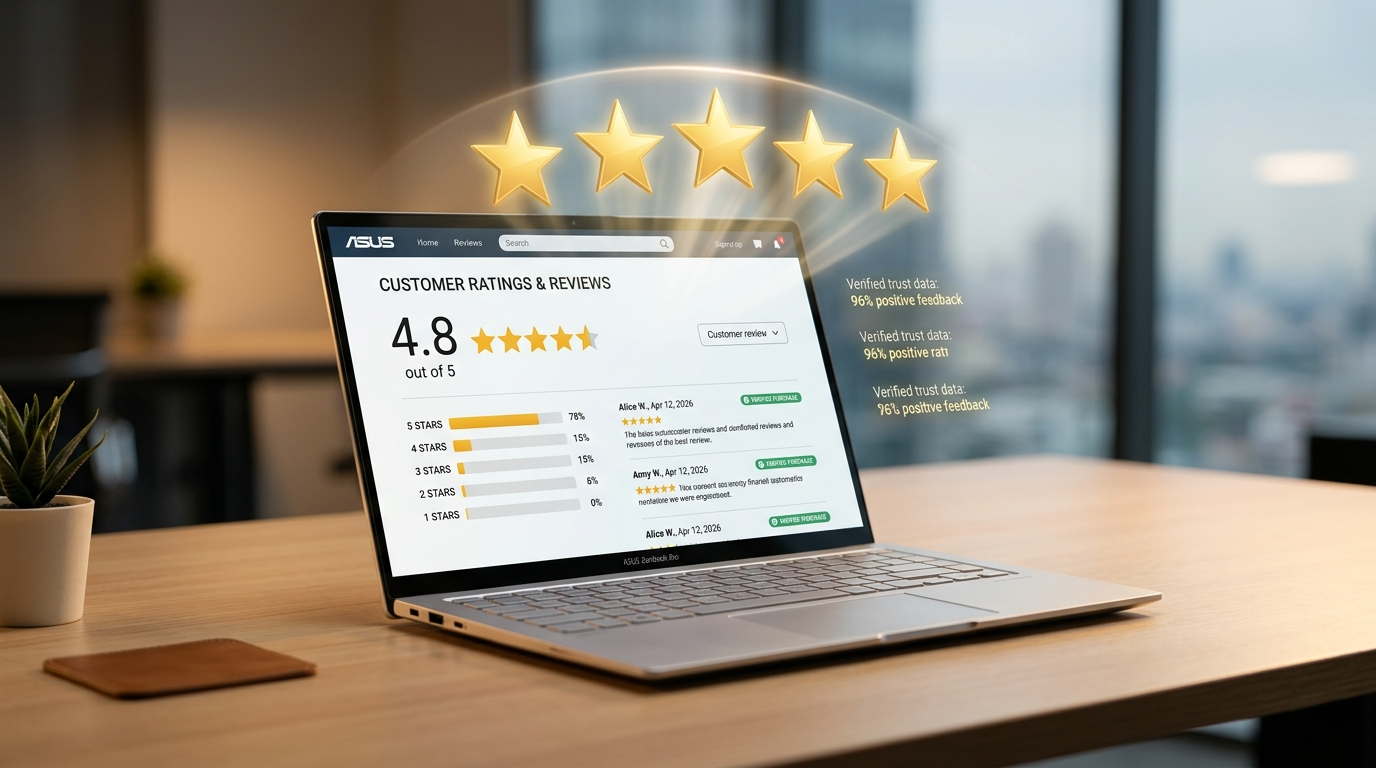
Before clicking “add to cart” on any laptop, most shoppers do the same thing: scroll straight to the reviews. But just how important are customer reviews when choosing a laptop — and how should you actually use them in 2026?
The honest answer is: reviews matter enormously, but only if you know how to read them. In an era where AI-generated fake reviews are increasingly sophisticated, review aggregators have become more refined, and verified purchase data carries more weight than ever. Understanding how to extract signal from noise is one of the most valuable shopping skills you can develop.
Why Reviews Still Matter — More Than Specs Alone
Laptop specifications tell you what a machine is designed to do. Reviews tell you what it actually does — day after day, in real-world conditions that no lab test perfectly replicates.
A laptop might spec out with a 72Wh battery promising 16 hours of life, but user reviews will tell you whether that figure is achievable under typical workloads or only under screen-off idle conditions. A gaming laptop might advertise whisper-quiet cooling, but aggregated reviews will reveal whether fan noise becomes intrusive after 30 minutes of gameplay. Specs describe potential. Reviews describe reality.
In 2026, this gap between spec-sheet and real-world performance is actually widening — not closing — because laptops are doing more complex things. AI-accelerated workloads, dynamic power limits, thermal throttling behavior, and battery management algorithms all interact in ways that are impossible to predict from spec sheets alone.
What Makes a Trustworthy Laptop Review?
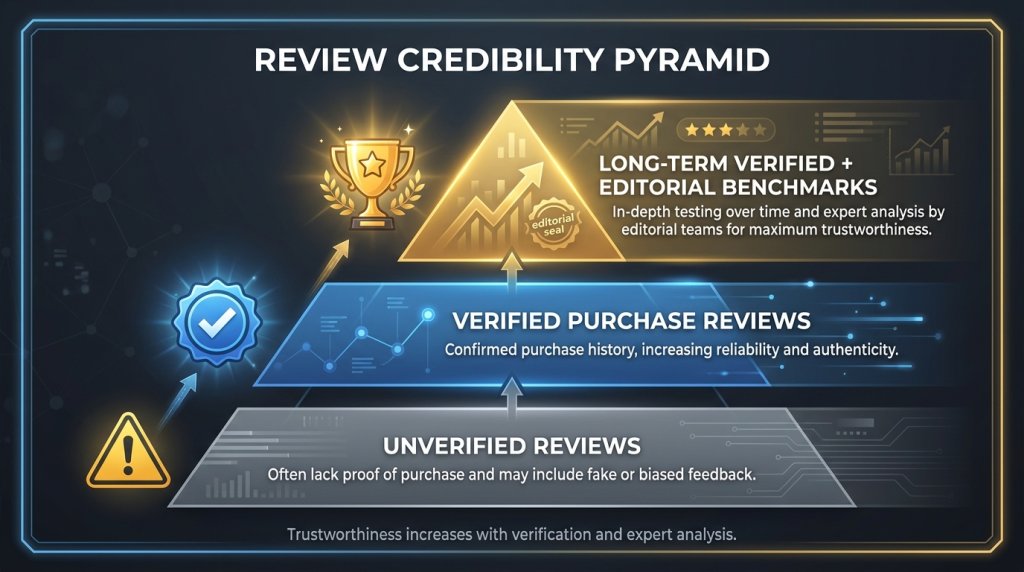
Not all reviews carry equal weight. Here’s how to evaluate the credibility of what you’re reading:
Verified Purchase Reviews
These are written by people who actually bought the product through the platform. On sites like Newegg, verified purchase badges confirm the reviewer received the item. These reviews carry meaningfully more credibility than unverified comments.
Review Volume and Distribution
A product with 4.3 stars across 800 reviews is significantly more trustworthy than one with 4.8 stars across 12 reviews. Look at the rating distribution histogram — a healthy review profile shows a natural spread, while a suspicious one shows disproportionate clustering at 5 stars with very few middle-ground ratings.
Recency
Laptop firmware updates, driver patches, and software changes can meaningfully alter performance over time. A Windows laptop’s battery life or thermal behavior six months after launch may be genuinely different from what early adopters experienced. Filter for reviews from the past 90 days to get the most current picture.
Specificity of Complaint or Praise
Generic reviews (“Great laptop! Highly recommend!”) provide little useful information. Specific reviews — describing actual use cases, identifying particular quirks, or quantifying performance under defined conditions — are where real purchasing intelligence lives.

Key Things Reviewers Reliably Tell You That Specs Can’t
| What Reviewers Cover | Why Specs Miss It |
|---|---|
| Actual battery life under real workloads | Spec claims measured under unrealistic idle conditions |
| Fan noise and thermal behavior | No standardized noise metric in spec sheets |
| Build quality feel and flex | Not quantified in any specification |
| Keyboard and trackpad tactile quality | Subjective and model-variant dependent |
| Long-term durability after 6–12 months | Only observable over time |
| Software bloatware and OS experience | Varies by retailer configuration |
| Real-world AI feature performance | NPU TOPS doesn’t translate directly to user experience |
For business laptops, reviewers who use the device professionally provide insight into enterprise-specific considerations: how well it handles large video calls, how the keyboard holds up over months of typing, whether the display causes eye fatigue during all-day use. These observations can’t be found in any spec sheet.
How AI Is Changing the Review Landscape in 2026
The review ecosystem has gotten more complicated in 2026. AI-generated review content — both fraudulent positive reviews and weaponized negative ones — has become harder to detect. Platforms have responded with increasingly sophisticated countermeasures:
- Behavioral analysis flags accounts that post reviews in unusual patterns
- NLP models identify stylistic signatures common to AI-generated text
- Purchase verification chains are more tightly coupled to review submission
The practical upshot for buyers: rely on platforms with strong verification infrastructure and supplement individual reviews with aggregated editorial benchmarks from trusted tech publications. A laptop with 4.5 stars across thousands of verified Newegg reviews and strong independent benchmarks from credible reviewers is a much safer bet than one with spectacular marketing claims and thin review data.

Using Reviews Effectively When Shopping for Specific Laptop Types
Gaming Laptops
For gaming laptops — including NVIDIA RTX 50 Series models — reviews are indispensable for assessing fan noise levels, sustained gaming performance under extended sessions, and how well the thermal system holds up over months of heavy use. Search specifically for long-term ownership reviews (6 months+), not just unboxing impressions.
Thin-and-Light and Business Machines
For 2-in-1 laptops and premium ultrabooks, reviews are most valuable for assessing hinge durability, touchscreen responsiveness, stylus accuracy, and actual productivity battery life — all things that only emerge through sustained real-world use.
Copilot+ PCs and AI Laptops
For the newest category — Copilot+ certified devices — reviews provide early signal on how well on-device AI features actually perform. NPU TOPS is a raw number; reviewers tell you whether real-time transcription, AI-generated content, and Copilot features feel smooth and useful or clunky and incomplete.
A Practical Review Reading Framework
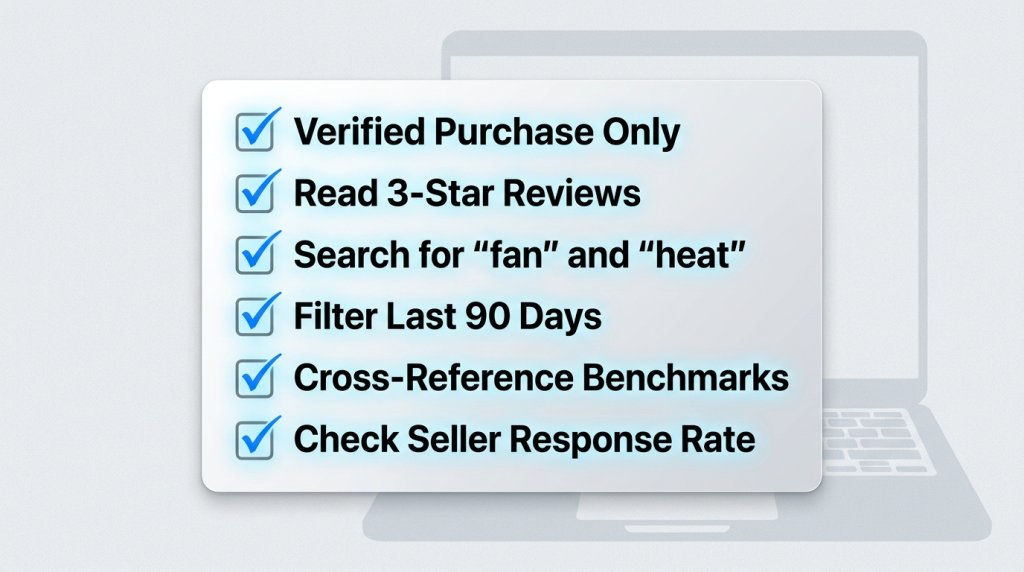
When evaluating reviews for a laptop you’re considering, use this checklist:
- Filter to verified purchases only — eliminate unconfirmed opinions
- Read the 3-star reviews — these are often the most honest and balanced
- Search the review text for specific terms: “fan,” “heat,” “battery,” “keyboard,” “hinge”
- Check review recency — weight the last 90 days more heavily
- Cross-reference with editorial benchmarks from independent tech reviewers
- Look at the seller’s response rate to negative reviews — responsive sellers indicate stronger post-purchase support
The Bottom Line
Customer reviews are one of the most powerful tools available to laptop buyers in 2026 — but only when read critically. The best purchasing decisions combine manufacturer specs, independent editorial testing, and aggregated real-world user experiences across hundreds or thousands of verified reviewers.
Use the Newegg Laptop Finder to filter by category and specifications, then use verified customer reviews to confirm that real-world performance matches the promise. And for curated selections that have already cleared a quality bar, Newegg Premium Laptop Upgrades aggregates top-performing models with strong review histories across all major categories.
Reviews won’t make the decision for you. But they’ll make sure you’re not surprised after you do.
Related Posts
- Best RTX 5090 gaming laptops: who should actually buy one, and which Newegg picks are worth it
- Gaming Laptops That Replace a Workstation for Video Editing: The Best Picks at Newegg
- Gaming Laptops for Engineering and CS Students: The Best Picks at Newegg
- Gaming Laptops That Double as 3D and CAD Workstations: The Best Picks at Newegg
- Your First Gaming Laptop: The Best Picks at Newegg for Someone New to PC Gaming