
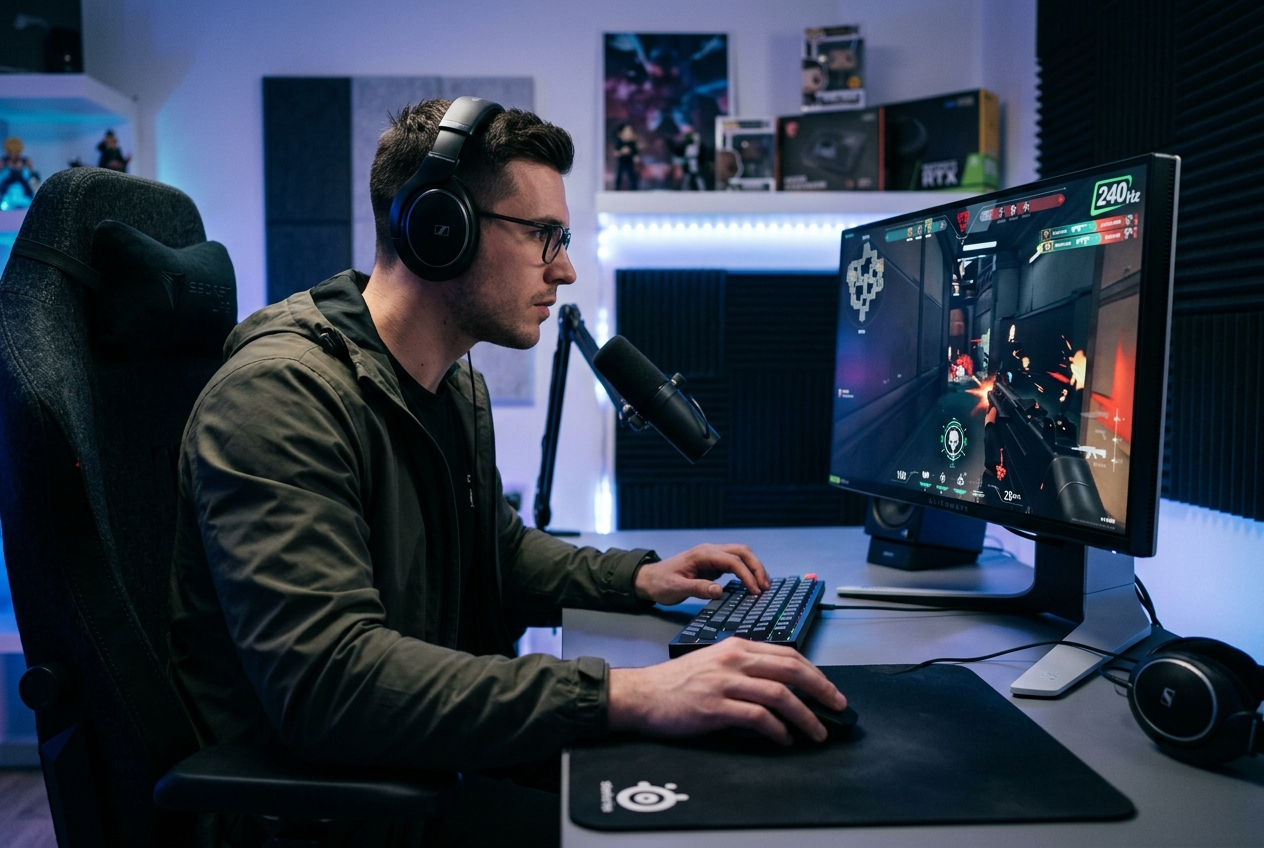
The question gets asked constantly in gaming communities: Do I need a high refresh rate monitor for competitive gaming? In 2026, the short answer is yes — but with critical nuance around what “high” actually means, how much difference it makes at different levels, and what your GPU needs to deliver before the monitor upgrade pays off.
This guide gives you the complete picture: the science behind refresh rate, the performance evidence, and how to decide what’s right for your specific situation.
What Refresh Rate Actually Measures
A monitor’s refresh rate — measured in Hertz (Hz) — tells you how many times per second the display updates with a new image. A 60Hz monitor shows 60 frames per second. A 144Hz monitor shows up to 144 frames per second. A 360Hz monitor shows up to 360 frames per second.
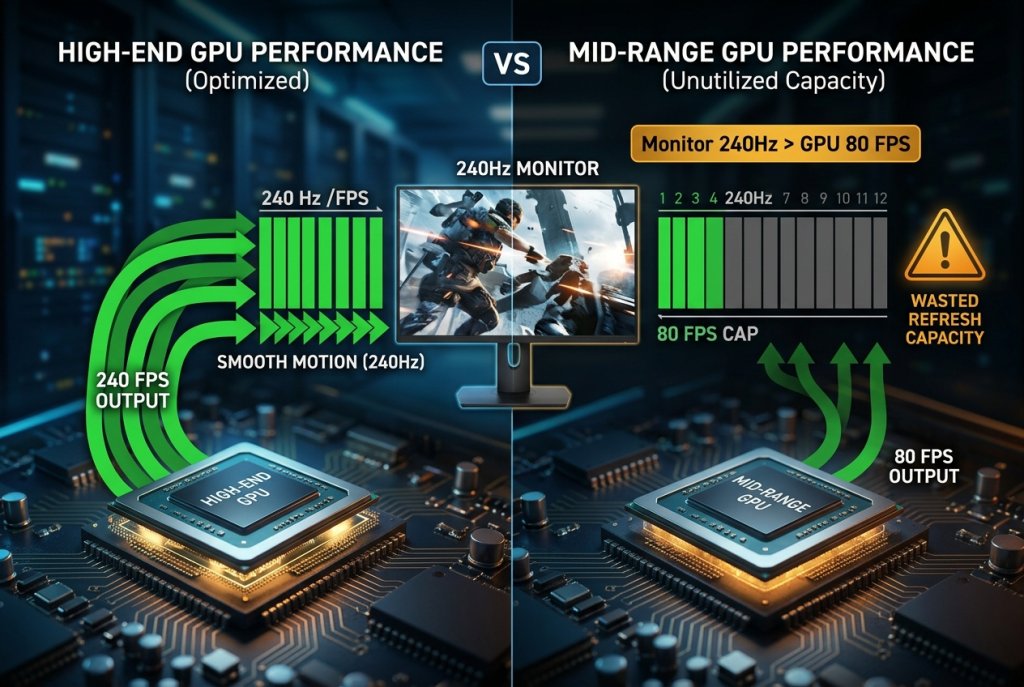
The critical word is “up to.” A high refresh rate monitor only delivers its full benefit when your GPU is actually producing frames at or near that rate. A 240Hz monitor running a game at 60 FPS still shows 60 frames per second — the extra headroom goes unused.
This GPU-refresh rate relationship is the most important practical consideration for any competitive gaming monitor purchase.
The Proven Performance Benefits of High Refresh Rates
Scientific research on refresh rate and competitive performance has produced consistent findings:
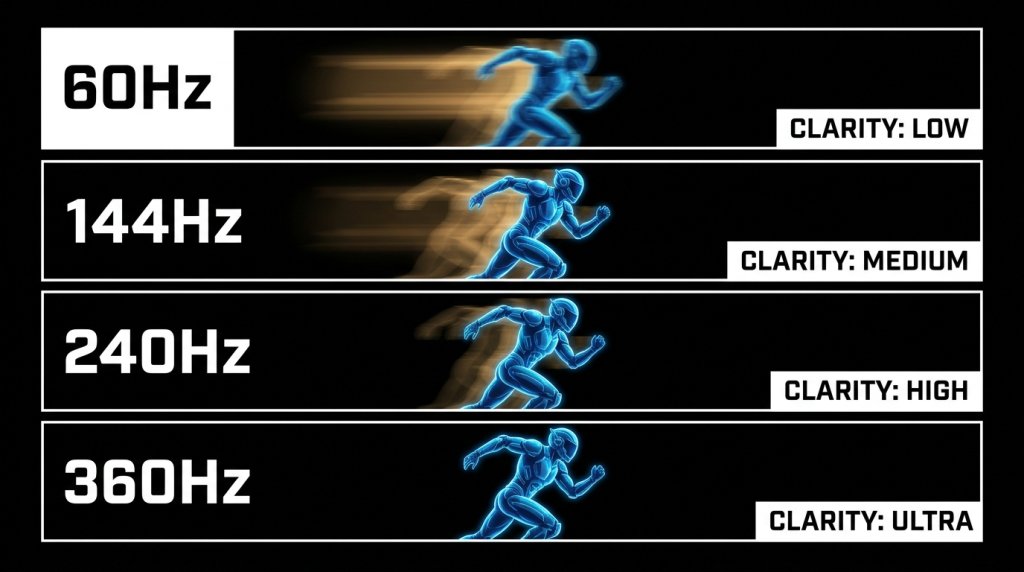
Motion clarity: Higher refresh rates reduce motion blur — the smearing of fast-moving objects during frame transitions. At 60Hz, fast-moving targets in games like CS2, Valorant, or Apex Legends exhibit visible smear that makes tracking harder. At 144Hz and above, targets appear significantly sharper in motion, making tracking and aiming more precise.
Reaction time and input lag: Higher refresh rates reduce the time between an event occurring in the game and appearing on screen. At 60Hz, the maximum display lag is approximately 16.7ms per frame. At 144Hz, 6.9ms. At 240Hz, 4.2ms. At 360Hz, 2.8ms. While these seem like small numbers, professional-level reaction times are measured in the 150–250ms range — and every millisecond of display lag is subtracted from the player’s available reaction window.
Frame pacing: Variable refresh rate technologies — G-Sync from NVIDIA and FreeSync from AMD — ensure that each frame arrives at the display without tearing or stuttering. This frame-level consistency is often more impactful than raw refresh rate alone.
The Law of Diminishing Returns: Where Each Jump Matters
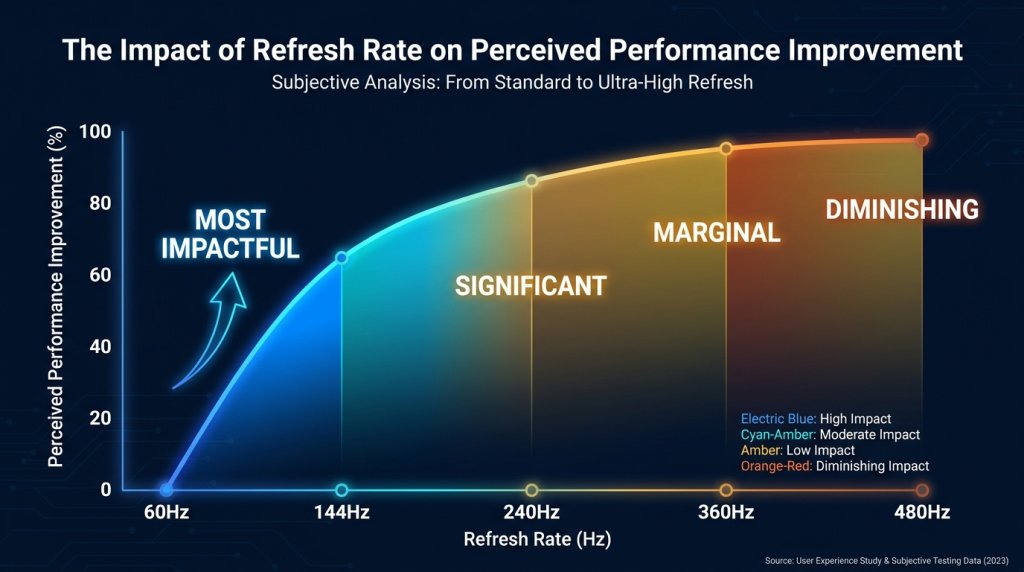
Not every refresh rate upgrade delivers equal benefit. Understanding where the returns diminish helps you invest correctly.
60Hz → 144Hz: The Most Impactful Upgrade
This is the upgrade that almost every study identifies as the most universally beneficial. The improvement in motion clarity, target tracking, and perceived smoothness is immediately visible to the vast majority of players. If you’re still on a 60Hz display, upgrading to 144Hz is the single highest-impact monitor investment available.
144Hz → 240Hz: Noticeable, Especially in Fast Games
The jump from 144Hz to 240Hz is perceptible to most attentive players, particularly in fast-paced titles where head-snapping and quick target acquisition are constant. Competitive research suggests approximately 75–80% of players can perceive a meaningful smoothness improvement at this tier.
240Hz → 360Hz and Beyond: Professional-Tier Marginal Gains
At the 360Hz tier, the perceptible benefit narrows to professional esports athletes who train extensively and whose performance margins are measured in fractions of a second. For dedicated competitive players pursuing ranked or professional play, 24–26 inch high-refresh monitors at 360Hz represent the current ceiling of practical value.
| Refresh Rate | Target Audience | Key Benefit |
|---|---|---|
| 60Hz | Casual / Console-equivalent | Baseline; perceptible limitation in competitive play |
| 144Hz | All competitive players | Essential tier; large, universal improvement |
| 240Hz | Serious competitive players | Significant motion clarity and lag reduction |
| 360Hz | Elite esports athletes | Marginal gains; diminishing perceptibility |
| 480Hz | Emerging; cutting-edge | Experimental; few games and GPUs can sustain |
The GPU Bottleneck: Your Monitor Is Only As Fast As Your Frame Rate
A 240Hz monitor is useless if your GPU produces 80 FPS. The math is simple: your monitor can only show what your GPU renders. This means high-refresh-rate gaming requires matching GPU performance:
- 1080p Full HD gaming at 240Hz is achievable on mid-range GPUs in most esports titles
- 1080p at 360Hz requires a high-performance GPU to sustain consistently
- 1440p at 240Hz requires an upper-mid to high-tier GPU
The competitive gaming community has largely standardized on 1080p for this reason — lower resolution means more GPU headroom for higher frame rates. Professional esports tournaments almost universally use 24-inch 1080p displays for exactly this reason.
OLED High-Refresh: The New Competitive Frontier
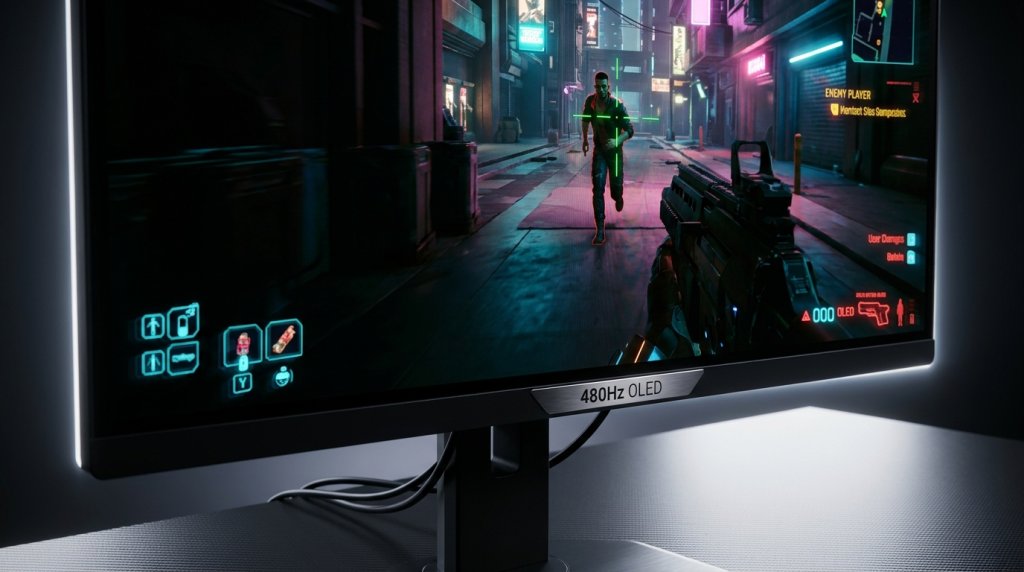
In 2026, OLED gaming monitors have entered the competitive gaming conversation in a meaningful way. OLED panels combine:
- Sub-0.1ms pixel response time (eliminating motion ghosting entirely)
- 240Hz to 480Hz refresh rates on current gaming models
- Perfect per-pixel black levels for superior target visibility in dark game environments
For competitive players who want both maximum speed and premium visual quality, OLED represents a genuine evolution — though the burn-in consideration remains a factor for users who leave static HUD elements on screen for extended hours.
High Refresh Rate Beyond Competitive Play
High refresh rate monitors don’t only benefit competitive gaming. In 2026, 144Hz has become a baseline expectation even in single-player gaming because of how dramatically it improves:
- UI and menu navigation — 60Hz interfaces feel noticeably sluggish once you’ve used 144Hz
- Open-world exploration — Camera panning in vast environments feels smoother and more responsive
- Cinematic game sequences — High-refresh rendering of cutscenes reduces judder and adds fluidity
Even 4K gaming monitors and HDR-enabled displays now routinely offer 144Hz or 160Hz refresh rates — meaning high refresh rate has graduated from a competitive niche to a mainstream gaming standard.
For curved immersive displays in the 33-inch and larger category, 144Hz represents the sweet spot of visual quality and smooth gameplay for single-player and mixed-use scenarios.
Quick Buying Decision Framework
You play competitive multiplayer as your primary game: → 144Hz minimum, target 240Hz, match to a GPU that can sustain high frame rates at 1080p
You play both competitive and single-player games: → 144Hz–240Hz IPS or Fast IPS; consider 1440p for a balanced experience
You play single-player games primarily: → 144Hz is the floor; resolution and panel quality matter more than pushing to 360Hz
You’re a professional or aspiring competitive player: → 360Hz at 1080p with the fastest panel available; GPU investment is equally critical
The Bottom Line
Yes, a high refresh rate monitor makes a real, measurable difference in competitive gaming — particularly at the 60Hz to 144Hz step. Beyond that, the gains continue but narrow. Whether the incremental improvement from 144Hz to 240Hz, or 240Hz to 360Hz, is worth the investment depends on how seriously you compete and whether your GPU can actually deliver the frames.
The most important takeaway: your GPU and your refresh rate must scale together. An upgrade to a 240Hz monitor without the GPU to back it up is a partial investment. Match both, and the competitive advantage is genuine.