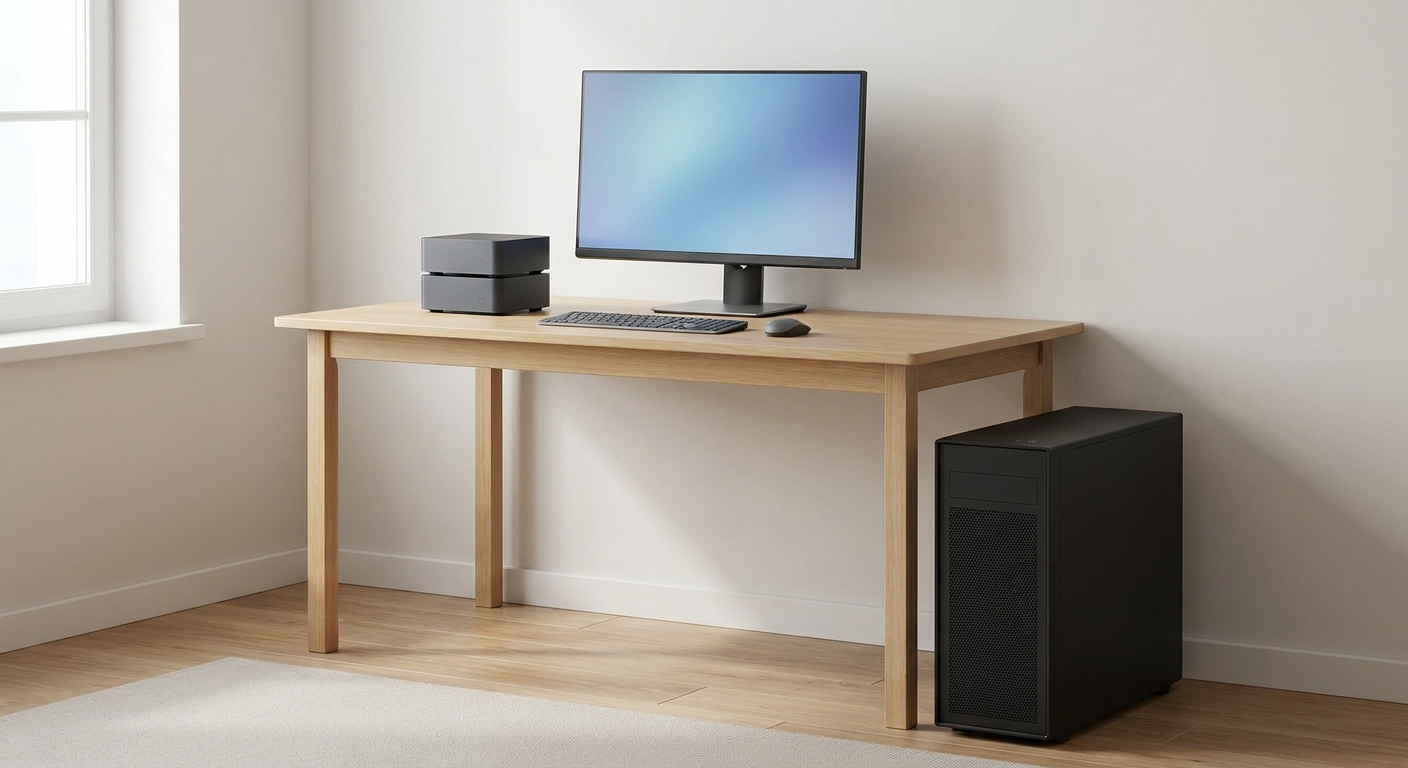
The first time someone asked me what a DGX Station is, I said "a server that fits beside a desk," and I still think that's the most honest short answer. It looks like a big tower PC. Inside, it's built around the same family of silicon NVIDIA uses in its data center racks, and it exists to run and build AI models that are far too large for an ordinary workstation.
If you're just starting to look at local AI hardware, the names blur together quickly: DGX Station, DGX Spark, GB300, GB10, RTX PRO. This guide is meant to sort them out before you go any deeper.
What Exactly Is a DGX Station?
DGX Station is an NVIDIA design that PC makers build and sell under their own names. According to ServeTheHome, NVIDIA supplies the motherboard with the processors already installed, which is why the different versions share the same core hardware and rear ports. On Newegg you'll find the MSI XpertStation WS300, the GIGABYTE W775-V10-L01, the ASUS ExpertCenter Pro ET900N G3 and the Supermicro Super AI Station. Availability varies, and some makers sell through sales inquiries, so it's worth checking each listing.
The heart of every version is the GB300 Grace Blackwell Ultra Desktop Superchip. It combines a 72-core Grace CPU built on Arm Neoverse V2 cores, a Blackwell Ultra GPU and a ConnectX-8 SuperNIC for networking. NVIDIA rates the system at up to 20 petaflops of FP4 AI compute with sparsity and says it can run models of up to roughly a trillion parameters locally. It ships with Ubuntu and NVIDIA's AI developer tools, and NVIDIA has announced a Windows edition it expects in the fourth quarter of 2026.

What Does 748GB of Coherent Memory Mean?
This is the number everyone quotes, and it's worth understanding properly. The 748GB is two pools joined together. The GPU has 252GB of HBM3e running at 7.1TB/s, and the CPU has 496GB of LPDDR5X running at 396GB/s. NVLink-C2C connects them at 900GB/s, and "coherent" means the CPU and GPU can each read the other's memory directly instead of copying data back and forth.
The practical takeaway for a beginner is simple. An AI model needs to sit in memory to run well, and the faster that memory is, the faster the model answers. The HBM is where the speed lives. The LPDDR5X is where the extra room lives.
How Is It Different From DGX Spark?
DGX Spark is the small sibling, and the shared branding makes the two sound closer than they are. Spark-class systems such as the MSI EdgeXpert 13SUS and the HP ZGX Nano G1n use NVIDIA's GB10 chip with 128GB of unified memory at 273GB/s, run from a 240W power supply and fit beside a keyboard. NVIDIA rates one unit for models up to 200 billion parameters.
A DGX Station has almost six times the memory, about 20 times the FP4 compute by NVIDIA's own figures, and much faster networking: two 400Gb/s ports on ConnectX-8 instead of ConnectX-7 at 200Gb/s. It also draws up to 1,600W and needs a 20A circuit. Because the two share NVIDIA's software stack, a Spark is a natural place to learn before moving up.

How Is It Different From an RTX PRO 6000 Workstation?
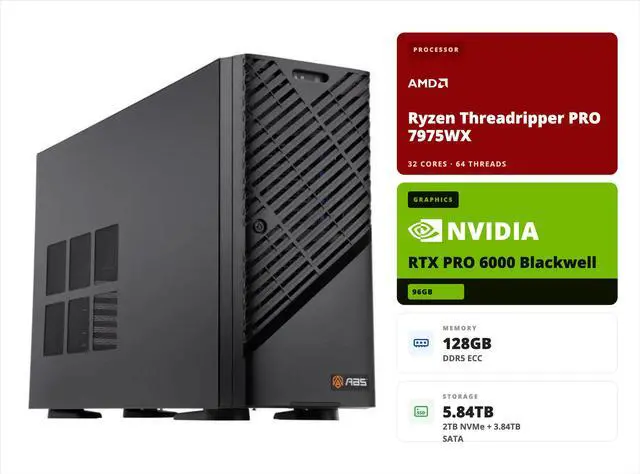
This comparison trips people up, because a machine like the ABS AI Workstation with an RTX PRO 6000 Blackwell looks like it does the same job. It's a traditional design: an x86 CPU, a Threadripper PRO 7975WX in that ABS build, plus a graphics card. The NVIDIA RTX PRO 6000 Blackwell Workstation Edition has 96GB of GDDR7 at about 1.8TB/s and four DisplayPort outputs, so you plug in a monitor and work like you would on any PC.
A DGX Station turns that around. Its GPU has more than two and a half times the memory of one RTX PRO 6000, but the GB300 has no display outputs of its own; the Mini DisplayPort on the back belongs to the management controller. ServeTheHome expects many buyers to add an RTX PRO card, such as the RTX PRO 2000 Blackwell, just for video output. It also pairs an Arm CPU with server-style remote management, and ServeTheHome thinks many owners will run it like a server, over the command line and the BMC.
Side by Side
| DGX Spark (GB10) | DGX Station (GB300) | RTX PRO 6000 workstation | |
|---|---|---|---|
| CPU | 20-core Arm | 72-core Arm (Grace) | x86 |
| Memory for AI | 128GB unified, 273GB/s | 252GB HBM3e at 7.1TB/s plus 496GB LPDDR5X | 96GB GDDR7 per card, about 1.8TB/s |
| Networking | ConnectX-7, 200Gb/s | ConnectX-8, two 400Gb/s ports | Depends on the build |
| Power | 240W power supply | 1,600W, 20A circuit | Depends on the build |
| Display | HDMI built in | Needs an add-in RTX PRO card | On the graphics card |
| Model size (NVIDIA) | Up to 200B parameters | Up to about 1T parameters | Depends on the cards |
Which One Should a Beginner Start With?
If you're learning, a Spark-class box is the sensible start. It runs the same NVIDIA software, handles models up to 200 billion parameters, and won't need an electrician. If your models already fit in 96GB and you want a familiar desktop, an RTX PRO 6000 workstation is easier to live with. The DGX Station earns its place when a team needs hundreds of gigabytes of fast memory or wants to serve many users at once, which is what the next two parts of this series dig into.
Frequently Asked Questions
Is an NVIDIA DGX Station a desktop PC or a server? It's a tower that sits beside a desk, but it's built around NVIDIA's GB300 superchip and includes a server-style BMC for remote management. It ships with Ubuntu and NVIDIA's AI developer tools.
What is the difference between DGX Station and DGX Spark? DGX Spark-class systems use the GB10 chip with 128GB of unified memory at 273GB/s and a 240W power supply, rated for models up to 200 billion parameters. DGX Station uses the GB300 with 748GB of coherent memory, including 252GB of HBM3e at 7.1TB/s, and is rated at 1,600W.
Who makes DGX Station systems? NVIDIA designs the platform and supplies the motherboard, and OEM partners including ASUS, Dell, GIGABYTE, HP, MSI and Supermicro build the systems. Newegg lists models from ASUS, GIGABYTE, MSI and Supermicro.
Can a DGX Station connect to a monitor? Not from the GB300 itself. Its Mini DisplayPort is for system management, so you add an RTX PRO Blackwell card. NVIDIA's datasheet lists the RTX PRO 6000 Workstation and Max-Q editions, the RTX PRO 4000 SFF and the RTX PRO 2000.
Does DGX Station run Windows? The standard edition ships with Ubuntu and NVIDIA AI Developer Tools. NVIDIA announced DGX Station for Windows on May 31, 2026 and expects it in the fourth quarter of 2026.
Read More
- NVIDIA: DGX Station -- Official GB300 specifications, including memory, networking and power.
- NVIDIA: DGX Spark -- Official GB10 specifications and supported model sizes.
- NVIDIA Newsroom: DGX Station for Windows -- NVIDIA's May 31, 2026 announcement of the Windows edition.
- ServeTheHome: NVIDIA DGX Station Systems Available at Last -- An overview of the shipping GB300 configuration and the OEMs building it.
- NVIDIA: RTX PRO 6000 Blackwell -- Official specifications for the card at the center of many RTX PRO AI workstations.