here!
I’m your shopping assistant for PC builds, upgrades, and everything tech.
Got questions? Ask away!
Start a conversation
here!
I’m your shopping assistant for PC builds, upgrades, and everything tech.
Got questions? Ask away!
Start a conversationShipped by Newegg
 Top Rated Top Rated Top Rated




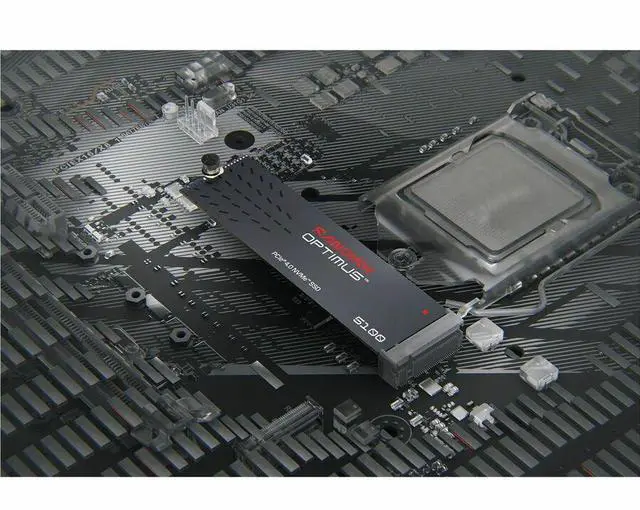
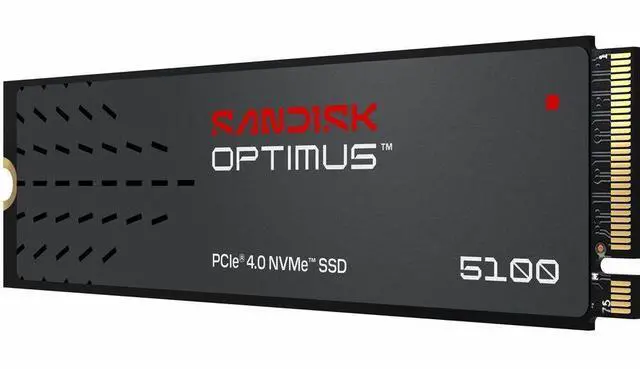



Any questions? Ask CelesteSM will help you find out quickly.
Overview
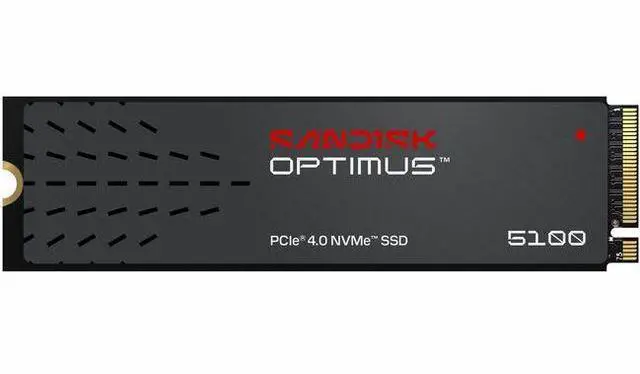
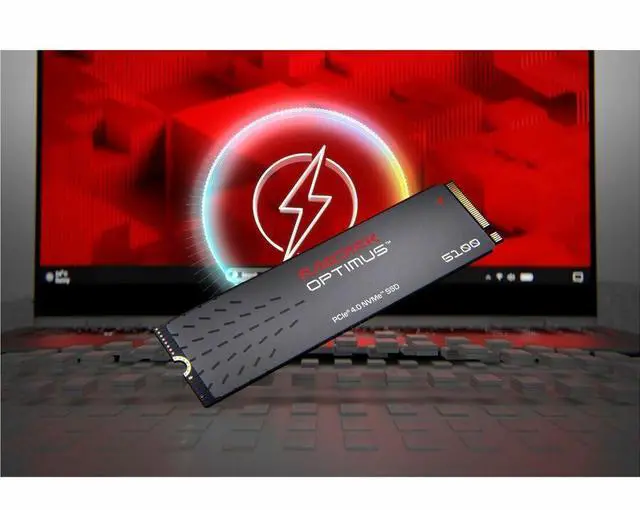
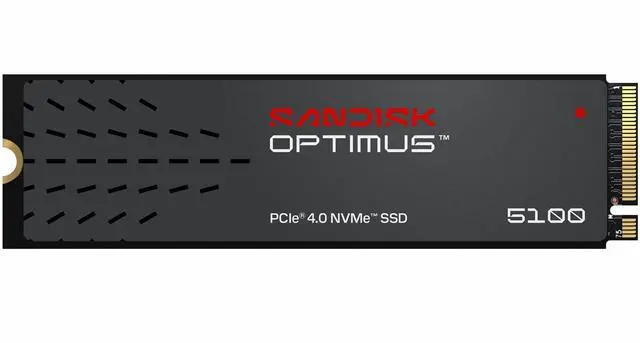
The SanDisk Optimus 5100 is a 4TB internal solid state drive for systems that support an M.2 2280 PCI-Express 4.0 x4 NVMe drive. It combines QLC 3D CBA NAND with high sequential and random performance in a compact internal storage design.
Key Features
Performance
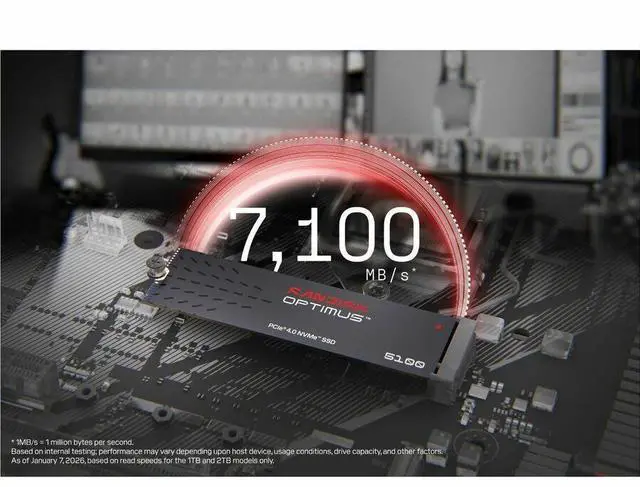
Sequential performance reaches up to 6900 MBps read and up to 6700 MBps write. 4KB random performance reaches up to 900,000 IOPS read and up to 1,100,000 IOPS write. The drive uses QLC 3D CBA NAND and has no DRAM, using SLC cache.
Design
The internal SSD uses an M.2 2280 form factor with a height of 2.38mm, width of 22mm, depth of 80mm, and weight of 5.7g. It is supplied without a heatsink.
Connectivity & Compatibility
The drive uses a PCI-Express 4.0 x4 interface and NVMe protocol. It is intended for systems with an M.2 2280 slot supporting PCI-Express 4.0 x4 NVMe storage.
Reliability & Durability
The drive is rated for 1200TB total bytes written and a 1,750,000-hour MTBF. Operating temperature is 0°C to +85°C, while storage temperature is -40°C to +85°C. Maximum shock resistance is 1,500G @ 0.5 ms half-sine. Operating vibration is 5 gRMS, 10-2000 Hz, 3 axes; non-operating vibration is 4.9 gRMS, 7-800 Hz, 3 axes.
Specifications
We want to ensure your holiday shopping this year is hassle-free. That’s why we’re automatically extending our return policies on almost every product! For purchases placed between November 1st, 2025 and December 31, 2025 you will have until January 31, 2026 to return your product.
The SanDisk Optimus 5100 is a 4TB M.2 2280 NVMe SSD for PCIe 4.0 x4 systems, with sequential speeds up to 6,900 MB/s read and 6,700 MB/s write; it suits creators and power users who need fast access to large project files and substantial internal storage.
| Attribute | Value |
|---|---|
| Best For | 4TB internal NVMe storage for gaming, personal, or business use in compatible desktop or laptop systems |
| Capacity | 4TB solid-state storage |
| Interface And Form Factor | M.2 2280 internal SSD with PCIe 4.0 x4 connectivity and NVMe protocol |
| Read Write Performance | Sequential speeds up to 6,900 MB/s read and 6,700 MB/s write; 4KB random performance up to 900,000 IOPS read and 1,100,000 IOPS write |
| Cache And NAND | QLC 3D CBA NAND with no DRAM cache (SLC) |
| Endurance And Reliability | 1,200TB endurance rating and 1,750,000-hour MTBF |
| Power And Operating Conditions | 4.5mW idle power; average active read and write power of 4.3W each; operating temperature 0°C to 85°C and storage temperature −40°C to 85°C |
| Shock And Vibration Resistance | Shock resistance up to 1,500G at 0.5ms half-sine; operating vibration 5gRMS at 10–2,000Hz across 3 axes and non-operating vibration 4.9gRMS at 7–800Hz across 3 axes |
| Physical Specifications | 22mm wide, 80mm deep, 2.38mm high; weighs 5.7g; supplied without a heatsink |
| System Compatibility | PC hardware platform; Windows system requirement; compatible-device listings include desktop and laptop |
| Model Identifiers | SanDisk Optimus 5100; model identifiers SDSP51400TAN-000E0 and SDSP51400TAN |
Q: Is the SanDisk Optimus 5100 4TB different from the WD Blue SN5100 4TB?
A: They are counterparts in the same 5100 product line: SanDisk’s Optimus 5100 replaced the WD Blue SN5100 as part of a branding change. Choose between listings based on price, availability, and the seller’s warranty terms; don’t assume the SanDisk branding alone means a performance upgrade.
Q: Should I get the Optimus 5100 4TB or the Optimus GX Pro 850X 4TB?
A: Choose the Optimus 5100 for a high-capacity PCIe 4.0 drive for everyday use and creator workloads. Consider the GX Pro 850X for frequent large writes or a gaming-focused build: it uses TLC NAND, while the 5100 uses QLC, which independent testing found can slow substantially after its write cache fills. Their advertised peak sequential speeds are similar, so the 5100’s peak figures alone do not settle the choice.
Q: Is the Optimus 5100 4TB a worthwhile upgrade from the WD Blue SN5000 4TB?
A: The 5100 is a reasonable upgrade when its price is competitive and faster sustained transfers matter: PCWorld found the SN5100 improved sustained throughput over the SN5000 in most tested workloads. The older SN5000 performed better in some random-operation tests, however, so the upgrade is less compelling if the SN5000 is substantially cheaper or your priority is that type of workload.
Q: Should I buy the Optimus 5100 2TB or 4TB?
A: Choose the 4TB model when you need more room for games, media, or project files; SanDisk rates it for up to 1,200 TBW. Choose 2TB if that capacity meets your needs and the higher advertised sequential-read rating matters: SanDisk lists up to 7,100 MB/s for 2TB and 6,900 MB/s for 4TB. These are manufacturer maximums, not guaranteed real-world speeds.
Q: Will this SSD work in my laptop or desktop?
A: It requires an available M.2 2280 slot that supports NVMe over PCIe. Check your device or motherboard specifications for slot support and physical clearance before buying; the drive’s PCIe 4.0 x4 speeds also depend on the host system supporting that interface.
Q: Is this SSD suitable for gaming and large file transfers?
A: It offers 4TB of storage and sequential speeds of up to 6,900 MB/s read and 6,700 MB/s write, making it suitable for storing games and working with large files. Actual speeds depend on the system and workload.
Q: Does this SSD include a heatsink?
A: No. The product is listed without a heatsink. Check whether your computer has an M.2 heatsink or other suitable cooling, and confirm there is enough room for the drive in its installed position.
Q: Is 4TB enough for games, projects, and everyday storage?
A: The drive provides 4TB of listed capacity, which can hold a large collection of games, applications, and work files. The space you need depends on file sizes and how much content you keep installed or stored locally.
Q: Is the SanDisk Optimus 5100 suitable as a game drive?
A: It can be considered for game storage: the 4TB model is a PCIe 4.0 x4 NVMe SSD, and its listed sequential read speed is up to 6,900 MB/s. Reddit discussion of the 5100 line says it can handle gaming, while noting that high peak speeds do not necessarily translate into noticeably better everyday performance. The discussion concerns a 1TB version, not this exact 4TB model.
Q: What are the main trade-offs of the Optimus 5100 for frequent large writes?
A: The 4TB model uses QLC NAND and has no DRAM, with an SLC cache listed in the specifications. Reddit discussion of the 5100 line flags write speeds after the cache is exhausted as a concern for QLC drives. If your workload regularly involves large sustained writes, treat that as a trade-off to investigate rather than relying on the listed peak write speed of up to 6,700 MB/s.
Q: Is the Optimus 5100 worth buying if I find it at a good price?
A: It may be worth considering if you need 4TB of M.2 2280 storage and your system supports PCIe 4.0 x4 NVMe drives. Reddit discussions raise price as a buying consideration, but the supplied product information does not include a current price, so value cannot be judged without comparing it with similarly sized drives.