
Your Browsing History

Any questions? Our AI beta will help you find out quickly.
Try me now
Quick View
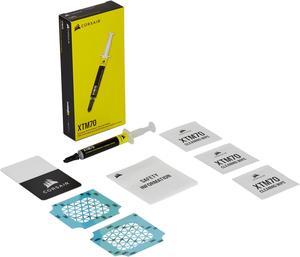
CORSAIR XTM70 Extreme Performance Thermal Paste, 3g

- Part Number: CT-9010010-WW
- Volume / Net Weight: 3.0g
- Model #: CT-9010010-WW
- $30.99
- $25.99 –
- Save: $5.00 (16%)
- Free Shipping
Quick View
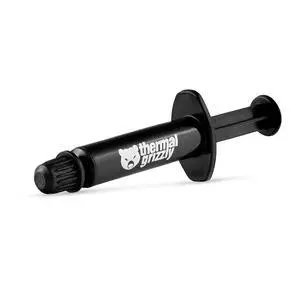
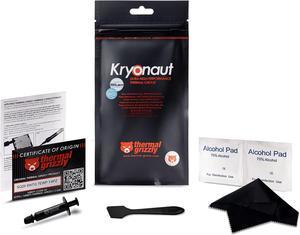
Thermal Grizzly Kryonaut The High Performance Thermal Paste for Cooling All Processors, Graphics Cards and Heat Sinks in Computers and Consoles
- Model #: Kryonaut 1g - TG-K-001-RS
- $11.99 –
- Free Shipping
Quick View
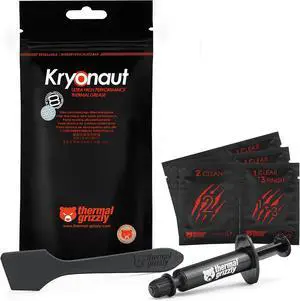
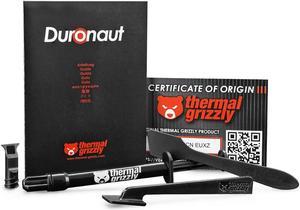
Thermal Grizzly Kryonaut - 1 Gram - Extremely High Performance Thermal Paste + 12 Cleaning Wipe 6 Wet & 6 Dry - for Demanding Applications and Overclocking CPU/GPU/PS4/PS5/Xbox
- Model #: k001 5 wipe combo
- $12.99 –
- Free Shipping
Quick View
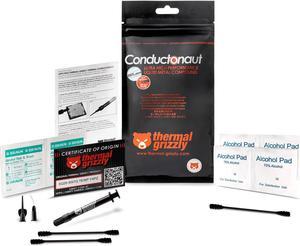
Thermal Grizzly Conductonaut Thermal Grease - 1 Gram Set + 3 Applicators + Pads - Liquid Metal Thermal Paste for Cooling The CPU, GPU Value Pack
- Model #: C-001 Combo
- $17.99 –
- Free Shipping
Quick View
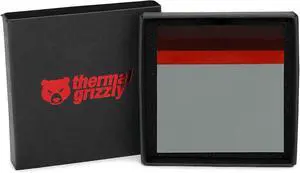
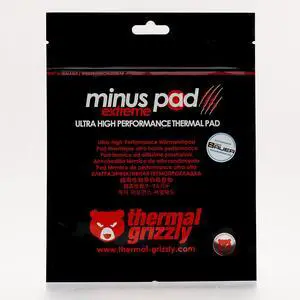
Thermal Grizzly - Minus Pad Extreme (100x100x1,5mm) - Self-Adhesive Cooling Conductive Thermal Pad - Elastic and Adaptable Silicone Thermopad CPU/GPU
- Model #: TG-MPE-100-100-15-R
- $209.99 –
- Free Shipping
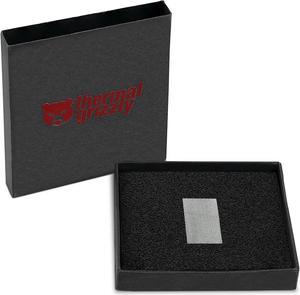
Quick View
Thermal Grizzly TG-KS-24-12 KryoSheet (24 x 12 x 0.2 mm)
- Model #: TG-KS-24-12
- $21.99
- $16.99 –
- Save: $5.00 (22%)
- More options from $16.99 - $21.63
- Free Shipping

Quick View
Thermal Grizzly Kryonaut Extreme - 2 Gram - Extremely High Performance Thermal Paste with 12 Cleaning Wipes 6 Wet & 6 Dry- for Maximum Thermal Conductivity While Overclocking CPU/GPU/PS4/PS5/Xbox
- Model #: KE-002 Combo with Wipes
- $27.99 –
- Free Shipping

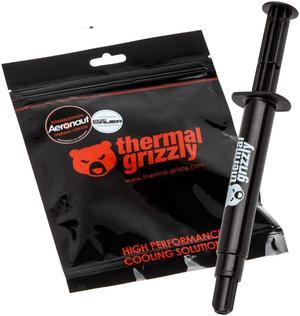
Quick View
Thermal Grizzly TG-A-015-R Aeronaut Thermal Grease Paste - 3.9 Grams
- Long Term Operating Temperature: -150 ° C / +200 ° C
- Model #: TG-A-015-R 3.9g
- $9.59 –
- Free Shipping
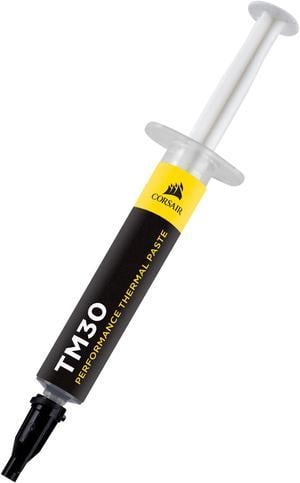
Quick View
CORSAIR TM30 Performance Thermal Paste, CT-9010001-WW.
- Volume / Net Weight: 3.5g
- Thermal Conductivity: 3.8 W/mK
- Specifications: CORSAIR TM30 thermal paste helps you push your PC to its limit, with a low-viscosity premium zinc oxide thermal material that’s easy to apply. TM30’s ultra-low thermal impedance ensures high-efficiency heat transfer between your hardware and cooler, lowering temperatures and allowing for higher clock speeds. Net Weight: 3g Thermal Conductivity: 3.8 W/mK Thermal Impedance: 0.01°C -in2/W Viscosity: 2300K cPs Specific Gravity: 2.5g/cm3
- Model #: CT-9010001-WW
- $9.99
- $8.99 –
- Save: $1.00 (10%)
- More options from $8.99 - $18.39
- Free Shipping
Quick View
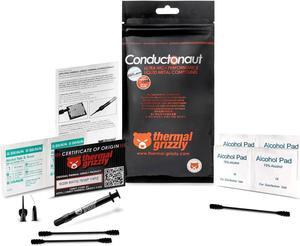
Thermal Grizzly Conductonaut Thermal Grease - Gram Set + Extra Applicators - Liquid Metal Thermal Paste for Cooling The CPU, GPU (Conductonaut) (5g Combo)
- Model #: C-005 combo
- $49.99 –
- Free Shipping
Quick View
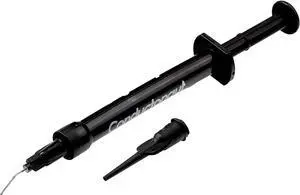
Thermal Grizzly Conductonaut - Aluminum, Thermal Paste Based on Liquid Metal - Not Suitable for Large Cooling Systems - Liquid Metal Thermal Paste for Cooling The CPU, GPU (5 Gram)
- Volume / Net Weight: 1.0g
- Thermal Conductivity: 73 W/mK
- Long Term Operating Temperature: 10 °C / +140 °C
- Features: Thermal Conductivity: 73 W/mk Consistency: Liquid Viscosity: 0,0021 Pas Density: 6,24g/cm3 Recommended Temperature: 10 °C / +140 °C
- Model #:
- $39.99 –
- $5.92 Shipping
Quick View
#1 Best Seller
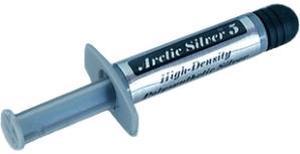
- Volume / Net Weight: 3.5g
- Long Term Operating Temperature: -50 to 130 C
- Specifications: Average Particle Size: < 0.49 micron < 0.000020 inch Extended Temperature Limits: Peak: -50 Celsius Degree to >180 Celsius Degree Long-Term: -50 Celsius Degree to 130 Celsius Degree Performance: 3 to 12 degrees centigrade lower CPU full load core temperatures than standard thermal compounds or thermal pads when measured with a calibrated thermal diode imbedded in the CPU core. Coverage Area: A 3.5 gram syringe contains enough compound to cover at least 15 to 25 small CPU cores, or 6 to 10 large CPU cores, or 2 to 5 heat plates. At a layer 0.003" thick, the 3.5 gram syringe will cover approximately 16 square inches.
- Model #: AS5-3.5G
- $7.29 –
- More options from $6.99 - $35.00
- Free Shipping
Quick View
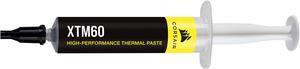
CORSAIR XTM60 High Performance Thermal Paste, 3g
- Part Number: CT-9010015-WW
- Volume / Net Weight: 3.0g
- Long Term Operating Temperature: - 20 to 125 °C
- Model #: CT-9010015-WW
- $9.99 –
- $4.99 Shipping
Quick View
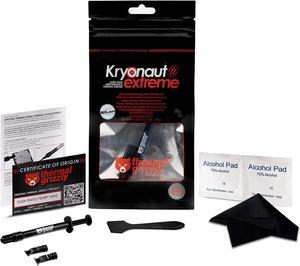
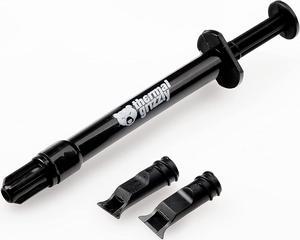
Thermal Grizzly Kryonaut Extreme The High Performance Thermal Paste for Cooling All Processors, Graphics Cards and Heat Sinks in Computers and Consoles (2 Gram)
- Thermal Conductivity: 14.2 W/mK
- Long Term Operating Temperature: -250 °C / +350 °C
- Model #: TG-KE-002 R
- $21.99 –
- More options from $21.95 - $23.62
- Free Shipping
Quick View
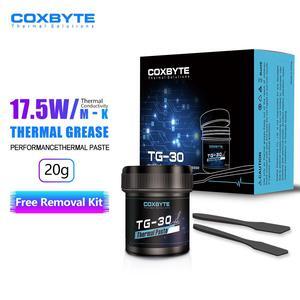
Coxbyte TG-30 thermal paste with ultra-high thermal conductivity of 17.5W/mK, Premium Performance Thermal Paste for all processors, Canned 20g
- Volume / Net Weight: 20g
- Thermal Conductivity: 17.5 W/mK
- Long Term Operating Temperature: -50 to 250 C
- Specifications: TG-30 adopts an improved nanocarbon tube composite formula with a thermal conductivity of 17.5W/mK (measured value), which can quickly reduce the temperature difference between CPU/GPU cores and meet the cooling needs of mainstream gaming consoles, high-performance graphics cards, and workstations. Its non-conductive properties completely avoid the risk of short circuit,
- Model #: coxbyte26

Quick View
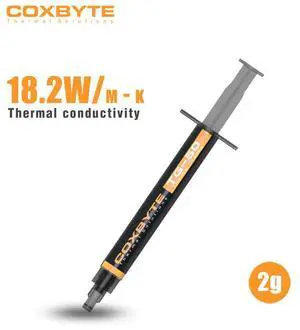
Coxbyte TG-50 thermal paste, 18.2W/mK ultra-high thermal conductivity suitable for CPU/server/GPU thermal conductivity, non corrosive,2g
- Volume / Net Weight: 2.0g
- Thermal Conductivity: 18.2 W/mK
- Long Term Operating Temperature: -50 to 250 C
- Specifications: TG-50 adopts a composite formula of nano carbon tubes and liquid metal, with a thermal conductivity exceeding 18.2W/mK (measured value), which can quickly reduce the temperature difference between CPU/GPU cores by more than 25 ℃,. Its non-conductive properties eliminate the risk of short circuits, with good viscosity optimization. Single point/nine
- Model #: coxbyte004
Quick View
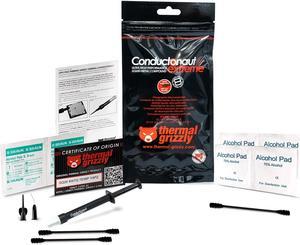
Thermal Grizzly Conductonaut Extreme Thermal Grease - 1 Gram Set + Applicators + Pads - Liquid Metal Thermal Paste for Cooling The CPU, GPU Value Pack
- Model #: CE-001 Combo
- $26.99 –
- Free Shipping
Quick View
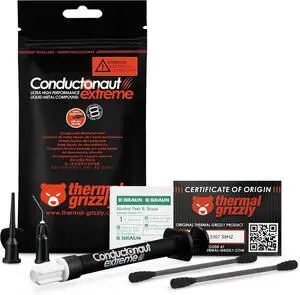
Thermal Grizzly Conductonaut Extreme Thermal Grease - 1 Gram Thermal Paste for Cooling The CPU, GPU
- Model #: CE 001
- $19.99 –
- More options from $19.99 - $33.46
- Free Shipping
Quick View
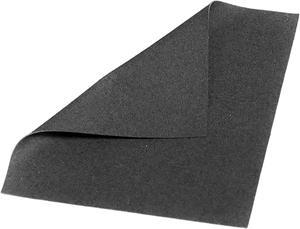
Thermal Grizzly TG-CA-38-38-02-R Carbonaut Thermal Pad - 38x38mm
- Thermal Conductivity: 62,5 W/mk
- Long Term Operating Temperature: -250 °C / +150 °C
- Specifications: The Thermal Grizzly Carbonaut pad is a carbon fiber thermal pad. Its special developed polymer results in its flexibility and its soft 'gap filler' properties. The carbon fiber structure ensures excellent thermal conductivity. Thermal Grizzly Carbonaut is lightweight and reusable. In addition, Thermal Grizzly Carbonaut has a very high thermal conductivity even with very little contact pressure. Thermal Grizzly Carbonaut heat transfer performance always remains constant. Note: Carbonaut is electrically conductive. Carbonaut is available pre-assembled in many standard CPU / GPU sizes. Size - CPU/GPU 32 x 32 - Intel Desktop CPUs (115x) e.g 6700K, 7700K, 9900K 38 x 38 - Intel 20xx HEDT CPUs and AMD Desktop CPUs. e.g. 7900X, 7980XE, 2700X, 1800X, 6950X 51 x...
- Model #: TG-CA-38-38-02-R
- $18.99 –
- More options from $17.98 - $18.99
- Free Shipping
Quick View
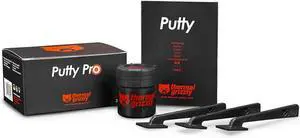
Thermal Grizzly TG-P-P-030 TG Putty Pro High-Performance Electrically Non-Conductive Thermal Putty for GPU and PCB Applications, 30g
- Model #: TG-P-P-030
- $44.99 –
- Free Shipping
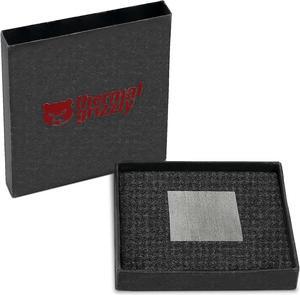
Quick View
- $21.99 –
- More options from $21.99 - $29.17
- Free Shipping
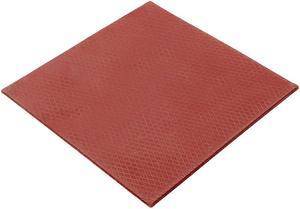
Quick View
Thermal Grizzly TG-MPE-100-100-05-R Minus Pad Extreme 100x100x0.5
- Long Term Operating Temperature: -100 °C / +200 °C
- Model #: TG-MPE-100-100-05-R
- $99.99
- $77.99 –
- Save: $22.00 (22%)
- More options from $77.99 - $99.99
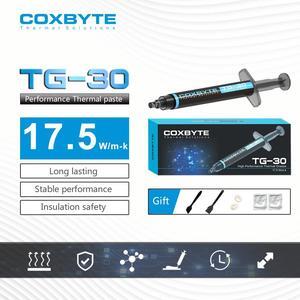
Quick View
Coxbyte TG-30 thermal paste, 17.5W/mK ultra-high thermal conductivity suitable for CPU/server/GPU thermal conductivity, non corrosive,4g
- Volume / Net Weight: 4g
- Thermal Conductivity: 17.5 W/mK
- Long Term Operating Temperature: -50 to 250 C
- Specifications: TG-30 adopts an improved nanocarbon tube composite formula with a thermal conductivity of 17.5W/mK (measured value), which can quickly reduce the temperature difference between CPU/GPU cores and meet the cooling needs of mainstream gaming consoles, high-performance graphics cards, and workstations. Its non-conductive properties completely avoid the risk of short circuit,
- Model #: coxbyte002
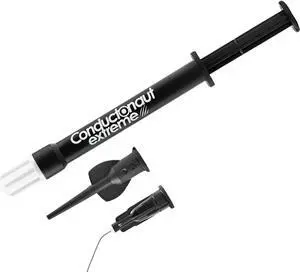
Quick View
Thermal Grizzly TG-CE-005-R Conductonaut extreme - 5 g
- Model #: TG-CE-005-R
- $49.99 –
- Free Shipping
Quick View
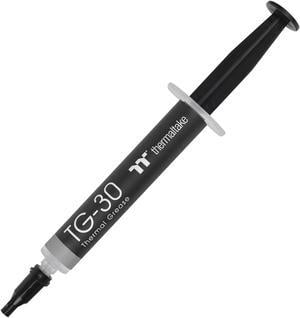
Thermaltake TG-30 Premium CPU/GPU Heatsink Thermal Compound - 4g, CL-O023-GROSGM-A

- Volume / Net Weight: 4.0g
- Thermal Conductivity: 4.5 W/mK
- Long Term Operating Temperature: -50 to 200 C
- Specifications: Viscosity: 76 Pa-s Dimensions: 7.05" (L) x 3.5" (W) x 0.59" (H) Weight: 4 g Shelf Life: 24 months Color: Grey
- Model #: CL-O023-GROSGM-A
Quick View
Arctic Silver 5 High-Density 12g/3cc Tube Polysynthetic Silver Thermal Compound
Limited time offer, ends 01/31
- Model #: AS5-12G -
- $94.90 –
- Free Shipping
Quick View
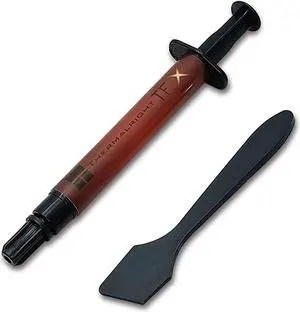
New Thermalright Tfx Thermal Compound Paste 14.3 W/Mk, Carbon Based High Performance, Heatsink Paste, Cpu For All Coolers, Interface Material, 2 G With Tool
Limited time offer, ends 01/31
- Model #: NVB21576
- $28.99 –
- Free Shipping
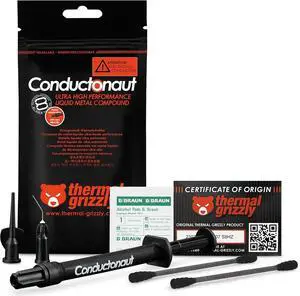
Quick View
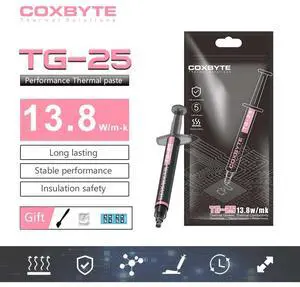
Coxbyte TG-25 Thermal Grease Performance Thermal Conductive Grease Paste 13.8 W/MK 2g For Game PC PS4 PS5 CPU GPU Cooling
Limited time offer, ends 02/05
- Brand: coxbyte
- Series: TG
- Volume / Net Weight: 2g
- Thermal Conductivity: 13.8 W/mK
- Model #: Coxbyte27
Quick View
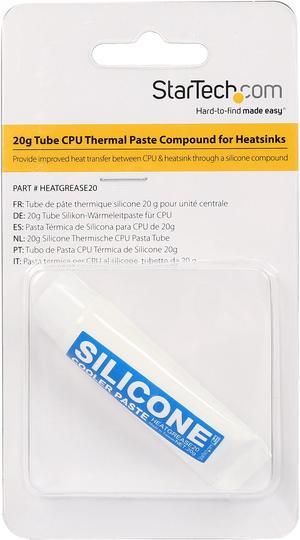
StarTech.com 20g Tube CPU Thermal Paste Grease Compound for Heatsinks Cooling - White (HEATGREASE20)
OUT OF STOCK
- Volume / Net Weight: 20g
- Thermal Conductivity: 1.06 W/mK
- Specifications: Color: White Bleed: <0.05% at 200°C/24 hours Evaporation: <0.001% at 200°C/24 hours Materials: Silicone Compounds 50% Carbon Compounds 20% Metal Oxide Compounds 30% Thermal Resistance: <0.195°C-m2/W Thermal Conductivity: >1.066 W/(m·K)
- Parts: 2 Year
- Model #: HEATGREASE20
- $13.99 –
- Free Shipping