
Choosing a new graphics card in 2026 means deciding between two very different approaches. NVIDIA’s RTX 5000 series, built on the new Blackwell architecture, doubles down on AI-assisted rendering and best-in-class ray tracing. AMD’s Radeon RX 9000 series, powered by RDNA 4, focuses on delivering strong raw performance at more accessible prices. Both have compelling arguments — and the right choice depends entirely on how you game.
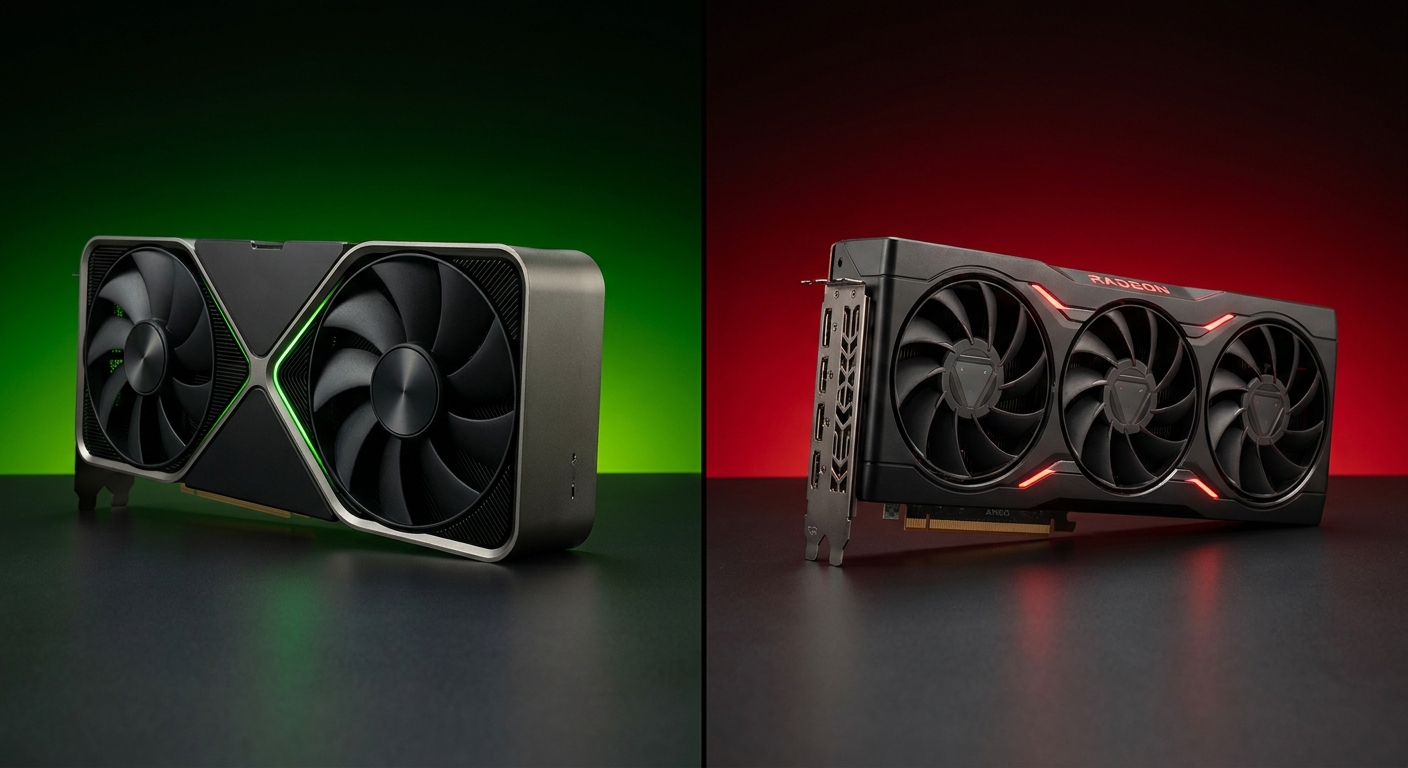
Meet the Contenders
For most gamers looking at a mid-to-high-end upgrade in 2026, the key matchups are the RTX 5070 vs. RX 9070 XT and the RTX 5060 Ti vs. RX 9060 XT. Here’s a quick look at what each card brings to the table.
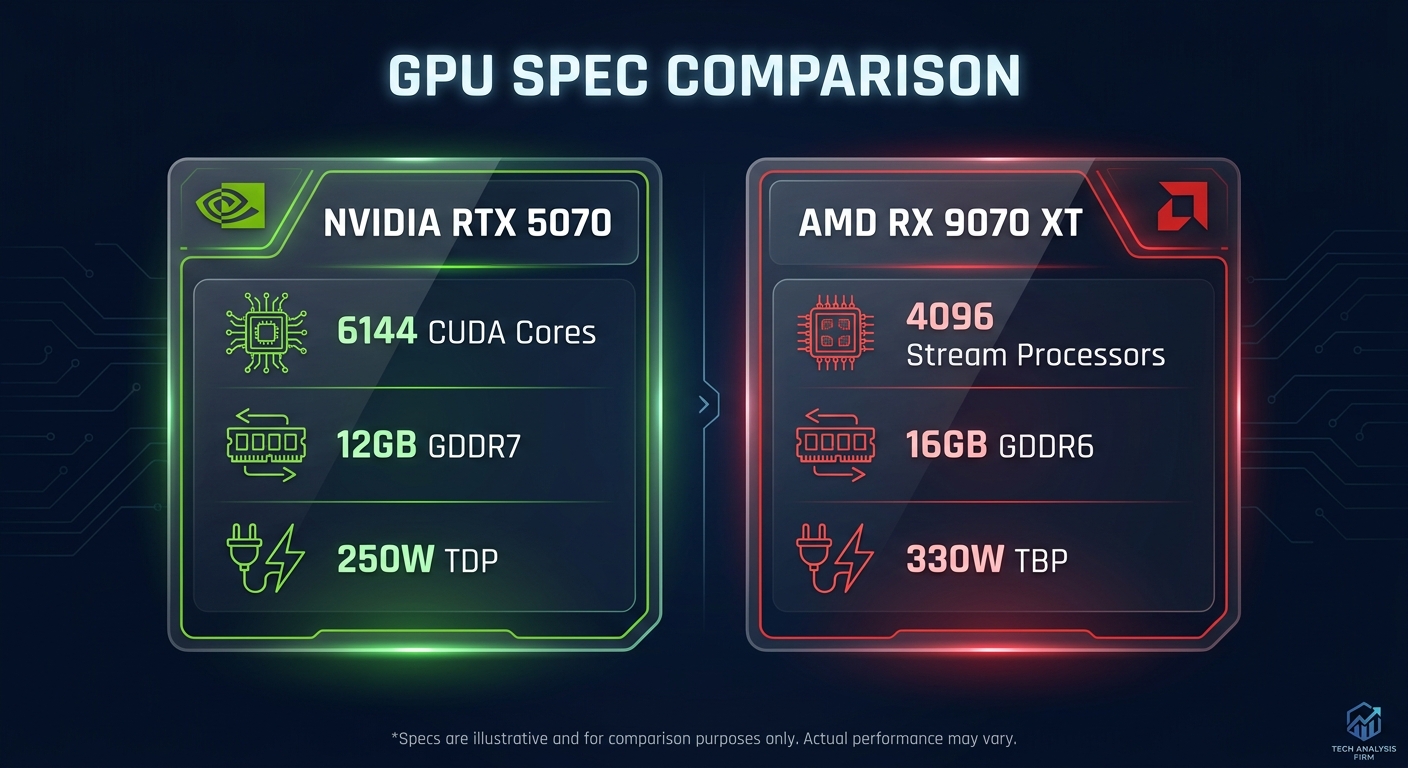
The RTX 5070 packs 6,144 CUDA cores, 12GB of GDDR7 memory, and a 250W TDP at an MSRP of $549. Its counterpart, the RX 9070 XT, features 4,096 stream processors paired with a generous 16GB of GDDR6 memory and a 330W TBP at $599. On paper, the AMD card has more VRAM and a lower price — but GPU performance is never just about the spec sheet.
A tier down, the RTX 5060 Ti offers 4,608 CUDA cores and 16GB of VRAM at $429, while AMD’s RX 9060 XT launches with 2,048 shaders and 8GB or 16GB configurations starting at $299 — making it one of the most affordable RDNA 4 options available. Both cards target 1080p to 1440p gaming, making them the most relevant choices for the majority of PC gamers today.
Gaming Performance: Where Each Card Excels
At 1440p resolution — the current sweet spot for gaming monitors — the RTX 5070 and RX 9070 XT are closely matched in traditional rasterized games. The gap widens when you turn on ray tracing. NVIDIA’s hardware ray tracing pipeline has long been an industry lead, and the Blackwell generation extends that advantage further. In titles like Cyberpunk 2077 and Alan Wake 2 with path tracing enabled, the RTX 5070 pulls significantly ahead of the RX 9070 XT.
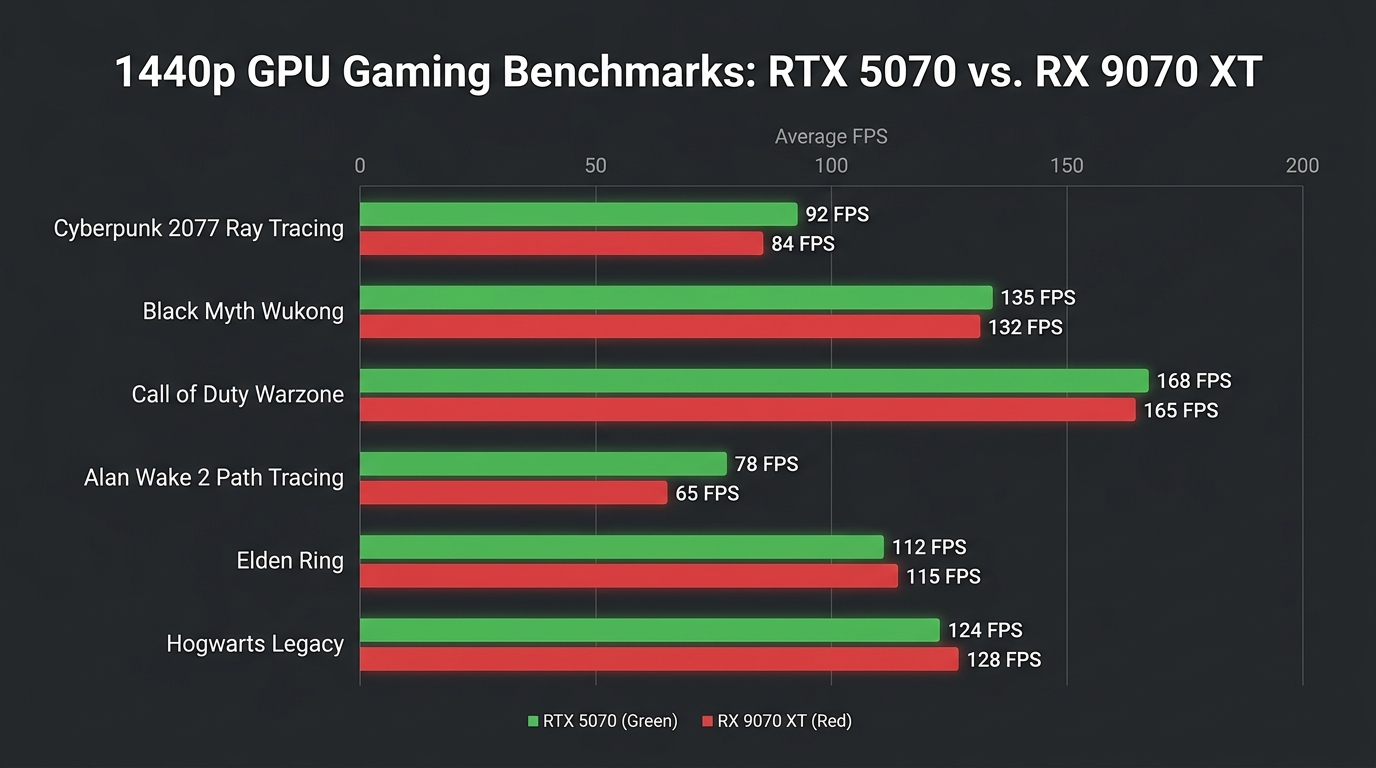
| Game (1440p, Ultra) | RTX 5070 (avg FPS) | RX 9070 XT (avg FPS) | Edge |
|---|---|---|---|
| Cyberpunk 2077 (RT Ultra) | ~85 FPS | ~60 FPS | NVIDIA (+42%) |
| Black Myth: Wukong | ~110 FPS | ~100 FPS | Tie |
| Call of Duty: Warzone | ~200 FPS | ~195 FPS | Tie |
| Alan Wake 2 (Path Tracing) | ~70 FPS | ~48 FPS | NVIDIA (+46%) |
| Elden Ring | ~165 FPS | ~158 FPS | Tie |
In rasterization-heavy games, AMD’s RX 9000 series is genuinely competitive. The RDNA 4 architecture delivers a major generational leap over RDNA 3, and AMD’s FSR 4 upscaling has closed the gap with DLSS 4 in a meaningful way.
AI Upscaling: DLSS 4 vs. FSR 4
One area where NVIDIA still leads clearly is AI-powered upscaling. DLSS 4, exclusive to RTX 40 and 50 series cards, uses a dedicated neural network (Tensor Cores) to generate frames and upscale resolution with impressive image quality. The RTX 5070’s 192 Tensor Cores deliver 988 AI TOPS, enabling smooth frame generation even at high resolutions.
AMD’s FSR 4 — available on the RX 9000 series — is a genuine improvement over FSR 3. It produces sharper results with less ghosting, and critically, FSR 4 works across a wider range of games (including some NVIDIA titles). However, in side-by-side comparisons at 4K, DLSS 4 still edges out FSR 4 for fine detail preservation, particularly in motion.
For competitive gamers who don’t use upscaling at all — running native resolution to minimize input lag — this entire category is a non-factor, and AMD’s cards become even more attractive on a per-dollar basis.
Power and Efficiency
Here’s where AMD has a meaningful advantage: the RX 9000 series consumes noticeably less power than comparable NVIDIA cards. If you have a lower-wattage power supply or a smaller form factor build, check your system’s headroom before upgrading. Newegg’s PC Power Supply Calculator can help you confirm whether your current PSU can handle either card, and if you need an upgrade, the Power Supply section on Newegg covers everything from compact SFX units to full ATX modular options.
Which Card Should You Buy?
Choose NVIDIA RTX 5000 if you: play ray tracing-heavy games and want the best visual experience, rely on DLSS 4 for 4K performance, do creative work (3D rendering, video editing, AI workflows) alongside gaming, or want a card with strong multi-year driver support and software ecosystem.
Choose AMD RX 9000 if you: primarily play esports or rasterization-focused games where performance is competitive, want more VRAM per dollar (16GB on the 9060 XT 16GB at $349), prefer lower power draw for a quiet or compact build, or want excellent 1440p performance at a more accessible price.
Recommended Cards on Newegg
For the NVIDIA camp, the GeForce RTX 5080 is the flagship choice for 4K gaming with maximum ray tracing, while the GeForce RTX 5090 represents the absolute top of the stack for enthusiasts. For mid-range buyers, the RTX 5060 Ti offers strong 1440p performance without breaking the budget.
For AMD, the Radeon RX 9060 XT is one of the most interesting value cards of the generation. The Radeon RX 7900 XTX from the previous generation also remains a strong option at a discounted price.
You can browse the full GPU & Video Graphics Device catalog on Newegg to compare current prices and filter by VRAM, TDP, and brand. Newegg’s Custom PC Builder helps you select compatible components in one place.
The Bottom Line
In 2026, both NVIDIA and AMD are delivering genuinely excellent graphics cards. If you game in ray tracing-heavy titles or need AI-accelerated creative tools, the RTX 5000 series is worth the premium. If you play broadly across a wide game library and want the best performance per dollar, AMD’s RX 9000 series deserves serious consideration. Either way, upgrading from a card older than the RTX 30 or RX 6000 generation will feel like a substantial leap forward.
Read More
Want to go deeper on RTX 5000 vs. RX 9000? Here are specific resources to help you decide:
- RX 9070 XT vs RTX 5070: Performance by FPS and Dollar — Newegg Gamer Community — Real Newegg buyers discussing which card delivers better value, with hands-on FPS data and dollar comparisons.
- AMD Radeon RX 9070 XT Review & Benchmarks vs. RTX 5070 — GamersNexus — In-depth technical review with real benchmark data across multiple games and workloads.
- AMD Radeon RX 9070 XT vs. NVIDIA GeForce RTX 5070 — TechSpot — Head-to-head review covering gaming, power efficiency, and value at multiple resolutions.
- I Bought an RX 9070 XT Instead of an RTX 5070 Ti — XDA Developers — A first-person buyer’s perspective on choosing AMD over NVIDIA in 2026.
- RTX 5000 vs RX 9000 GPU Comparison — YouTube — Video benchmark comparison covering 1080p, 1440p, and 4K performance across popular titles.
Related Posts
- Best GPUs for 1080p Gaming in 2026
- Best GPUs for 1440p Gaming in 2026: Top Picks for Every Budget
- Best Mechanical Keyboards in 2026
- Best Gaming CPUs in 2026
- Best 4K Projectors for Home Theater and Gaming in 2026
Frequently Asked Questions
Answers to the most common questions about this topic.